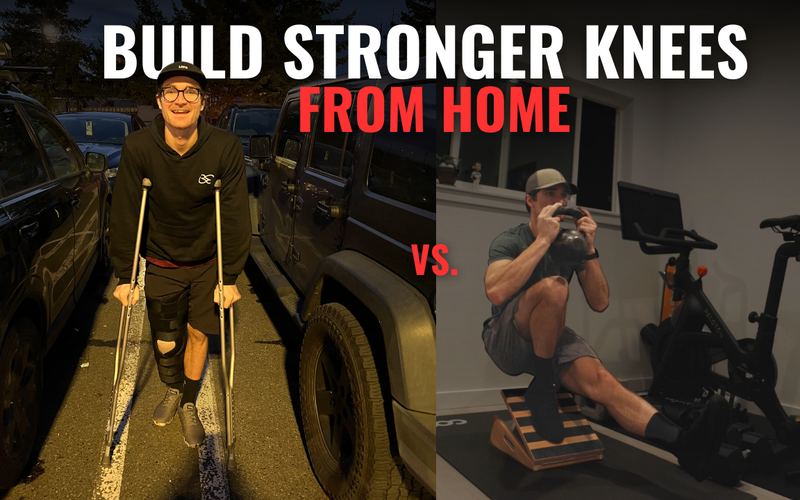
If you've been through physical therapy for your knee, you've probably done a lot of low-impact exercises built to strengthen the muscles around it and calm the pain down. That work matters. PT got me back on my feet after every one of my four ACL tears, and I'd never tell anyone to skip it.
The gap I ran into every time was what came after. Rehab got me functional. It never got me strong. There wasn't enough load, and there wasn't enough progression, to build the kind of strength that gets rid of knee pain for good and protects the knee from the next injury. So after rehab ended, that's what I started chasing, and it changed how I think about knee pain.
Your knee sits in the middle of a chain
The knee is a hinge between your hip and your ankle. It doesn't generate much force on its own. The muscles above it and below it decide how much load it has to deal with, and how well the kneecap tracks while it does.
When your feet, calves, tibialis, quads, hamstrings, hips and glutes are all strong, they each take their share. When one or two of them are weak, the knee picks up the slack. That's usually where you end up feeling it, whether it's on stairs, on a hike, or a few miles into a run.
So when someone tells me their knee hurts, I don't start at the knee. I start at the ground and work up. Here's the whole chain, what each piece does for your knee, and the exercises I use to train it. Every exercise links to a short video demo.
1. Feet and calves
Your feet meet the ground first, so they're your first shock absorbers. Every step, every landing and every stride starts here. If your calves are weak, more of that impact travels straight up into the knee.
There are two calf muscles, and they need different work. The gastroc, the big one you can see, works hardest when your knee is straight. The soleus underneath it works hardest when your knee is bent, which is the position you're in on stairs, on descents and in a squat.
- Knees-over-toes calf raise. Knee bent and pushed forward over the toes, so the soleus does the work. 3 sets of 15 to 20.
- Single-leg straight-leg calf raise. Knee locked, full range from a deep stretch at the bottom to all the way up on your toes. 3 sets of 12 to 15 per side.
2. Tibialis
The tibialis anterior is the muscle on the front of your shin. It slows your foot down every time it hits the ground, and it's what controls you on the way down stairs and downhills. Almost nobody trains it. I had no idea you could until years into my own rehab.
It has a partner, the tibialis posterior, which runs behind the inside of your ankle and holds your arch up. When it's weak, your arch drops, your shin rotates in, and your knee follows it.
- Tibialis raises. Back against a wall, feet out in front of you, lift your toes toward your shins. 3 sets of 20 to 25. Once you can do 25 clean reps, rest a small weight across your feet.
- Calf raises with a lacrosse ball between your feet. Squeeze the ball with your heels the whole way up and the whole way down. That squeeze switches on the tibialis posterior and the small muscles in your feet. 3 sets of 15.
3. Quads
Your quads control how your knee bends and straightens, and they hold your kneecap in its groove. This is where PT spends a lot of its time, and for good reason. The difference after rehab is how much you load them, and through how much range.
I train them three ways. Short range for the VMO, the teardrop muscle above the inside of the knee that keeps the kneecap tracking. Mid range for single-leg strength. And full range, so the knee is strong in the deepest positions and not only the comfortable ones.
- Poliquin step up. Heel elevated on a slant board or a plate, tap the other heel to the floor and drive back up. Short range, all VMO. 3 sets of 10 to 15 per side.
- Bulgarian split squat. Back foot on a bench, front shin travelling forward. Mid range single-leg strength, with a hip flexor stretch on the back leg for free. 3 sets of 8 to 10 per side.
- Slant board squat. Heels elevated, knees travelling over the toes, as deep as you can go without pain. Full range. 3 sets of 8 to 12. Start with bodyweight and hold a dumbbell once it feels easy.
4. Hamstrings
Your hamstrings protect the knee from the back side. They pull the shin bone backward, which is the same job your ACL does. That's why every ACL rehab includes them, and why I train them harder than anything else now that I'm living without an ACL.
Every rep has two halves. The eccentric half is when the muscle is lengthening under load, like lowering yourself down slowly. The concentric half is when it's shortening, like curling your heel toward your glute. I never learned that in rehab, and you need both. Eccentric hamstring strength is what protects the knee when you're slowing down, cutting or landing. Concentric strength is what builds the muscle so it's big and strong enough to do that job.
- Nordic curls. Eccentric. Kneel with your ankles anchored and lower yourself forward as slowly as you can. If you can't control it yet, use a band or a strap for help. 3 sets of 3 to 5 slow reps.
- Romanian deadlifts. Eccentric. Hinge at the hips with a soft knee and lower the weight down your shins. 3 sets of 8 to 10.
- Banded hamstring curls. Concentric. A seated or lying hamstring curl machine works too if you're at a gym. 3 sets of 15 to 20.
5. Hips
PT does train your hips, especially the glute med on the side of your hip. It's the classic fix: your knees cave in, so you strengthen the glutes and the knee tracks better. That's real, and I still do it.
The parts that get skipped are the hip flexors and the adductors. Your hip flexors drive your knee up in every stride and every step up, and when they're weak the quads and the knee take over that job. Your adductors, the inner thigh, hold your knee in line from the inside the same way your glute med does from the outside. Train one side and skip the other and you've only built half of it.
- Side-lying hip abduction. Glute med. Top leg straight, lift it slowly and don't let your hips roll back. 3 sets of 15 to 20 per side.
- Weighted hip flexor raise. Hold something heavy, lift your knee above hip height, and lower it slowly. 3 sets of 10 to 12 per side.
- Copenhagen plank. Adductors. Top foot on a bench, lift your hips and hold. 3 holds of 20 to 30 seconds per side. Bend the top knee to make it easier.
6. Low back and glutes
Your glutes are the biggest muscles in the chain, and they're the engine for stairs, hills and getting out of a chair. Your low back keeps your spine steady so the glutes can do that work. When the glutes are weak, the hamstrings and the knee end up doing hip work, and that's a fast track to a sore knee.
- Back extension. My favorite here, because you're working your glutes and your hamstrings and getting some low back love in as well. 3 sets of 10 to 15. Hold a plate at your chest once bodyweight is easy.
- Hip thrust. The exercise that lets you load the glutes the heaviest. 3 sets of 8 to 12.
- Feet-elevated glute bridge. Same idea with no barbell, feet up on a bench or the couch. 3 sets of 12 to 15.
How to put it together
You don't need all of this at once, and you don't need a gym for most of it. Here's how I'd start:
- Pick one exercise from each group. That's six exercises.
- Run them two or three times a week. Thirty minutes covers it.
- When the top of the rep range feels easy, add weight or move to the harder option in that group.
- Use the pain gate. Mild discomfort that's gone by the next day is fine. Sharp pain, or pain that's worse the next morning, means you back off on range or load and try again next session.
When all six groups are strong, you've built a fortress of strength around your knee, and it starts tracking the way it's supposed to. That did more for my knee than anything I ever aimed straight at it.
If you'd rather have it all written out for you, every one of these exercises, with sets, reps, weights and the weekly progression, is inside the programs in the Strong Knees System. And the free cheat sheet below puts this whole article on one page you can save to your phone or stick on the gym wall.