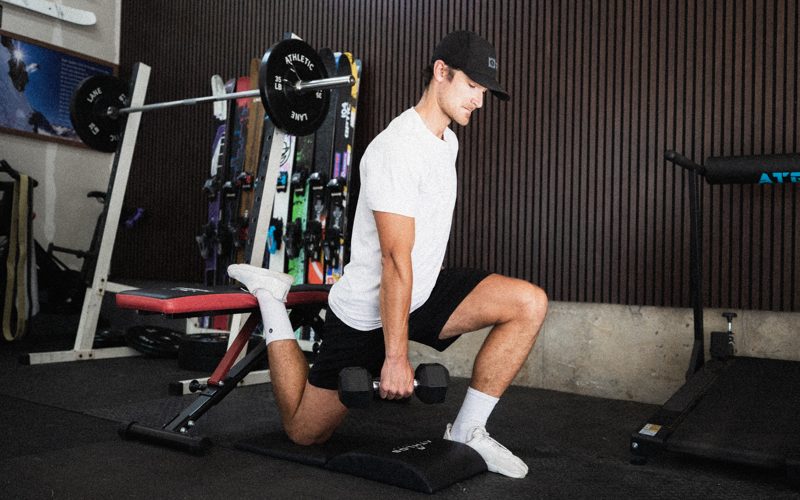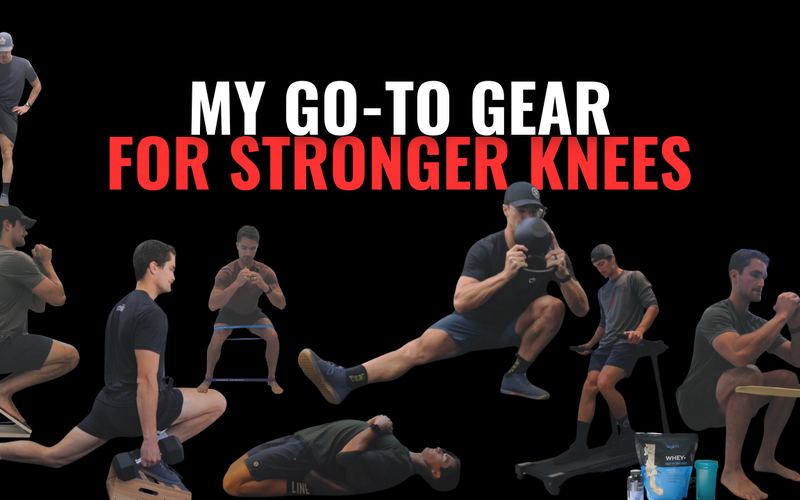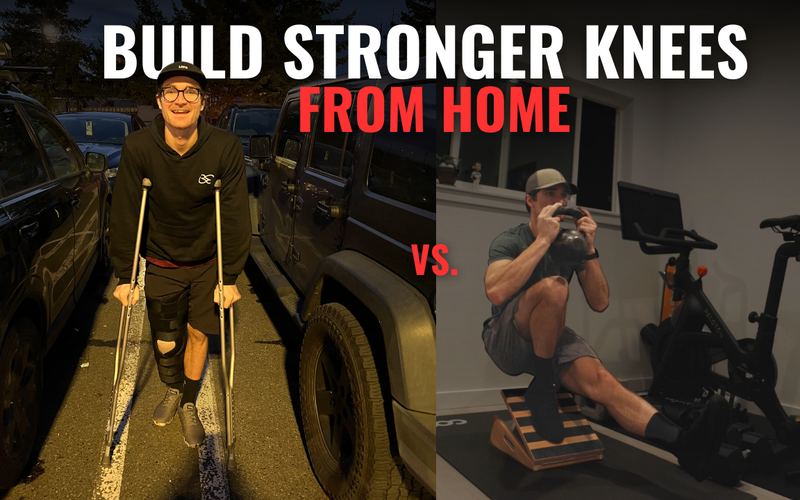
A few weeks ago I posted a reel with the weekly routine I give people who want to get out of knee pain at home. Three days a week, about 30 minutes, resistance bands only. No gym, no machines, no equipment that doesn't fit in a drawer. The comments filled up with people asking for the whole thing written out, so here it is: every exercise, the sets and reps, why it's in there, and a short video demo for each one.
This isn't a random list of knee exercises. It's the same band and bodyweight work that starts every program I write, including the one I used to get my own knee, which has no ACL in it, ready to hike Kilimanjaro. It looks easy on paper. Done slowly and consistently, it's the base everything else gets built on.
Who this is for
If stairs make you wince, your knee stiffens up after sitting, or you've been told to "strengthen the muscles around the knee" and never got a plan for it, start here. It also works as a reset for people who train hard and have a knee that keeps nagging. I run a version of it myself in the weeks my knee gets loud.
It is not a substitute for getting a swollen, locking or unstable knee looked at. Get that checked first. Then come back to this.
Why resistance bands, and why at home
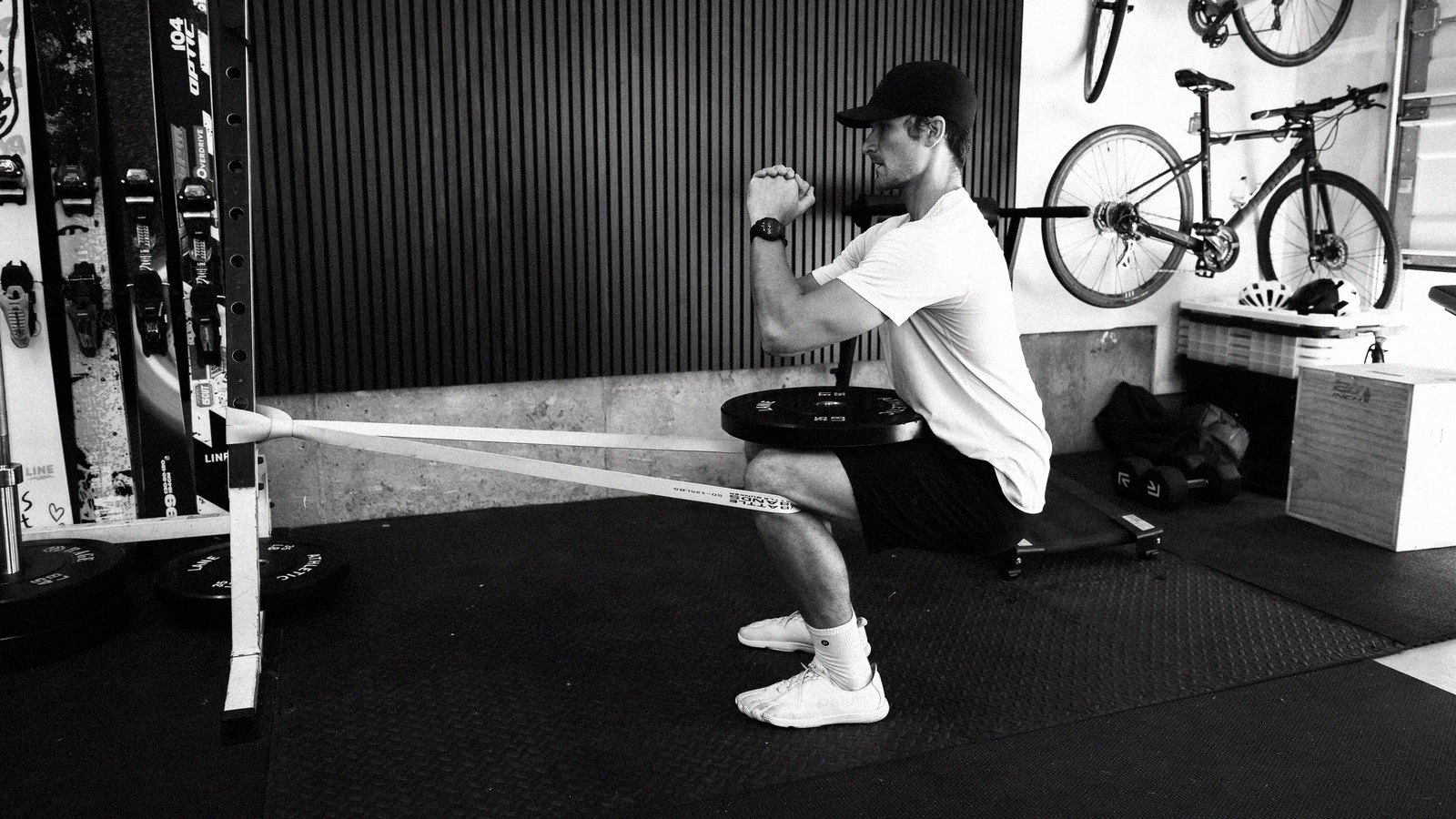
Bands are the most knee-friendly way I know to load a leg. Anchor one to a door and you can work the quads with a TKE or a Spanish squat in positions that would hurt with a barbell, because the band pulls the shin back and takes the shear off the joint. You control the tension by where you stand. You can train every day of a trip with the whole setup in a backpack.
At home also means you'll do it. The sessions are 30 minutes, there's no drive to the gym, and the hip and hamstring work in Day 2 and Day 3 is mostly floor work you can do while something's in the oven. The people who get out of knee pain are the ones who show up three times a week for six weeks, and that's a lot easier from your living room.
What you need
- Small resistance bands for the hip and glute work.
- Large resistance bands for TKEs, Spanish squats, RDLs and hamstring curls. These are the ones I use.
- A door anchor, so any closed door becomes your anchor point.
- A slant board is optional. A thick book or a wedge under your heel does the same job for step ups.
Those are affiliate links to the exact things I train with. I earn a small commission at no extra cost to you.
The one rule
Pain during an exercise stays at 3 out of 10 or less, and the next morning your knee should feel the same as it did before you trained. If you pass both checks, keep going and add a few reps next week. If you miss either one, drop the band tension or shorten the range next time. That's not a setback. That's the routine doing its job.
Day 1: Quads
Your quads control how the knee bends and straightens, and they hold the kneecap in its groove. When they're weak or they switch off because of pain, everything else in the knee gets overloaded. Day 1 wakes them up.
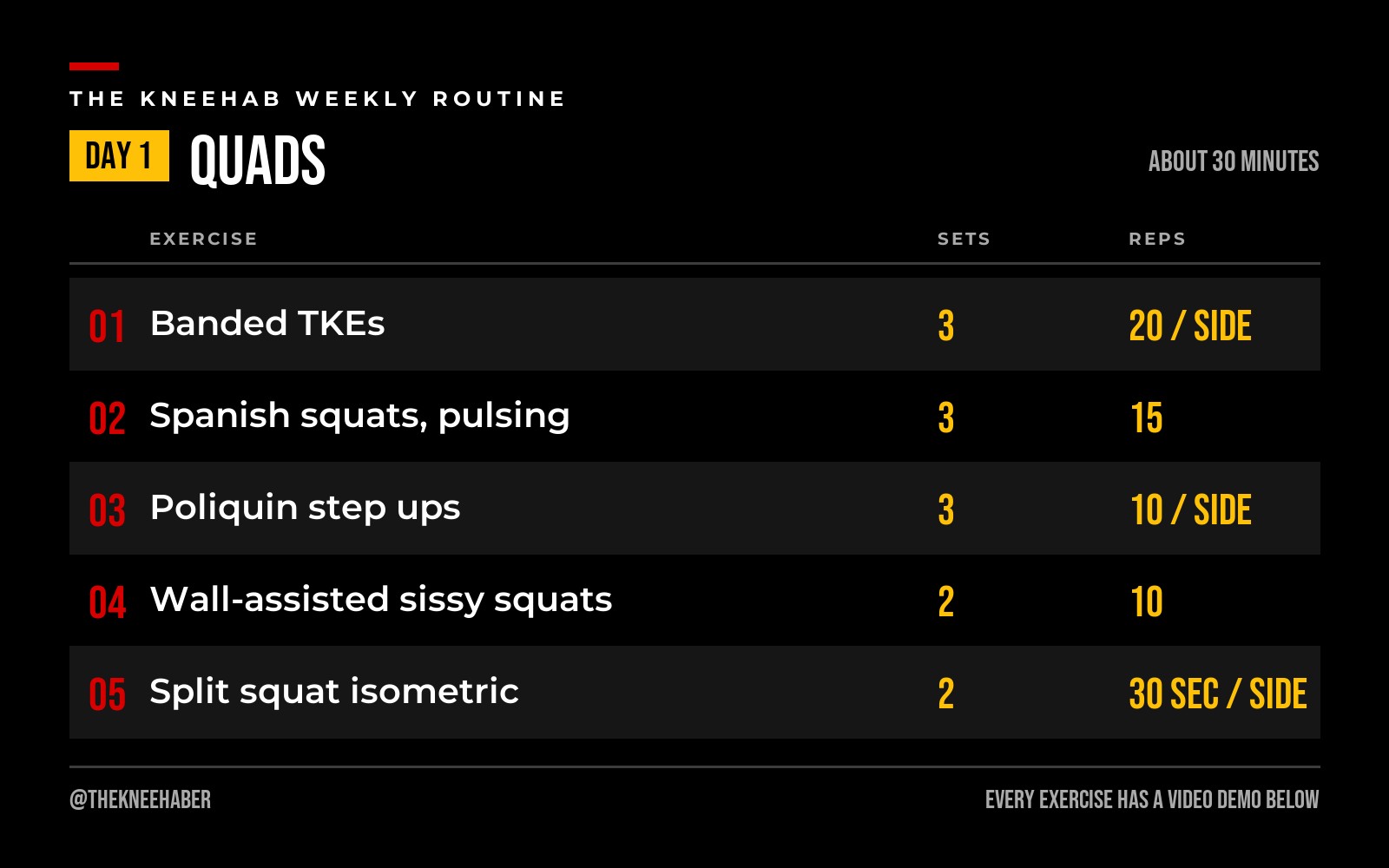
- Banded TKEs, 3 sets of 20 per side. Band anchored behind you, loop behind the knee, straighten the leg against it. It fires the VMO, the teardrop muscle on the inside of the knee that keeps your kneecap tracking straight. This is the first exercise I give almost everyone.
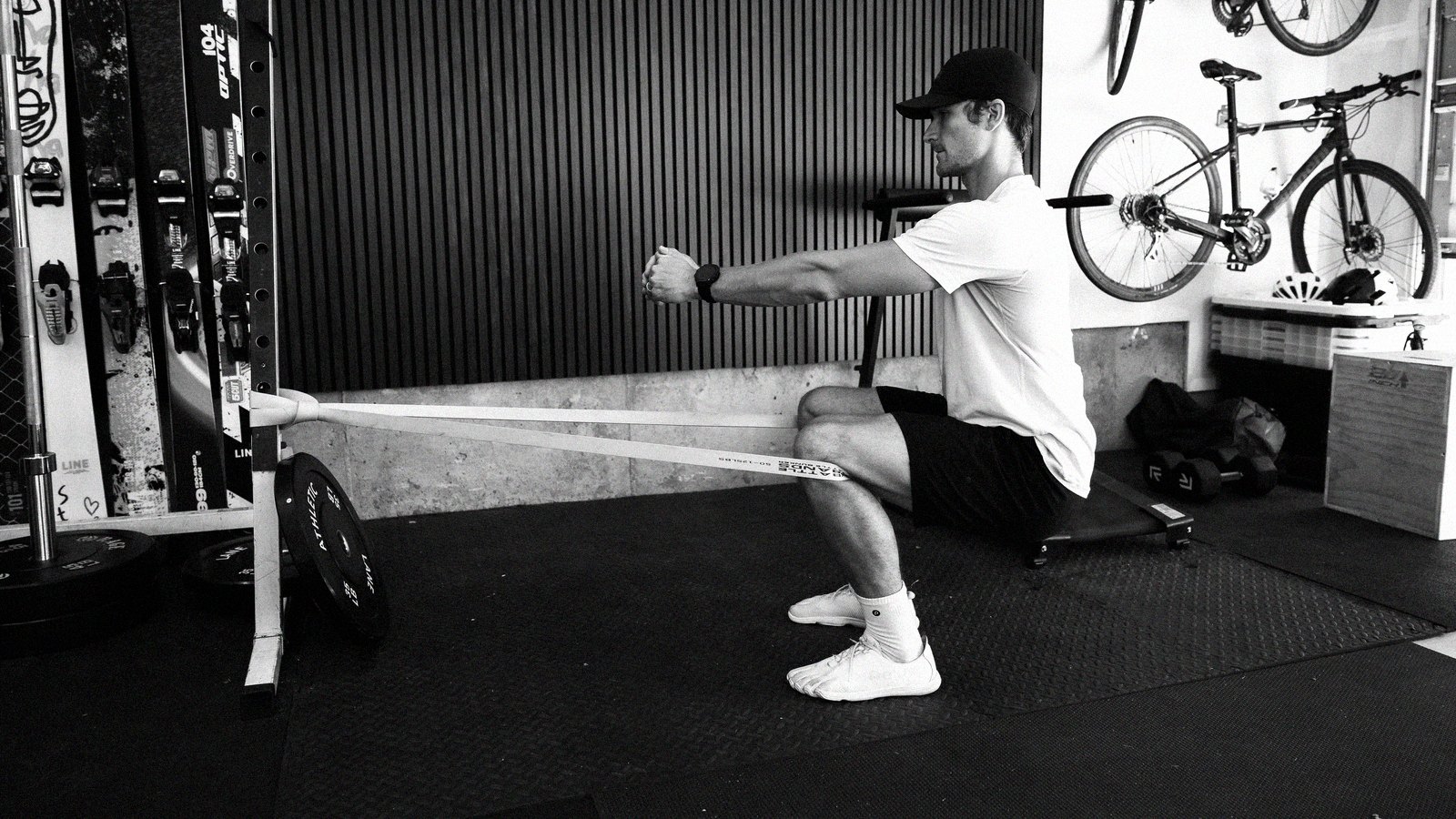
- Spanish squats, pulsing reps, 3 sets of 15. Band behind the knees, anchored low, sit back and pulse in the bottom half. It pushes blood into the knee and builds tendon tolerance without any impact. If your knee is cranky, this is usually the exercise that calms it down.
- Poliquin step ups, 3 sets of 10 per side. Heel up on a slant board or a thick book, tap the other heel to the floor and drive back up. Short range, straight into the VMO. Start on flat ground if the slant is too much.
- Wall-assisted sissy squats, 2 sets of 10. Hands on the wall, knees travel forward, hips stay tall. This trains the knee through a range you probably haven't loaded in years, and that's exactly why it works.
- Split squat isometric, 2 holds of 30 seconds per side. Front shin forward, back knee hovering, and hold. Isometrics are the safest way to build strength and tendon tolerance in a position that normally hurts.
Day 2: Hamstrings and glutes
The back of the leg protects the knee from behind. Hamstrings pull the shin back, glutes take the load off the joint on every step and every stair. This is the day that's easiest to skip, and it's the one I'd never cut.
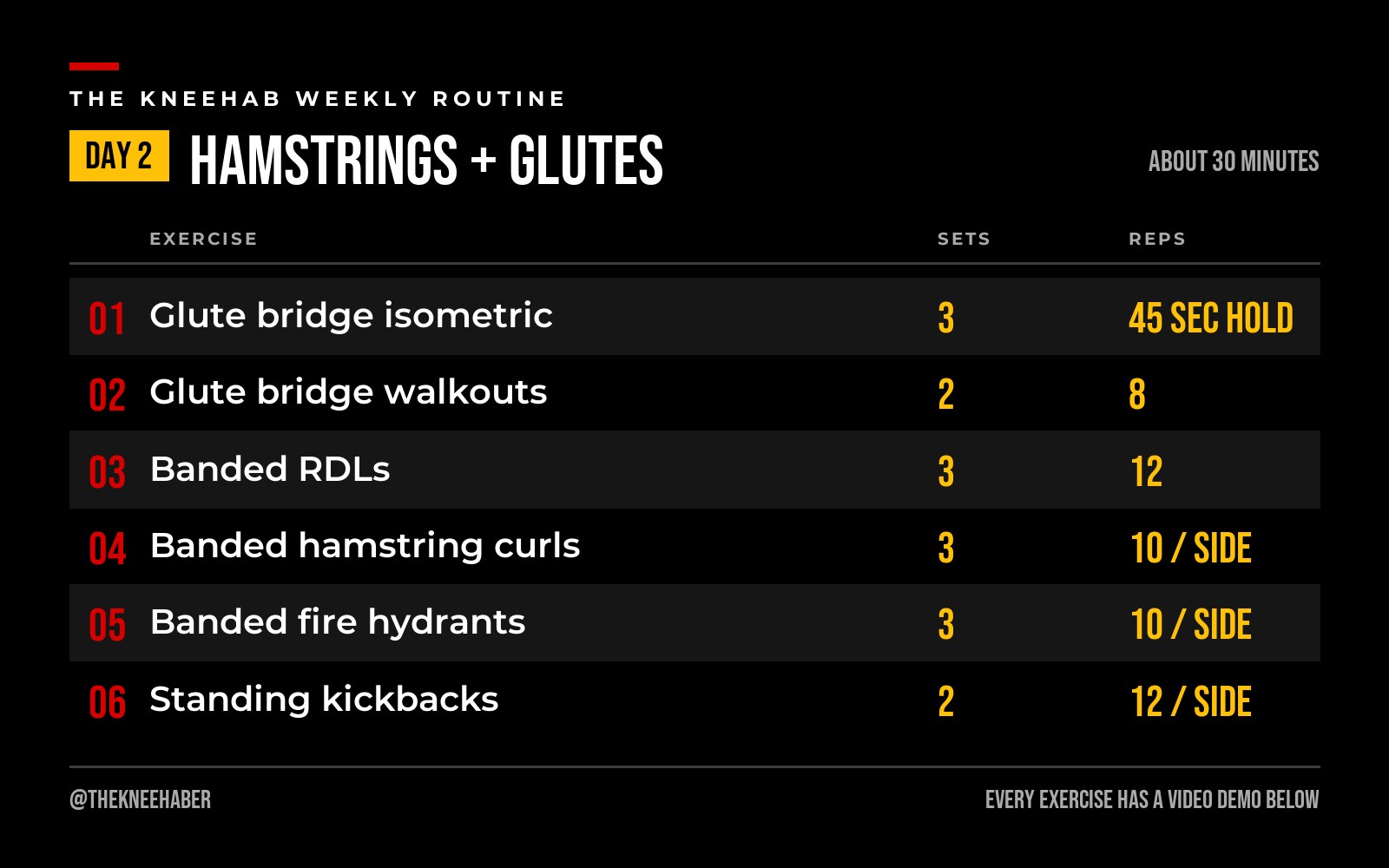
- Glute bridge isometric, 3 holds of 45 seconds. Drive the hips up and hold the top. Glutes and hamstrings switch on together, which takes work away from the knee on every step.
- Glute bridge walkouts, 2 sets of 8. From the bridge, walk the heels out and back in. Your hamstrings have to control the knee the whole way, the same job they do when you slow down or land.
- Banded RDLs, 3 sets of 12. Stand on the band, hinge at the hips with a soft knee, stand tall. This loads the back of the leg, the side of the knee that gets the least attention.
- Banded hamstring curls, 3 sets of 10 per side. Lying on your front, band anchored low, curl the heel toward the glute and lower it slow. Hamstrings pull the shin backward, which is the same job your ACL does. I train them harder than anything now that I live without one.
- Banded fire hydrants, 3 sets of 10 per side. On all fours, band above the knees, lift the knee out to the side. Glute med, the muscle that stops your knee from caving in.
- Standing kickbacks, 2 sets of 12 per side. Band around the ankles, kick straight back and squeeze the glute at the top. Simple, and it teaches the glutes to finish the movement instead of the low back.
Day 3: Hips
Your hips steer your knees. Weak outer hips let the knee cave in, weak inner thighs let it drift out, and weak hip flexors hand their job to the quads. Train all three and the knee starts tracking the way it's supposed to.
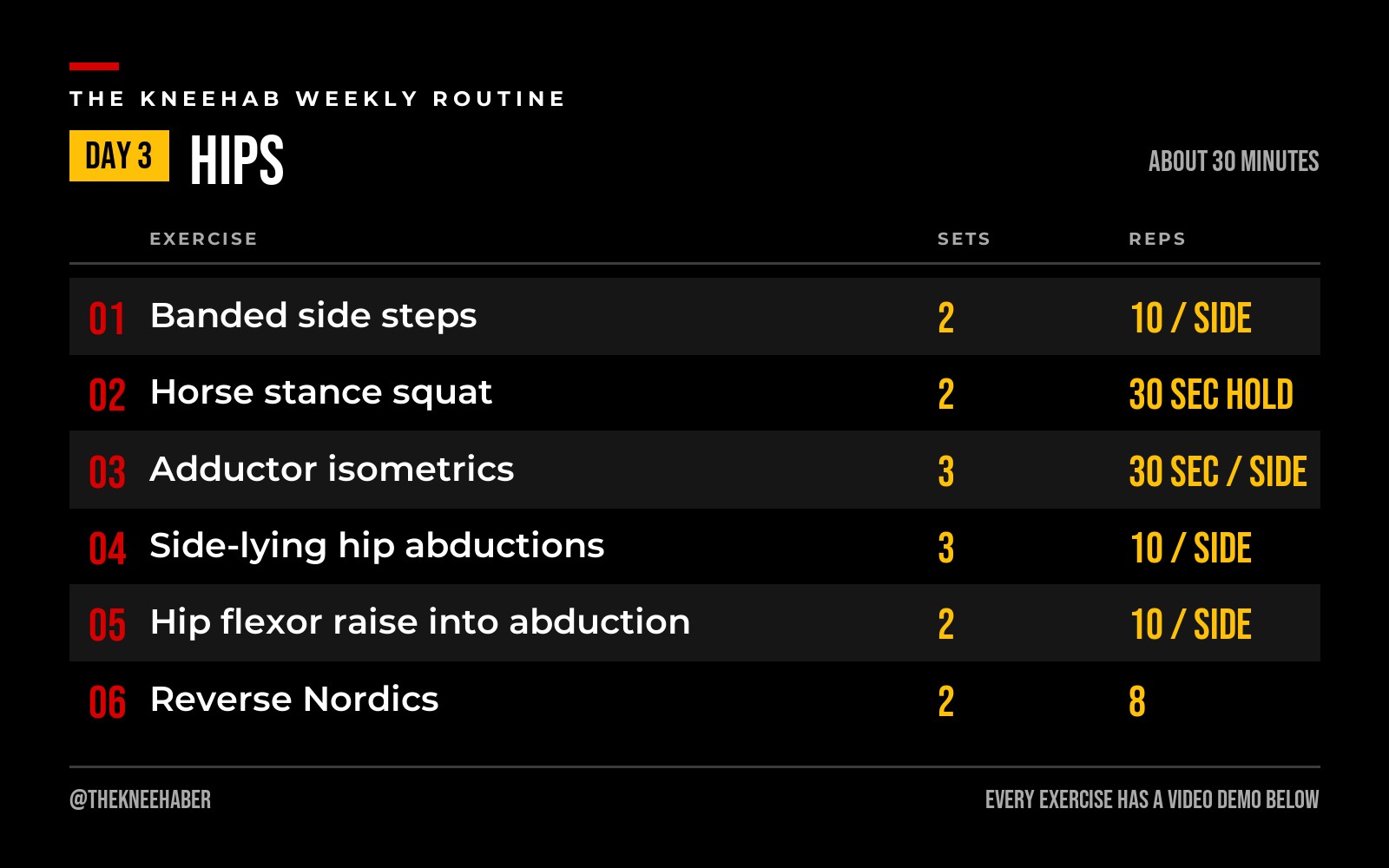
- Banded side steps, 2 sets of 10 per side. Band around the ankles, slight knee bend, step sideways and keep tension the whole time. Outer hips, and the knees learn to stay stacked over the feet.
- Horse stance squat, 2 holds of 30 seconds. Wide stance, sit into the bottom and hold. Inner thighs and glutes working together, and a lot of people feel their hips open up here for the first time.
- Adductor isometrics, 3 holds of 30 seconds per side. Squeeze a ball, a pillow or your fist between the knees and hold. Adductors hold the knee in line from the inside the same way the glute med does from the outside.
- Side-lying hip abductions, 3 sets of 10 per side. Top leg straight, lift slowly, don't let the hips roll back. More glute med, because it can't be strong enough.
- Hip flexor raise into abduction, 2 sets of 10 per side. Mini band around the feet, drive the knee up, then push it out. Hip flexors drive your knee up on every step and every stair, and when they're weak the quads and the knee take over that job.
- Reverse Nordics, 2 sets of 8. Kneel tall, lean back from the knees with a band or a doorframe for support, come back up. Full-length quad work that doubles as the best hip flexor stretch I know.
How to run it
- Three sessions a week with at least a day between them. Monday, Wednesday and Friday is the easy version. Each one takes about 30 minutes.
- Every rep slow and controlled. Two to three seconds on the way down beats a fast, sloppy rep every time.
- Run it for four to six weeks. When a set feels easy, add a few reps before you add anything else.
- Watch the demo once before you try an exercise, then train. Every exercise above links to a short video of me doing it.
In my experience it takes two to four weeks of this before stairs start to feel different, as long as you don't skip the hip and hamstring days.
Rather do a little every day? The 5-day version
Same idea, three exercises a day, Monday to Friday, about 20 minutes each. Pick this one if a 30-minute session never seems to happen but 20 minutes before work does.
- Monday, isometrics and lower leg. Wall sit 3 x 45 seconds, bent-knee calf raise hold 3 x 30 seconds, tibialis raises 3 x 20.
- Tuesday, quads. Banded TKEs 3 x 20 per side, slant board step downs 3 x 8 per side, wall-assisted sissy squats 2 x 10, reverse Nordics 2 x 8.
- Wednesday, posterior chain. Single-leg banded RDLs 3 x 10 per side, banded hamstring curls 3 x 10 per side, glute bridge walkouts 2 x 8.
- Thursday, hips. Banded lateral walks 2 x 10 per side, adductor isometrics 3 x 30 seconds per side, banded hip flexor raises 2 x 12 per side.
- Friday, isometrics and full range. Spanish squat hold 3 x 30 seconds, split squat isometric 2 x 30 seconds per side, front-foot-elevated ATG split squat 2 x 8 per side.
Both plans, with every video link, are in the free PDF at the bottom of this page.
Questions I get about this routine
Can you strengthen your knees at home without equipment?
You can start. Wall sits, split squat holds, sissy squats, glute bridges, side-lying hip work and tibialis raises are all bodyweight. The bands matter for the TKEs, Spanish squats, RDLs and hamstring curls, and those four are where the knee changes the most, so a set of bands is the one thing I'd buy.
How often should you do knee strengthening exercises?
Three times a week, with a rest day between sessions. Muscles and tendons adapt on the off days, not during the session. Every day at low effort, like the 5-day version, works too. What doesn't work is one hard session a week.
Do resistance bands help knee pain?
They help because they let you load the knee in positions that would hurt with a barbell or body weight. A Spanish squat with a band takes the shear off the knee while the quads and the tendon still work hard. That's why so much of this routine runs off a door anchor.
What comes after the routine?
Load. Once stairs feel better and the sets feel easy, the next step is heavier work, more single-leg strength, and eventually jumping and sprinting if that's your thing. That order, from this routine up to running and sport, is the whole idea behind the Strong Knees System. The routine is where it starts.