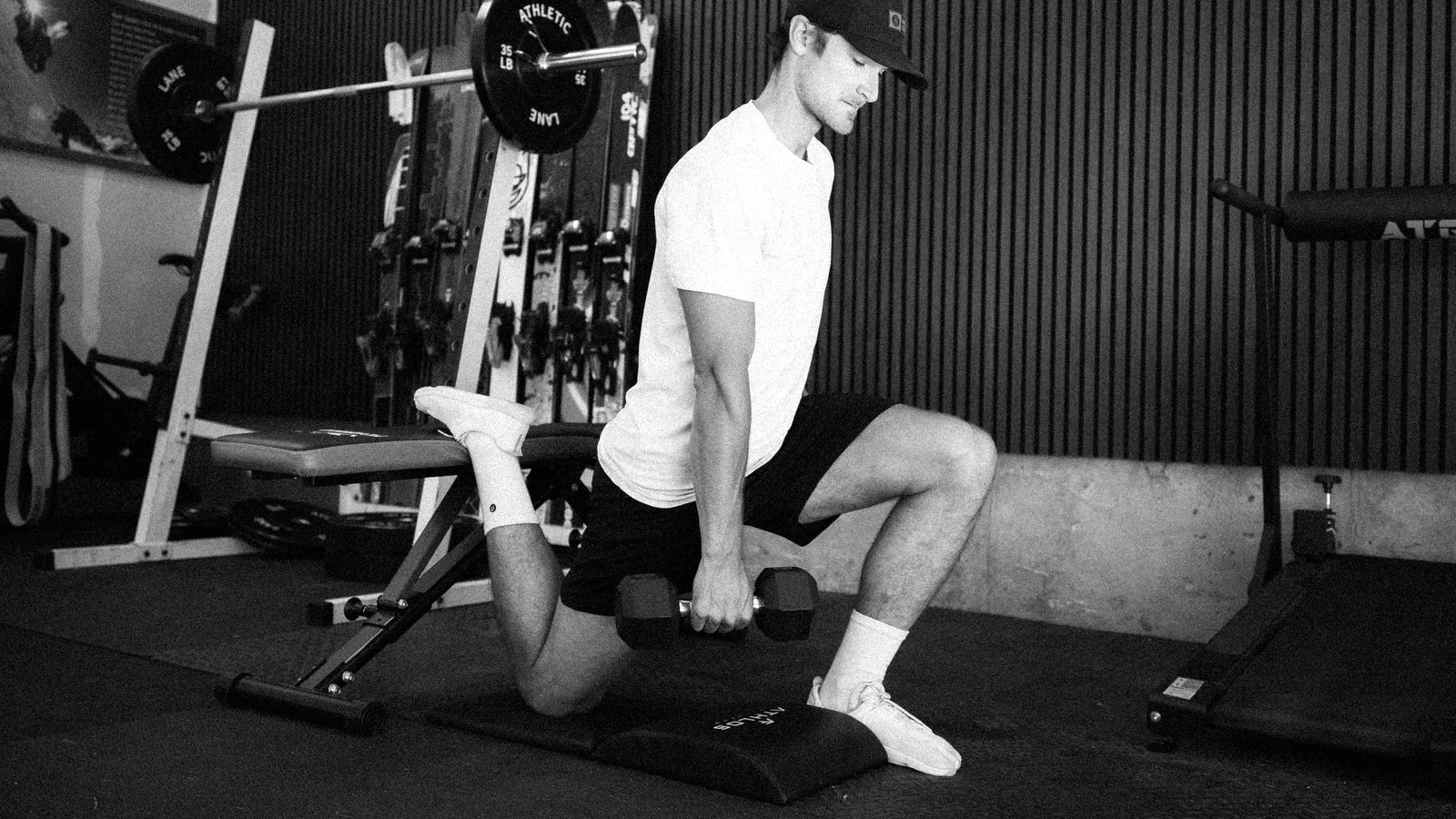
ATG stands for "Ass to Grass" and for Athletic Truth Group, the training company run by Ben Patrick, the Knees Over Toes Guy, who put this exercise on the map. It takes your knee through its full range of motion under control, stretches the hip flexor of the back leg, and loads the quad, hamstring and glute of the front leg all at once. It's a stretch and a strength exercise in the same rep, which is why it's such a good fit for a knee that's been through something.
A full knee bend also moves synovial fluid through the joint, which is the closest thing your knee has to oil. That's a big part of why a stiff, achy knee usually feels better after a few sets, not worse.
How to do it
- Stand in a long lunge stance. Front foot flat, back foot up on its toes, hands on a wall, rack or chair if you need balance.
- Drive the front knee forward and out over the toes as you lower. The goal at the bottom is your front hamstring resting on your calf, torso tall.
- Keep the back toe pressed into the floor and the back knee just off the ground. You should feel a stretch through the back hip flexor.
- Push through the whole front foot to stand, and keep the knee tracking over the toe on the way up.
If you can't get there yet
Almost nobody can do the full version on flat ground the first time, and you shouldn't try. Elevate the front foot on a step, a box or a stack of plates, high enough that you can reach the bottom position with a tall torso and a flat front heel. That's your starting height. Lower it an inch or two every week or two, and only when the current height feels clean. Please don't feel like you have to get to flat ground fast. The elevated version is a real exercise, and it's where the form gets built.
Making it harder
Once you're on flat ground with solid form, add load. A dumbbell in each hand or a kettlebell held at the chest. After that, slow the lowering to three seconds, then add a pause at the bottom. The ATG split squat isometric (holding the bottom position for 30 to 45 seconds) is how I load it when a knee is cranky, because there's no movement to argue with.
Sets and reps.
3 sets of 5 reps per side, three times a week. Rest about 30 seconds between sides, because your hip flexors will be feeling the stretch. Add weight when 5 reps on flat ground feels like an RPE 5.
Mistakes I see most
- Leaning forward to get lower. Depth comes from the front knee travelling forward, not from the chest dropping. If the torso folds, raise the front foot.
- Front heel lifting. Your ankle is the limit. Elevate the front foot for now, and do the ankle session in the mobility library on off days.
- Rushing to flat ground. Front-foot elevated with perfect form beats flat ground with a wobble. Lower the elevation over weeks, not sessions.
- Knee caving in at the bottom. Push the knee out toward the little toe. If it keeps caving, hold onto something and slow the descent down.
Where it lives in the Strong Knees System
You'll meet it front-foot elevated early on, loaded with dumbbells in Kneehab Strength, and it comes back as knee armor in the second block of Kneehab Performance, where it sits next to the heavy squats to keep full range of motion in the knee while the weights go up.
Equipment
Nothing to start. A step or a sturdy box for the elevated version, and dumbbells or a kettlebell once you're on flat ground. A slant board under the front foot makes the elevated version easier on a stiff ankle.
That's an Amazon affiliate link. As an Amazon Associate I earn from qualifying purchases, at no extra cost to you.