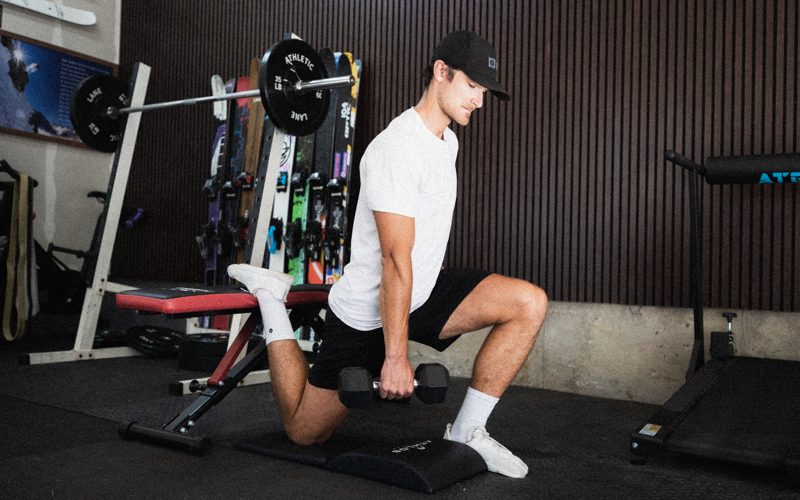
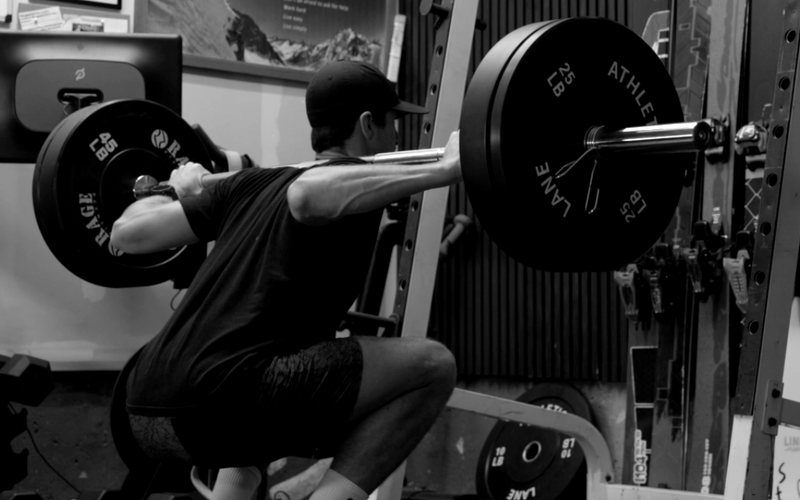
"Don't let your knees go over your toes." We've all heard that saying when it comes to exercising. I heard it in gyms, in PE class and all through my ten years of kneehab. I was never taught how to squat deep or how to train my knees through their full range of motion, and keeping my knees behind my toes definitely didn't stop my ACL from tearing again. (I've torn it four times now. Here's the whole story if you're new here.)
I can't tell you things would have gone differently if somebody had taught me this stuff during those years. I do wonder about it, though. What I can tell you is that training knees over toes has been a life changer for me, and I think it's a big reason I'm still able to ski, lift and play sports without knee pain, even without an ACL.
So in this post I'm going to walk you through where that old rule came from, what the research says now, why knees over toes training works, and how to start doing it yourself without overdoing it. I hope it helps!
Quick note: some of the links in this post are affiliate links. If you buy something through one, it costs you nothing extra and it helps keep this website alive.
Where "don't let your knees go over your toes" came from
For starters, the rule isn't as old as you'd think. In 1961 a professor at the University of Texas named Karl Klein published a study on the deep squat. Klein had been studying the knee for about 20 years (he hurt his own in a high school hockey game), and he built his own aluminum device that clamped around the thigh and calf to measure how loose a knee was. He used it to compare people who had done a lot of deep squatting with people who hadn't, reported that the squatters had looser knee ligaments, and told everybody to stop squatting deep.
That study landed hard. In the summer of 1961 the Army ordered an end to the squat jumps it had been using for two decades. The next spring, Sports Illustrated ran a full story on Klein with the headline "The Knee Is Not for Bending." A knee that's not for bending! It sounds crazy now, but that was the advice back then. In that story Klein says anything below a half knee bend "is useless and ruinous," and the magazine reports that the American Medical Association's journal had come out against deep knee exercises and that New York's schools had just told their gym teachers to drop deep knee bends.
Somewhere along the way, "don't squat deep" turned into "don't let your knees go over your toes," and that's the version that got passed down through gyms, PE classes and rehab clinics for the next 60 years. (Klein's original paper isn't online, but I've listed it with the rest of my sources at the bottom of this post.)
Here's the part that's hard to believe. When other researchers went back and tested the same idea, they couldn't get the same result. A 1971 study that trained people with deep squats and half squats found no meaningful difference in knee stability between the two. In 1989, another group of researchers had 100 college students do eight weeks of full or half squats, and their knee stability didn't change. That same group also measured competitive powerlifters and weightlifters, people who squat heavy all the time, and found their knees were as tight as or tighter than people who didn't squat at all. And in 2013, a review of more than 160 papers concluded that the concerns about deep squats were unfounded, and that deep squats done with good technique and gradual loading are an effective way to strengthen and protect the knee.
So this whole rule traces back to one study from 1961 that nobody was able to repeat. And a lot of us, me included, spent years training (and rehabbing) around it.
What happens when you avoid knees over toes
I'll say this as plainly as I can. When you never strength train with your knees over your toes, you aren't strengthening your knees at all. If anything you're making them weaker, because you're not actually using them.
There's a study that shows this really well. In 2003, a group of researchers had seven lifters squat two ways: normally, and with a wooden board in front of their knees so they couldn't travel past the toes. With the knees blocked, the work at the knee dropped by about a fifth. The work at the hips went up roughly ten times, because the only way to get down without your knees moving forward is to fold over at the hips. The researchers' own conclusion was that blocking the knees probably just shoved the load onto the hips and low back, and that squatting properly may need the knees to travel a little past the toes.
At the time, I'm sure less load on the knees sounded like a good thing. But think about what that actually means. If you're not loading your knees, you're not building any strength around your knees either, and that is obviously not a good thing.
Meanwhile, your knees go over your toes all day long whether you train for it or not. Standing up from a chair, walking down the stairs, getting out of the car, squatting down to grab something off the floor. You're doing it dozens of times a day and you might not even know it. In sports it's constant. Every time you land a jump, slow down from a sprint or absorb a turn on skis, your knees are out past your toes with a lot more than your bodyweight on them.
Why knees over toes training works
Your knees only get strong in the positions you train in. If you only ever train with your shins straight up and down, that's the only position your knees are strong in. So every time they do go over your toes (which, like I just said, is all the time in life and especially in sports), they're in a position they've never been trained for, and that's where you can become susceptible to injury. When you train that position on purpose, a little bit at a time, it stops being the weak spot.
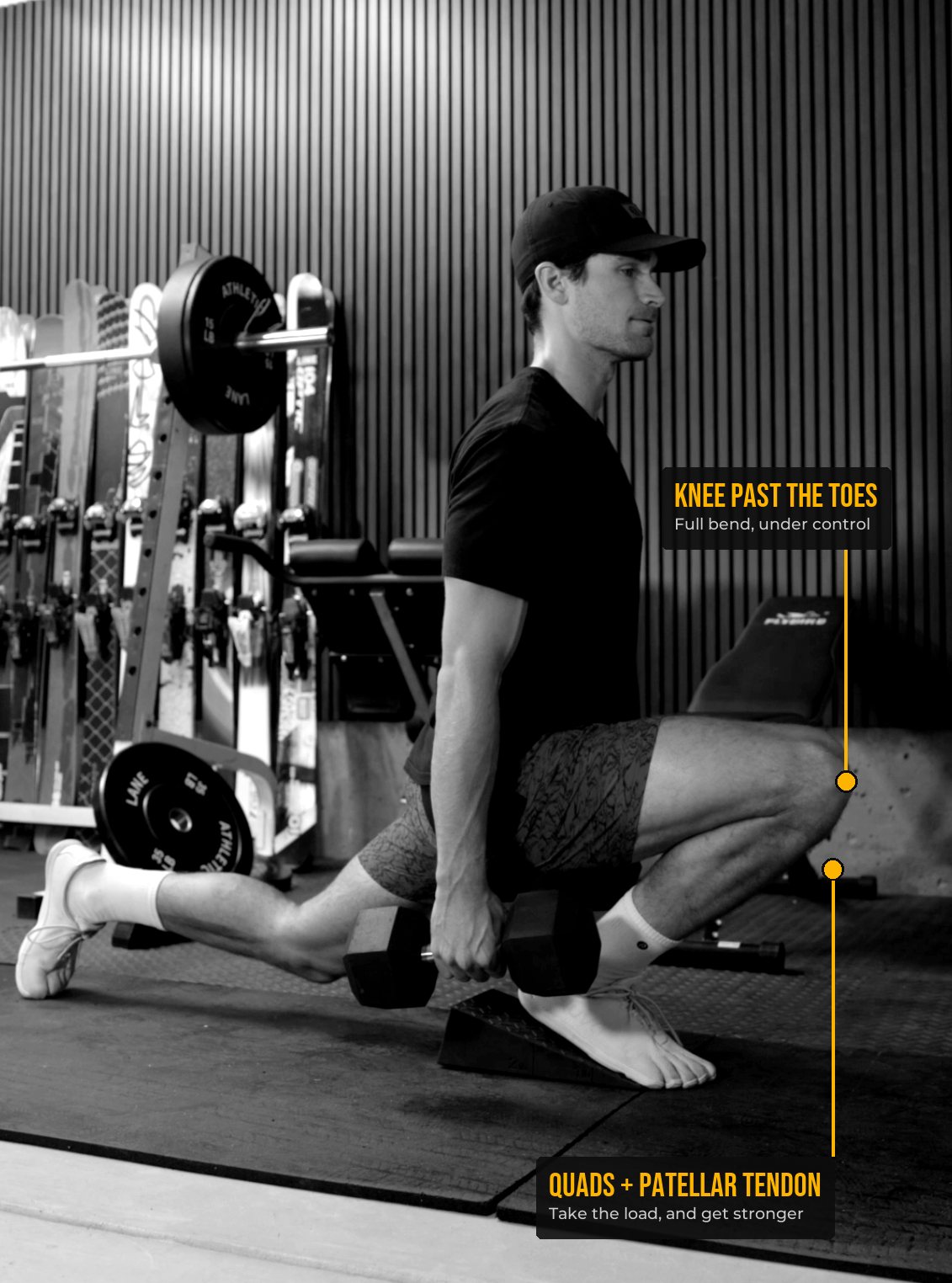
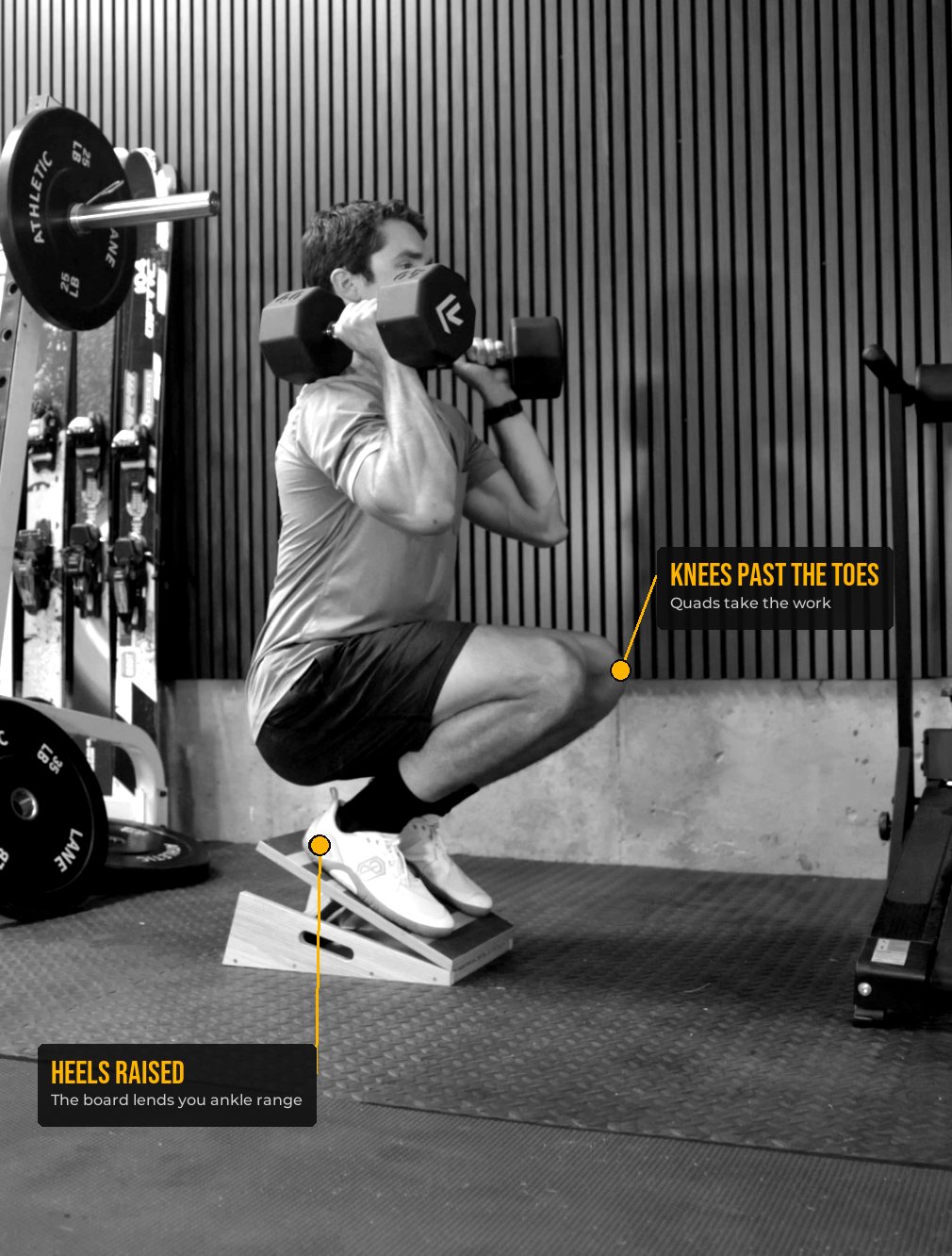
It builds the muscles and tendons around your kneecap. The further your knee goes over your toes, the more work your quads and the tendons above and below your kneecap have to do. That's exactly why people were told to avoid it, and it's also why it works. Muscles and tendons get stronger when you load them and let them recover, and they get weaker when you don't. You can see it in the photo below. My front knee is well past my toes, and my quads and my patellar tendon (the one just below the kneecap) are doing the work.
It trains the VMO. The VMO is the teardrop-shaped part of your quad on the inside of your knee, and it helps keep your kneecap tracking the way it should. Movements where the knee travels forward over the toes, like Poliquin step ups and slant board squats, are my favorite ways to train it. (I wrote more about the VMO in this post on quad strength.)
It works your ankles too. If you have limited ankle mobility, you're going to have trouble getting your knees over your toes without your heels popping up or your ankles hurting. That's where a slant board can really help. Raising your heels lends you the ankle range you don't have yet, so your knees can travel forward and your quads can do the work. With that said, working knees over toes is also going to help your ankles over time, because it makes you train dorsiflexion (bending your ankle so your shin moves toward your toes), a movement you probably don't train very much unless you're squatting deep.
Where I learned all of this
I didn't come up with any of this, and I wouldn't know any of it if it wasn't for Ben Patrick. You might know him as the Knees Over Toes Guy. ATG, his training system, stands for "Ass to Grass" and for Athletic Truth Group, and it's built around the same ideas as this post: start from the ground up, walk backward, earn your range of motion before you add weight, and keep it pain-free.
After my fourth ACL tear I knew I needed to try something different. Physical therapy got me back on my feet every single time. It did its job, but there was never quite enough load or progression to build the strength I needed to get rid of knee pain for good. The ATG program was a big part of what started to help me, and I think it's a big reason I'm still able to do so many things without knee pain, even without my ACL. It's also why I went on to earn my ATG Level 2 coaching certification in 2024, and it's the backbone of how I coach today.
If you want to go straight to the source, ATG Online Coaching is where I started, and I can't give it enough credit. The ATG backward treadmill lives in my garage (here's my full review of it), and ATG makes a ton of other equipment that helps you train knees over toes. I can't recommend any of it highly enough.
How to start knees over toes training
The key isn't grabbing a slant board and a heavy weight and going straight to deep squats, but progressively working your way into knees over toes training. A lot of these movements are going to feel like a stretch at first, and some of them might feel pretty easy. But when you train knees over toes you're putting a lot of stress on your knees (that's the whole idea), so you've got to be careful not to overdo it. I know how tempting it is to ramp things up quickly when something feels good. Patience is key here. Remember, restraint is the hardest trick in the book.
My approach is the same for every movement below. Start slow, learn the movement and get the form dialed. Then increase the range of motion. Then add weight. Keep any discomfort under a 4 out of 10 while you're training, and if your knee feels worse than it did the day before, back off the range of motion or the weight you're using and go from there.
Here's the order I'd go in.
1. Walk backward
Backward walking, or dragging a sled backward if you have one, gets your knees over your toes with almost no impact. It's the gentlest knee exercise I know, and it's where I'd start anybody. I wrote a whole post on why backward sled drags are so good for your knees. Here's a quick demo.
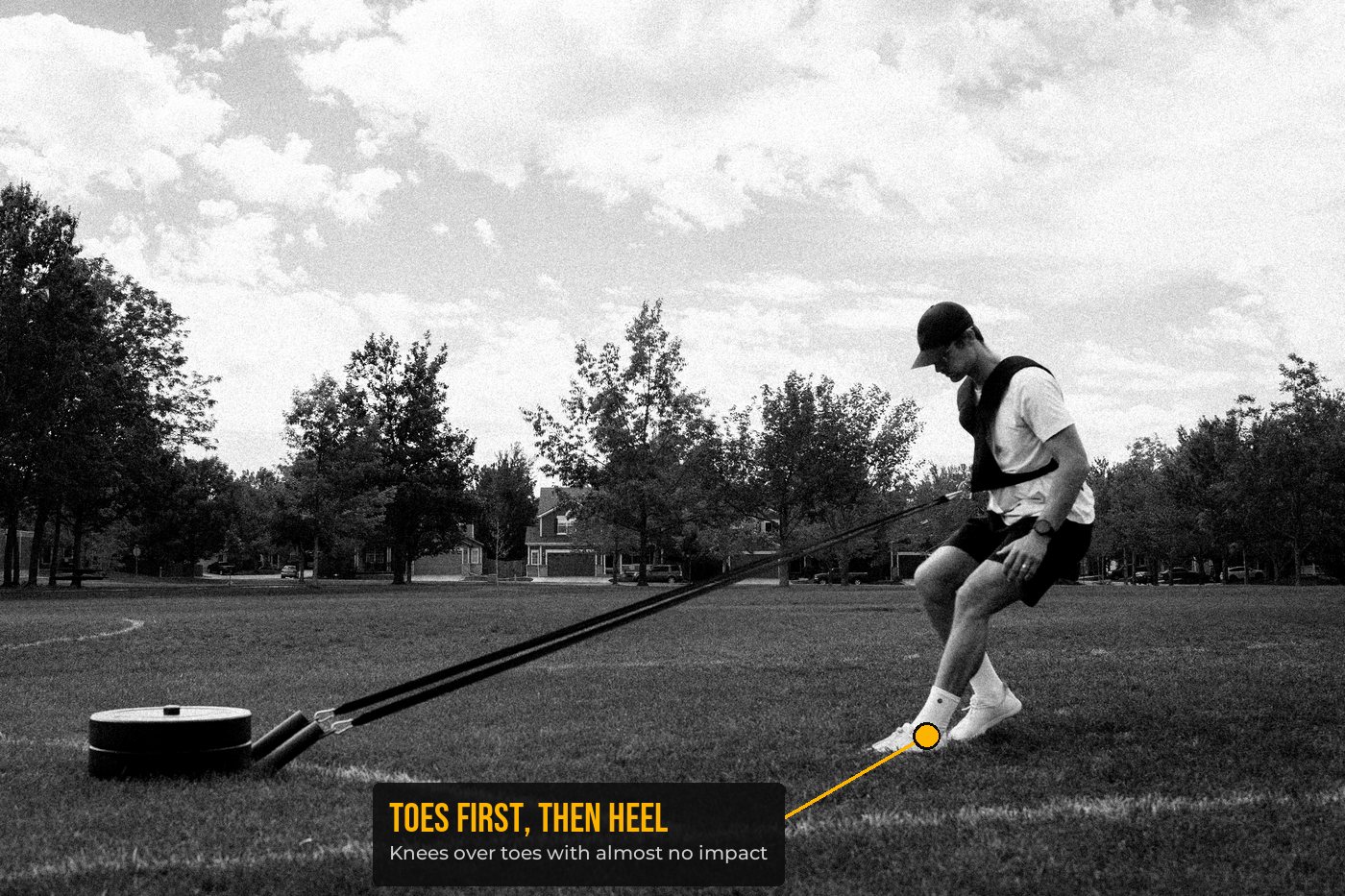
Start with: 10 minutes, three times a week, or three to five minutes as a warm-up before you train.
2. Tibialis raises and calf raises
These train the muscles below your knees, which take on a lot of the impact from the ground before it ever gets to your knees. I go into a lot more detail in Strong Feet, Strong Knees and in my post on the tibialis muscle.
Start with: 2 sets of 20 tibialis raises, 2 sets of 15 to 20 knees over toes calf raises and 2 sets of 15 single-leg calf raises per side.
3. Slant board squats
Stand with your heels up on a slant board (a couple of weight plates work if you don't have one yet), let your knees travel forward over your toes and squat as deep as you can without pain. Use just your bodyweight to start. Go a little deeper over the weeks, and once you can get all the way down comfortably, pick up a dumbbell or two like in the photo above. Here's a quick demo.
Start with: 3 sets of 10.
4. Front-foot-elevated ATG split squats
The ATG split squat is a true stretch-strength exercise. Your front leg gets stronger through a full bend while your back hip gets a big stretch. Start with your front foot up on a box, a bench or a stair. The higher your front foot, the easier it is. Keep your front heel down, keep your torso tall, and let your front knee travel as far past your toes as you comfortably can. The goal is to get your front hamstring to cover your calf while your back knee stays off the ground.
Once that's easy, lower your front foot a little at a time until you're on flat ground, and then start adding weight. I'd urge you not to rush down to flat ground, though. It's more important to get the form dialed first. I break the whole movement down in my ATG split squat guide.
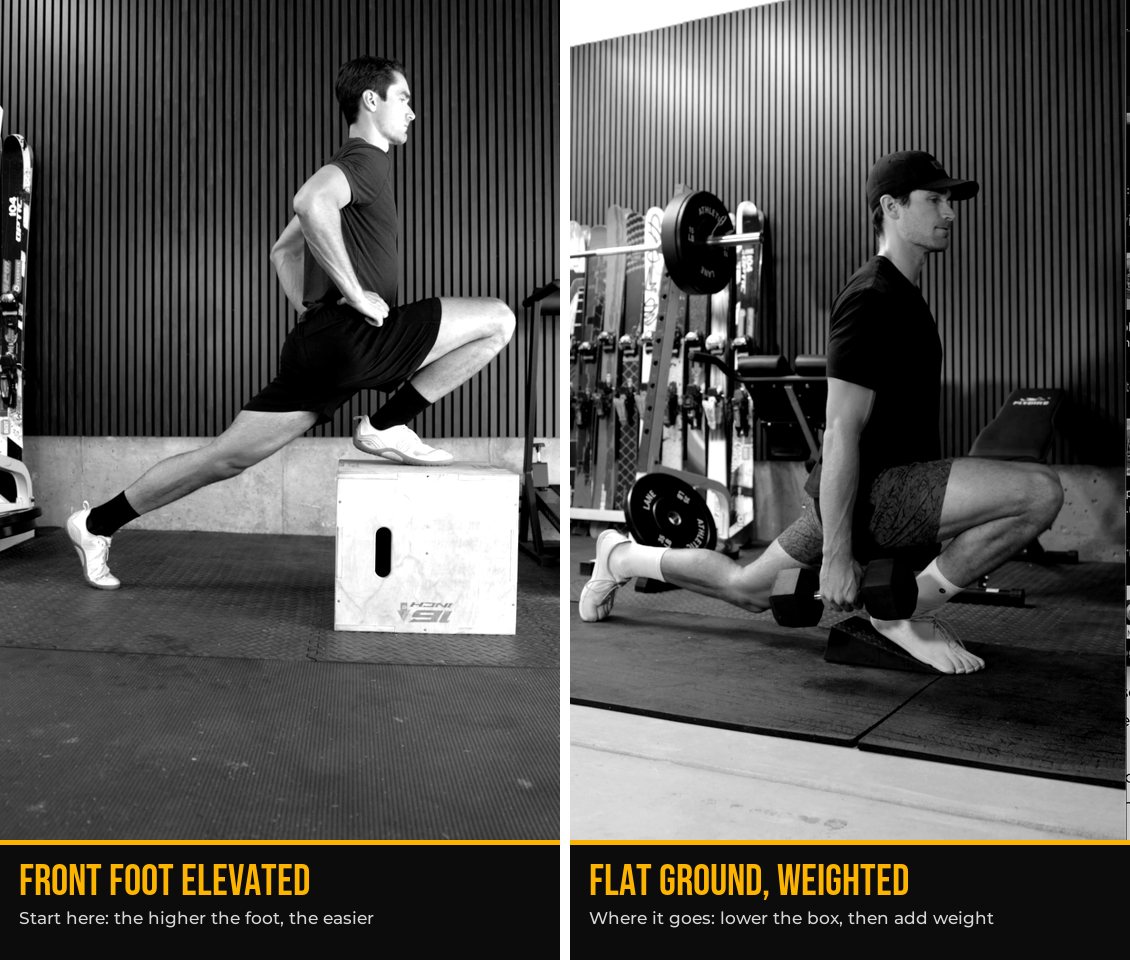
Start with: 3 sets of 5 to 6 per side, resting about 30 seconds between sets.
5. Poliquin step ups
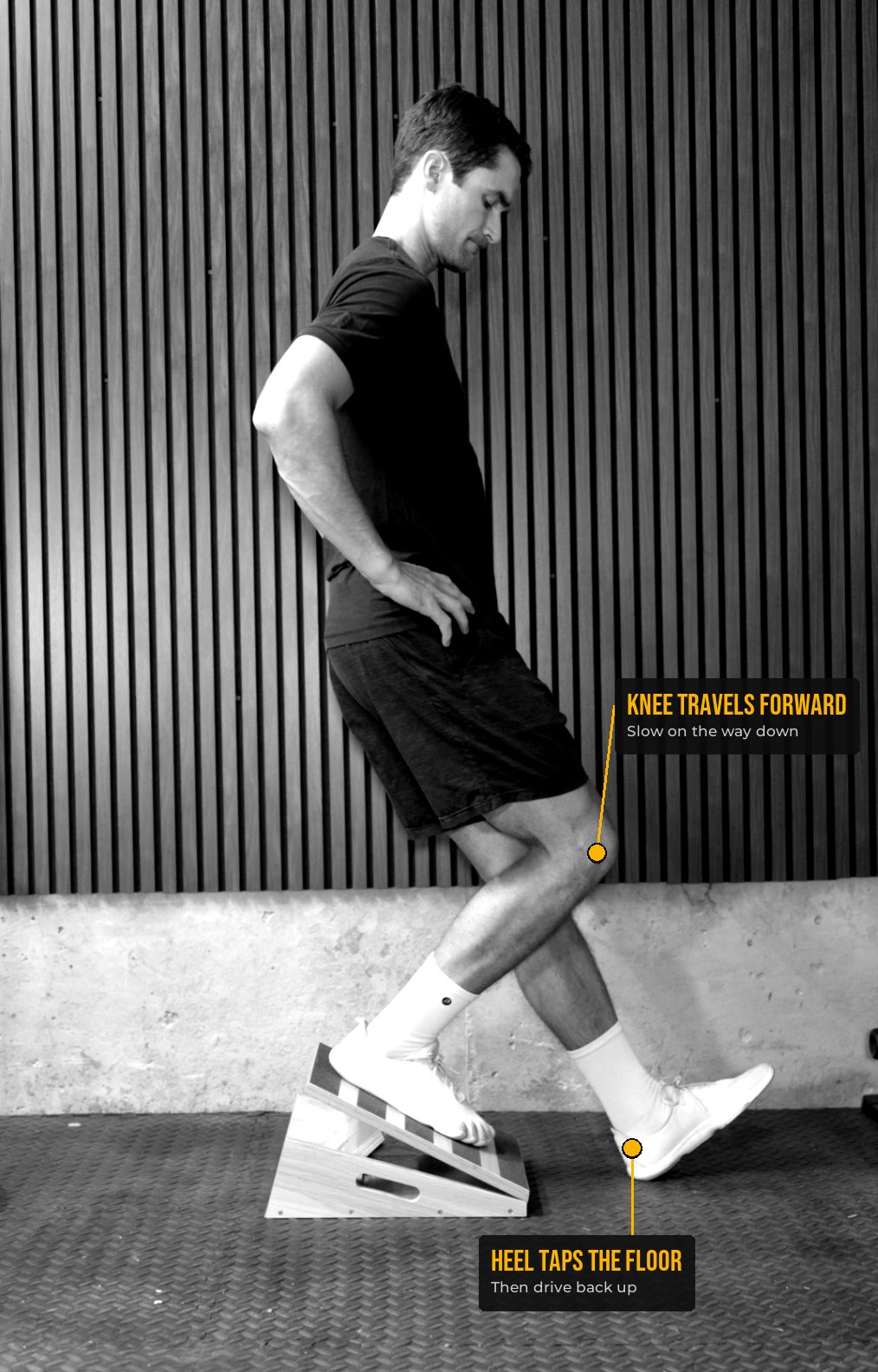
Named after the late strength coach Charles Poliquin, this one goes right after the VMO. Stand on one leg, reach your other heel out in front of you, and bend your standing knee forward over your toes until that front heel taps the floor. Then drive back up. Go slow on the way down. Start on a flat surface, then move up onto a slant board like I'm using in the photo, and then add weight. Here's a quick demo.
Start with: 3 sets of 10 per side.
When to add weight
Once all five of those feel easy and your knees feel good the next day, the next step is adding load to your deep squats. It doesn't have to be a barbell, either. One dumbbell or two dumbbells will do the job just fine. Add a little at a time (5 to 10 percent a week is plenty) and focus on getting 1% better each week. You can't lose if you don't quit!
If you'd like the first eight weeks of this written out for you, that's what my free Kneehab Foundations guide is. It's three sessions a week with a band and your bodyweight, with sets, reps and a video of me doing every exercise.