Hips: Mobile and Strong. Why Your Knee Caves In, and What a Desk Job Has to Do With It
Connor Clayton · The Kneehaber ·
If you've been through physical therapy for a knee, you've probably done clamshells and side-lying leg lifts with a band around your knees. I did plenty of them, and I still think they're worth doing. The glute med is the muscle on the side of your hip that keeps your knee from caving inward, and a knee that caves is a knee that hurts. Here's the catch, though. Lying on a table firing up your glute med is not the position you get hurt in. You get hurt standing on one leg, with your legs tired, trying to stand up, run, or hold a ski turn. That's when your hip has to do its job, and that's the kind of hip strength the table exercises can't build on their own.
So this post is about the hips: what they actually do for your knees, what sitting at a desk all day does to them, and the hip exercises I'd recommend for getting them mobile and strong at the same time. I hope it helps!
Quick note: one of the links in this post is an affiliate link. If you buy something through it, it costs you nothing extra and it helps keep this website alive.
What your hip actually does for your knee
Here's the picture I keep in my head. The hip is the steering wheel and the knee is the front tire. The tire doesn't decide where the car goes. It just gets shredded when the steering is bad.
Your knee's alignment from side to side is mostly decided above it. Where your thigh bone points is set by the hip, and the hip is run by three groups of muscles: the glute max on the back, the glute med on the side, and the deep rotators underneath them. When those muscles fire on time with enough force, your thigh stays stacked over your foot on a single-leg landing, a stair, a ski turn. When they don't, three things happen at once: the thigh rotates inward, the pelvis drops on the free side, and the knee drifts toward the middle. That inward drift is called knee valgus, and it's the position behind most non-contact ACL tears. It's also a big contributor to pain around the kneecap and down the outside of the knee.
Two things I'd want you to know so I'm not overselling this. First, a weak hip on a table test isn't the whole story. A review of the research on kneecap pain found that hip weakness shows up alongside the pain more than it predicts it, and a study of runners found that the link between weak hips and a knee drifting inward showed up at the end of a long run, when they were tired. Strength matters, but control when you're tired matters just as much, which is why I train the hips standing, on one leg, with a weight in hand. Second, hip work on its own fixes fewer knees than it gets credit for. It helps kneecap pain, and the researchbacks that up, but it works best as part of rebuilding the whole chain, quads included, not instead of it. That's why every program I write trains both.
The desk job problem
If you work at a desk all day, you probably already know this: your hip flexors are way too short. Sitting leaves them shortened for eight hours, and it leaves your hip not rotating for eight hours. Then you stand up and ask that hip to control your thigh on a stair, a landing or a ski turn, and it can't. It doesn't have the range, and it hasn't practiced holding a position in months. So the knee does the rotating instead, and the knee is bad at it. It's a hinge with almost no rotational tolerance, stuck between a hip and an ankle that were built to rotate.
That's why your hips have to be two things at once: mobile enough to get into the positions life asks for, and strong enough to hold them there. Stretching alone gives you flexibility you can't control. Strengthening alone makes you overly stiff. You need both, and the good news is that the best hip exercises do both at the same time. They start as a stretch, and once the stretch feels easy, you add weight and the same movement becomes a strength exercise. That's the whole method, and it's how the exercises below are laid out.
Grab the free weekly routine first
Everything below is pulled from my free Kneehab Weekly Routine, which has a whole hip day in it alongside a quad day and a posterior chain day, with sets, reps and a video of me doing every exercise. If you'd rather have the week written out than piece it together from this post, grab it here and keep reading.
Free download
The Kneehab Weekly Routine (free)
A free week of knee training with a whole hip day in it: three sessions a week, about twenty minutes each, with the quad day and the posterior chain day around it. Every exercise with sets, reps and a video of me doing it.
The PDF lands in your inbox in about a minute. You'll also get my weekly knee-training email, and you can unsubscribe anytime.
These are the stretches and stretch-strength movements I'd start with. Every one of them can be done at home, and every one of them turns into a strength exercise later on.
1. Front-foot-elevated ATG split squat
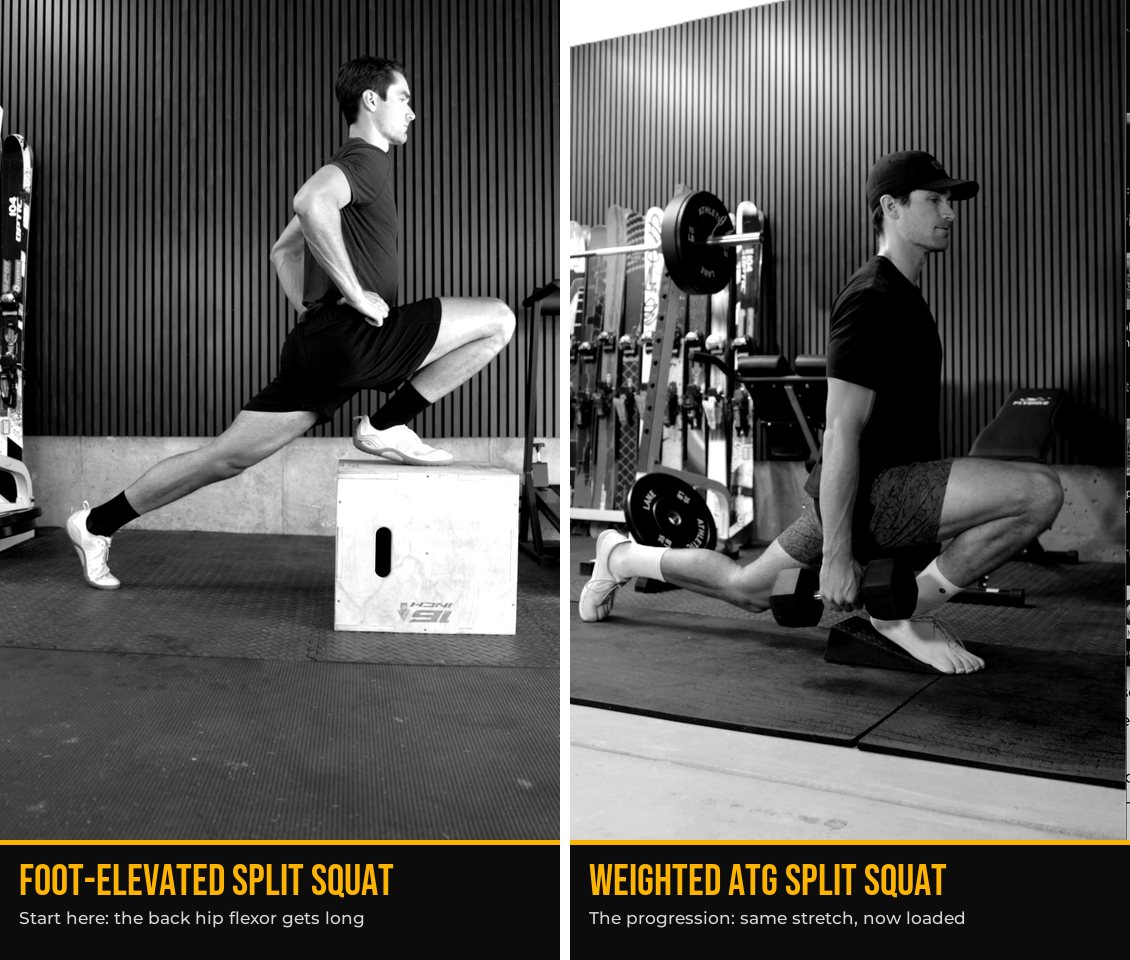
This one starts as a stretch and turns into a strength exercise, which is why it's first. With your front foot up on a box or a step, you lower your back knee toward the floor and let your front knee travel forward over your toes. The hip flexor of the back leg gets pulled long at the bottom of every rep, which is exactly what a day of sitting shortens, and the front leg gets a full-range quad and hip workout at the same time. Here's the foot-elevated version to start with. Once it feels easy, lower the front foot to the floor, pick up a dumbbell in each hand, and it becomes the weighted ATG split squat: the same stretch, now building strength in that range. It's probably the single best thing I've done for my own hips and knees.
Left: the mobility version, front foot up, back hip flexor getting long. Right: the same movement loaded with dumbbells once the stretch is easy.
Start with: 3 sets of 8 per side with the front foot elevated, a two-second pause at the bottom. Add the dumbbells when the bottom position feels easy.
2. Couch stretch
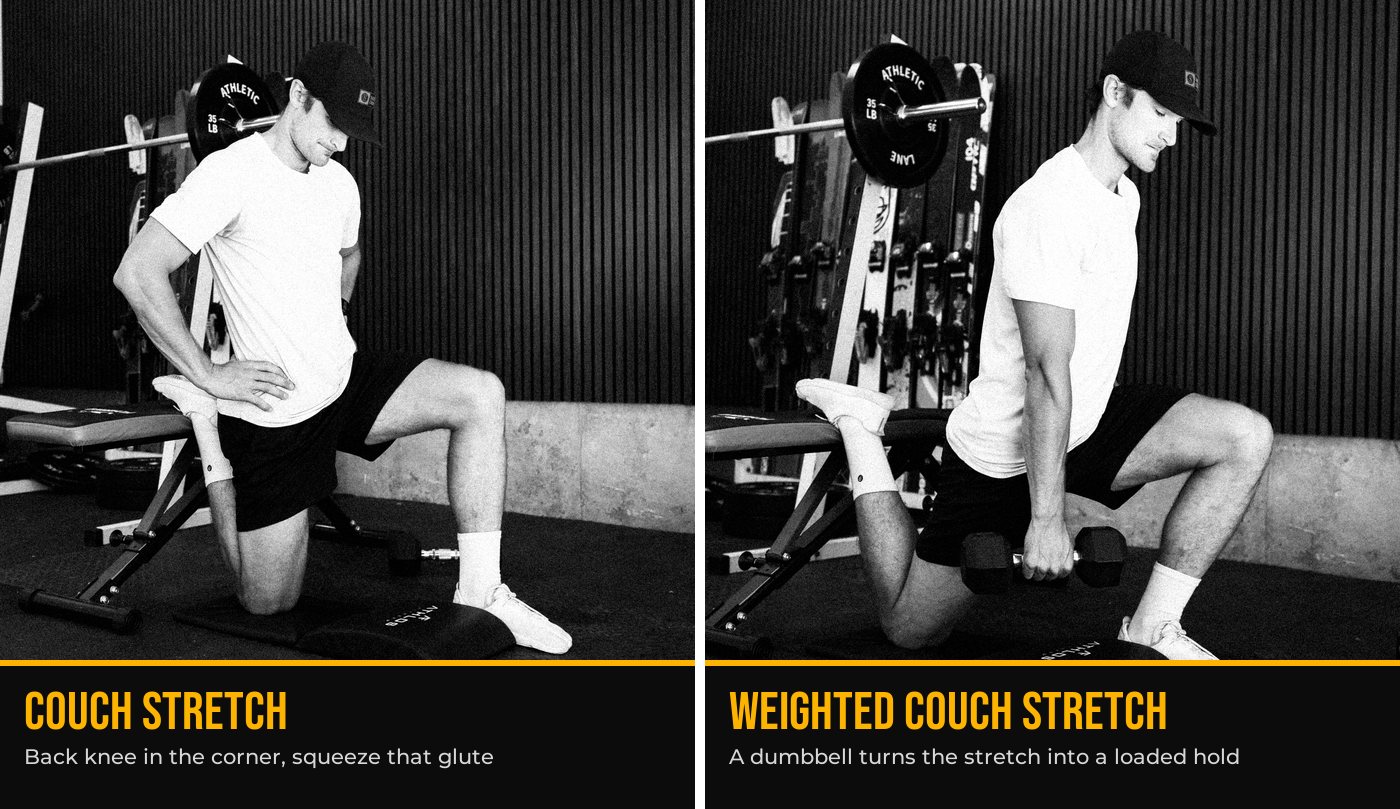
The couch stretch is the most direct hip flexor stretch there is. Back knee in the corner where the floor meets the wall (or a couch, which is where the name comes from), back shin up the wall, front foot flat, and you squeeze the glute of the back leg so the stretch lands in the hip flexor and not in your lower back. Here's how I set it up. The progression is a dumbbell held at your chest or resting on the front knee, which turns the stretch into a loaded hold.
The couch stretch, then the weighted version. Squeeze the back glute so it lands in the hip flexor.
Start with: 60 seconds per side after any session, breathing slow. Add the weight when 60 seconds feels comfortable.
3. Incline pigeon
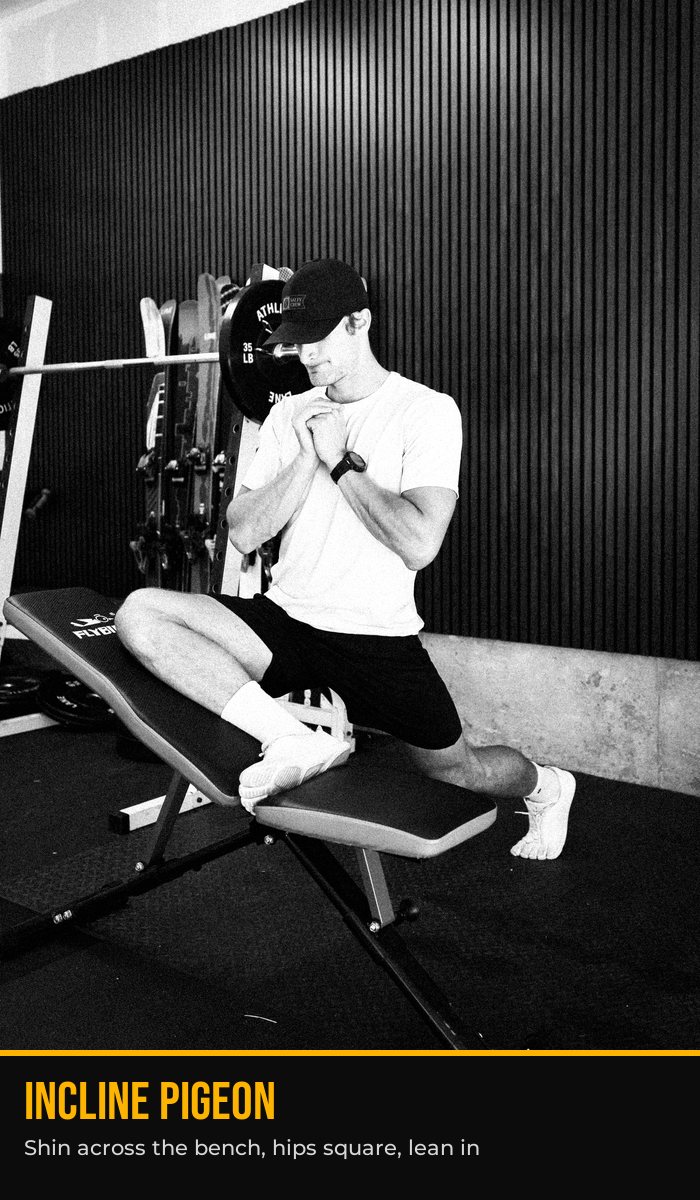
Shin across a weight bench, hips square, and lean in. This is the one for the upper hip: the glute and the deep rotators that steer the thigh. The bench lets you control how deep you go, which is why I like it over the floor version for anyone whose knee doesn't love the floor. Here's the full setup. No bench? A pigeon on the floor with your hands on blocks does the same job.
Incline pigeon. Sit tall first, then fold forward over the shin as the hip opens up.
Start with: 45 to 60 seconds per side. Sit tall first, then fold forward over the shin as it opens up.
4. Hip 90/90s and the internal rotation foot lift
Sit on the floor with both knees bent to 90 degrees, one leg in front of you and one out to the side, and switch sides slowly without using your hands. Internal rotation is the range sitting takes away first, and it's the range your knee gets asked to borrow when the hip doesn't have it. Here are the 90/90s. The foot lift is the progression and the one I'd never skip: stay in the 90/90 position, keep the back knee on the floor, and lift the back foot off the ground. Here's the internal rotation foot lift. That turns the stretch into strength in the exact range you just opened.
Start with: 5 slow switches, then 10 foot lifts per side with a one-second hold at the top.
5. Lateral lunge
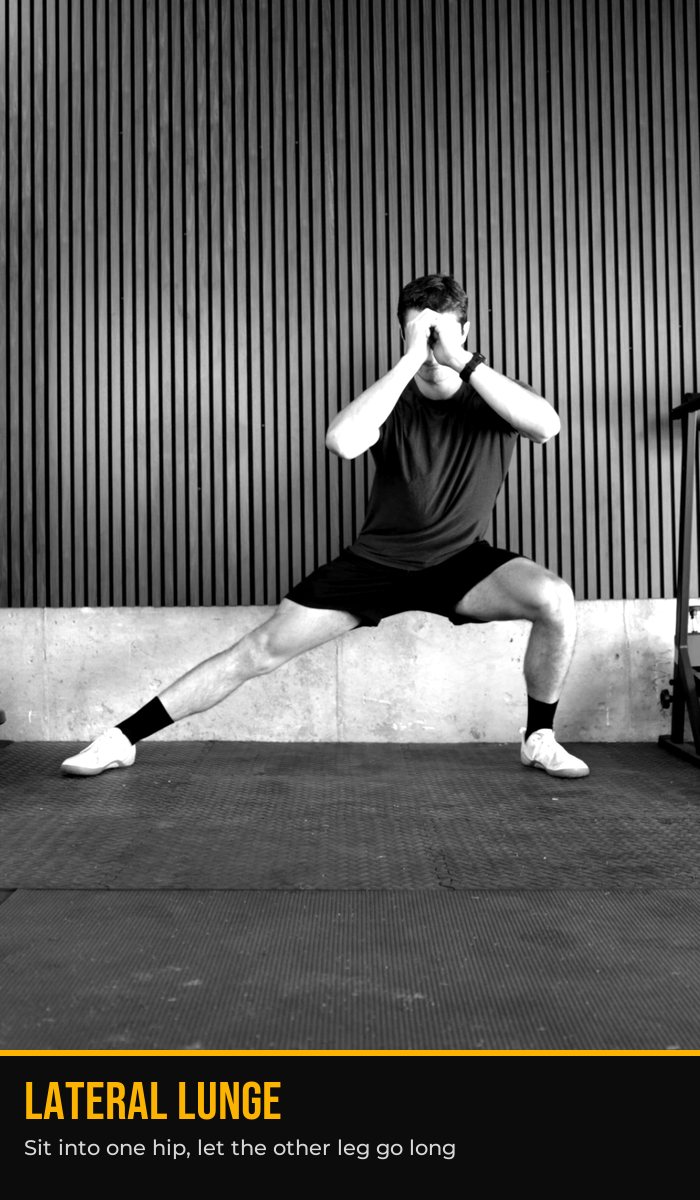
Step wide, sit back into one hip, and let the other leg go straight with the foot flat. The adductors (your inner thigh muscles) on the straight leg get long while the hip on the bent side does the work, so you're stretching one side and strengthening the other in the same rep. Here's the mobility version: bodyweight, hands at your chest, as deep as you can control.
The lateral lunge, mobility version. One hip opens while the other one works.
Start with: 3 sets of 8 per side, pausing at the bottom. Once it's easy, it moves to the strength section below.
6. Horse stance squat
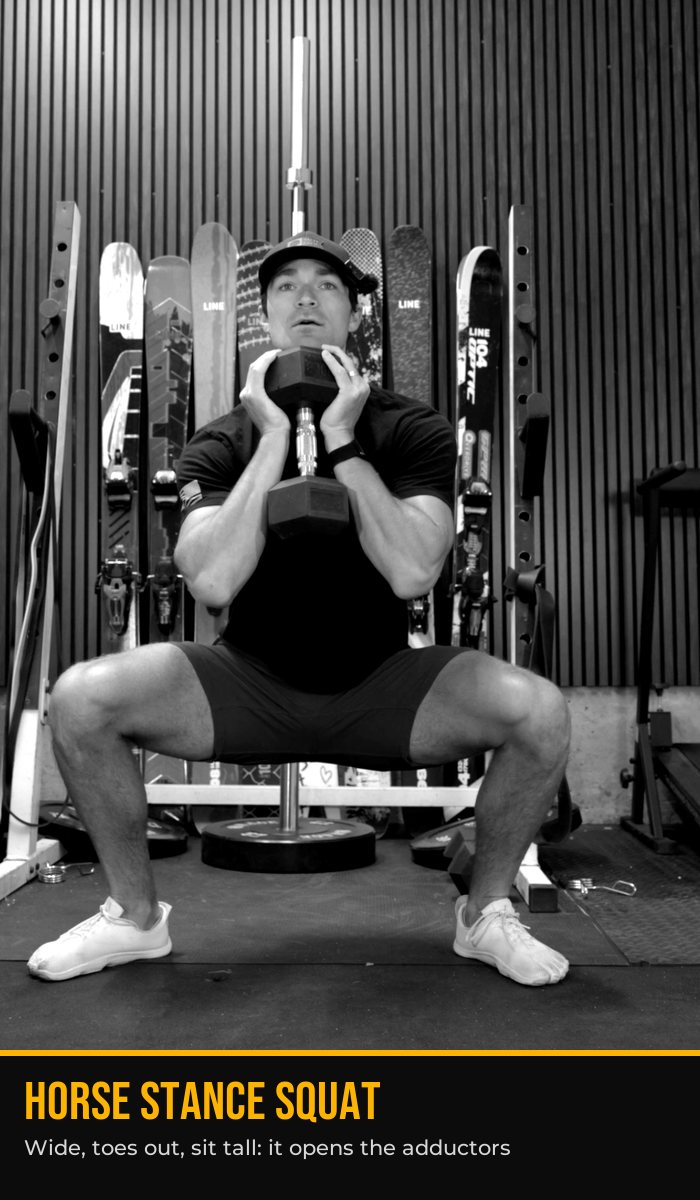
Feet wide, toes turned out, and sit straight down with your chest up until your thighs are level with the floor. This is the one for the adductors, and it opens up the hips better than anything else I've found. Admittedly, it's a bit of an awkward one, since you're really opening up the legs for lack of a better term, but it's still really effective. Here's the horse stance squat. You don't need the weight. I hold one because it helps me sit deeper, and because the hold becomes a strength exercise once you add it.
Horse stance squat. Awkward, and one of the best hip openers I know. The dumbbell is optional.
Start with: 3 holds of 30 seconds, bodyweight. Add a dumbbell at the chest when 30 seconds feels easy.
Strong: holding the positions, then loading them
Here's the progression I'd want you to take from the mobility work above. Once a stretch feels too easy, add weight to it. Hold the position longer. Then keep working for more range of motion, using the weight to help you get there. That's how you become strong and flexible at the same time, which, honestly, is the key to a lot more than knees. The exercises below are where the hips get strong enough to control your thigh on one leg under load, and that's the only kind of hip strength that protects a knee.
1. Weighted lateral lunge, then the Cossack squat
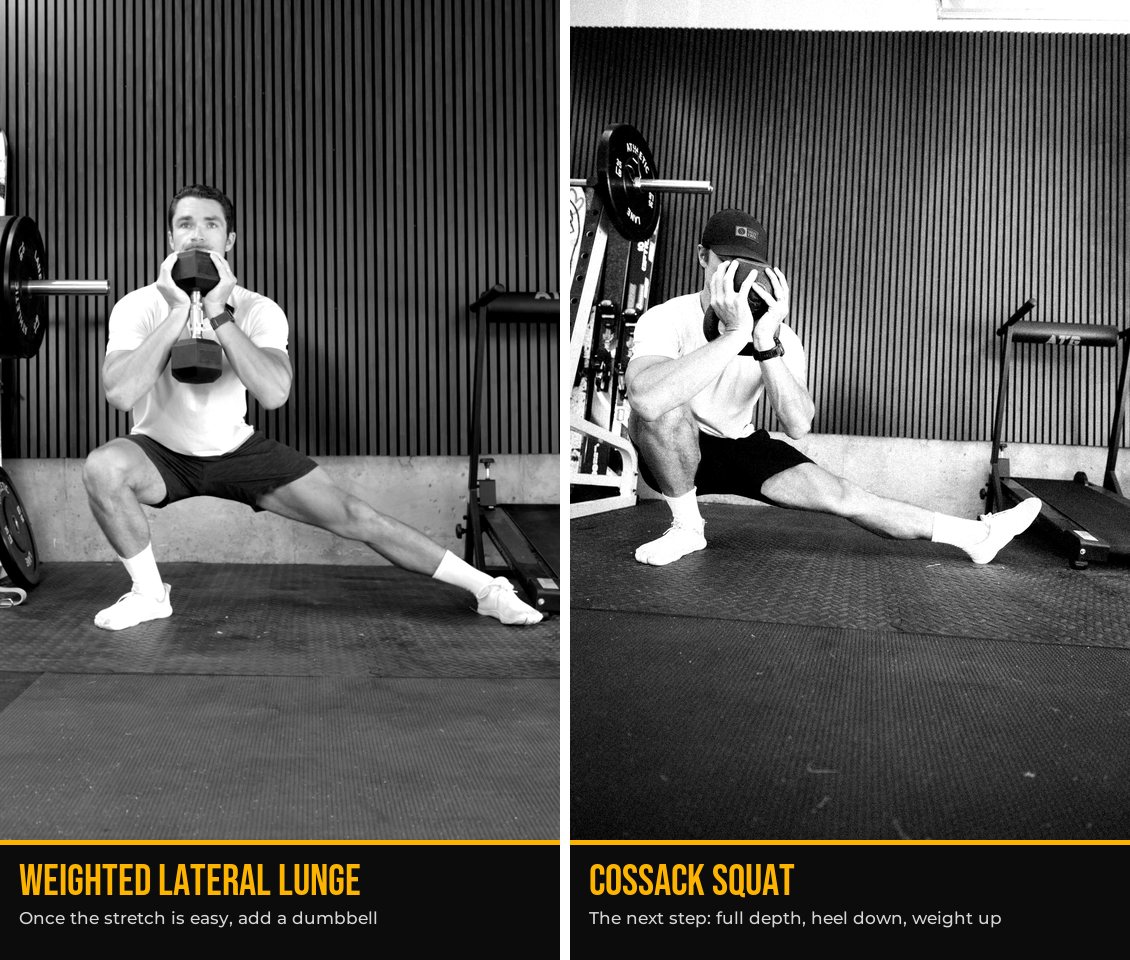
The lateral lunge from above with a dumbbell held at your chest. The weight pulls you deeper into the stretch and makes the working hip earn its way back up. The next step after that is the Cossack squat: the same wide stance, but you sit all the way down onto the heel of the working leg with the other leg straight and the toes pointing up. Full depth, heel down, weight at the chest. You can always increase the weight, which is the point. A lot of these movements start as a stretch, and this is what they turn into.
Left: the lateral lunge with a dumbbell. Right: the Cossack squat, all the way down onto one heel. Same stretch, more strength.
Start with: 3 sets of 6 to 8 per side with a light dumbbell. Earn the Cossack over a few weeks by going a little deeper each session.
2. Weighted ATG split squat and the weighted curtsy lunge
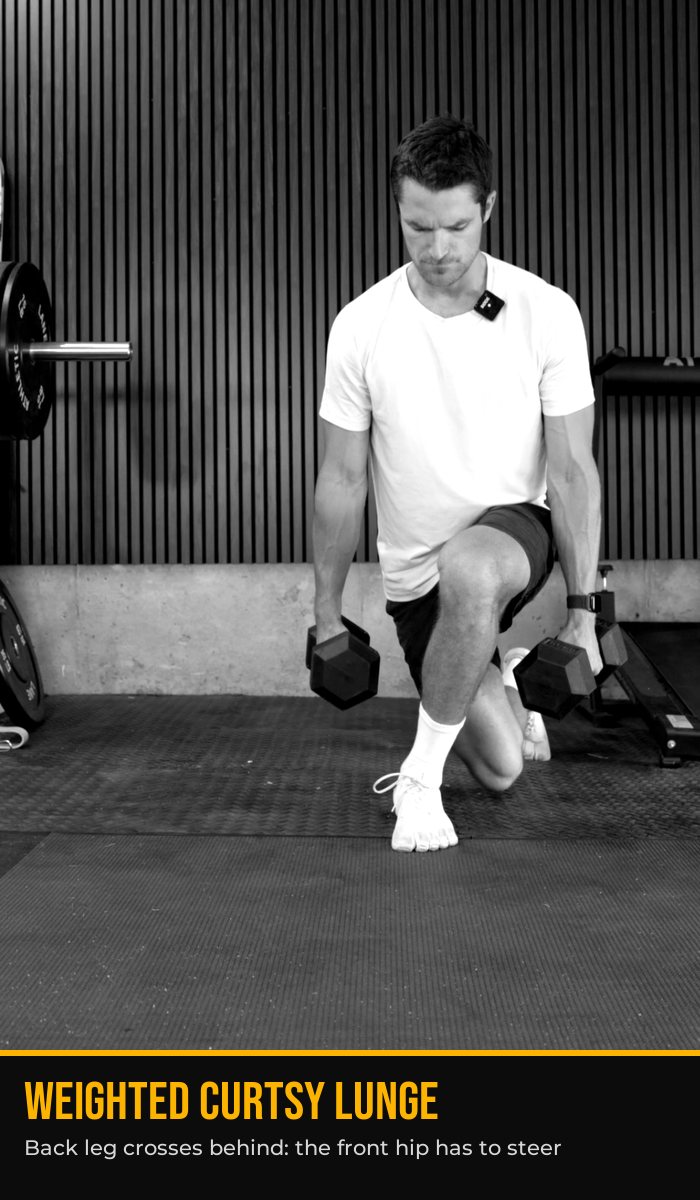
The weighted split squat is the progression from the first mobility exercise, and I'd keep it in a program forever. The curtsy lunge is its cousin: the back leg crosses behind the front leg instead of going straight back, so the front hip has to steer the thigh against a pull toward the middle. That's the exact job the glute med has on a landing or a ski turn, loaded with a dumbbell.
The weighted curtsy lunge. The front hip has to hold the thigh steady against a pull toward the middle.
Start with: split squats, 3 sets of 8 per side. Curtsy lunges, 3 sets of 8 per side, slow on the way down.
3. Hip flexor raises, banded then weighted
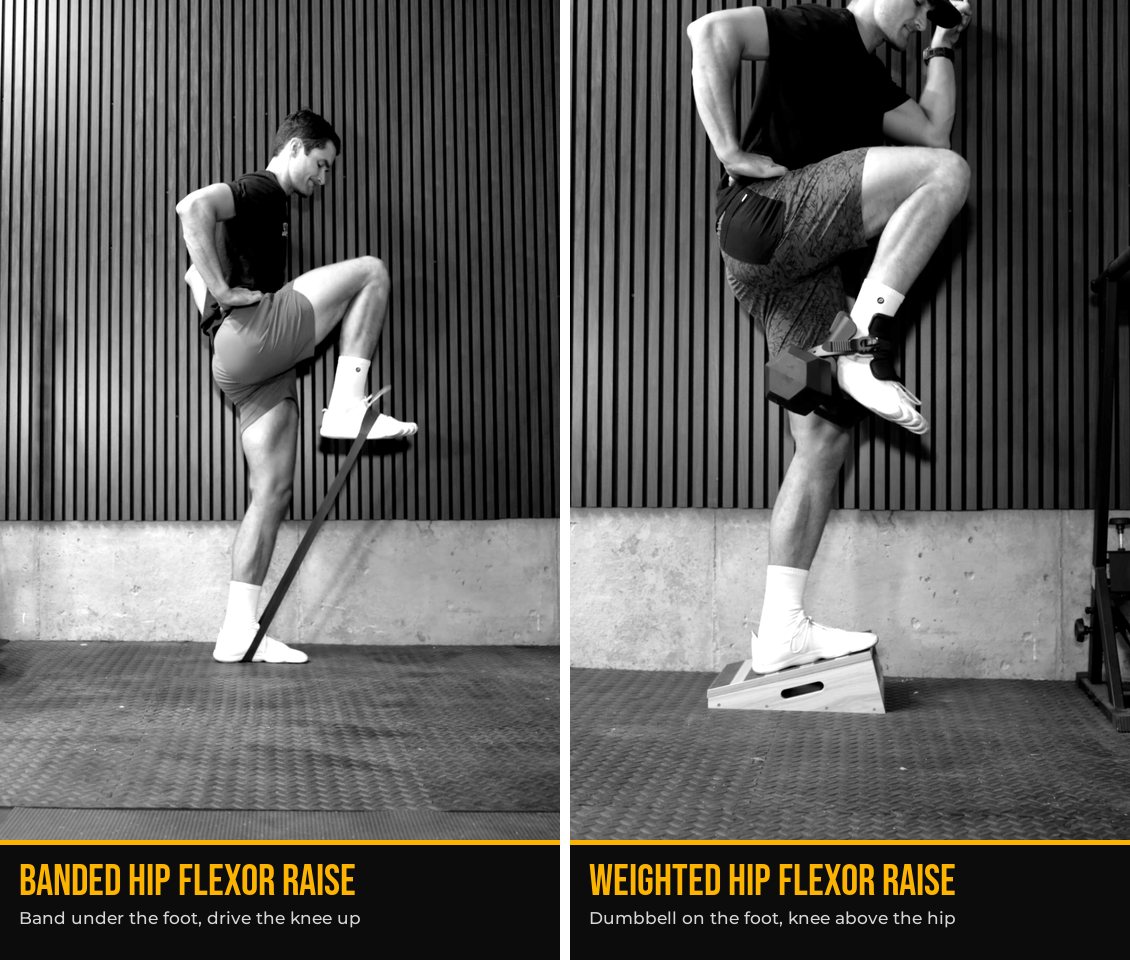
Your hip flexors drive your knee up on every step, stair and stride, and when they're weak the quads and the knee take over that job. They're also the muscles sitting shortens, and the fix for a short, weak muscle is to make it strong through its full range, not just to stretch it. Stand tall, drive one knee up above hip height, and lower it slowly. Start with a band under the foot, then graduate to a dumbbell resting on the foot. The bands I use are from Battle Bunker. They're my go-to for quality and durability.
Banded first, then weighted. Knee above the hip, and slow on the way down.
Start with: 3 sets of 10 per side, slow on the way down. Add the dumbbell when the band version is easy.
4. Hip flexor raise to abduction
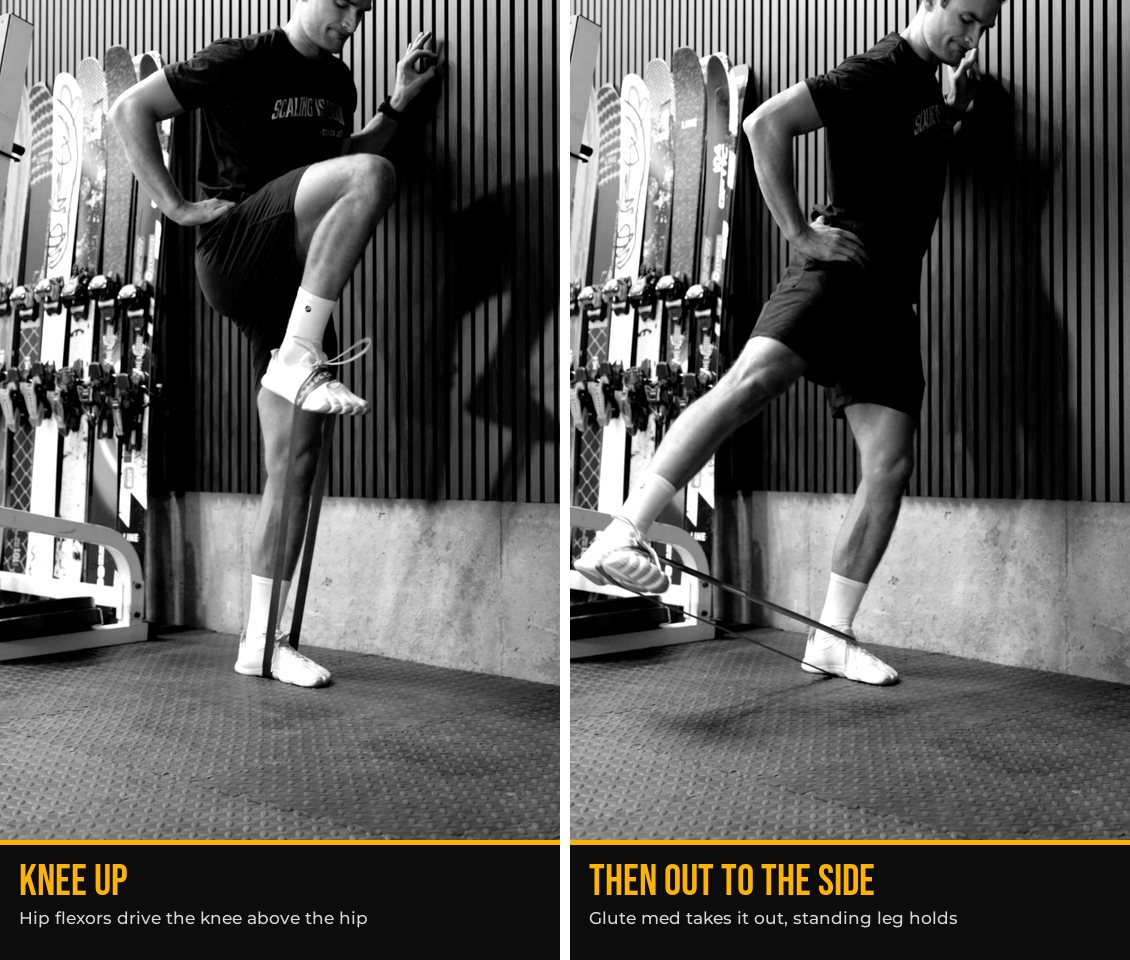
This is three hip jobs in one rep. Mini band around both feet, drive one knee up, take it out to the side, then bring it back and lower it slowly. The hip flexors drive the knee up, the glute med takes it out, and the standing leg has to hold your pelvis level the whole time, which is the part that matters for a knee. Here's the full movement.
Knee up, then out to the side, then back and down. Three hip jobs in one rep while the standing leg holds the pelvis level.
Start with: 3 sets of 8 per side. Slow is the whole point.
5. Standing hip abductions and the side plank with a leg lift
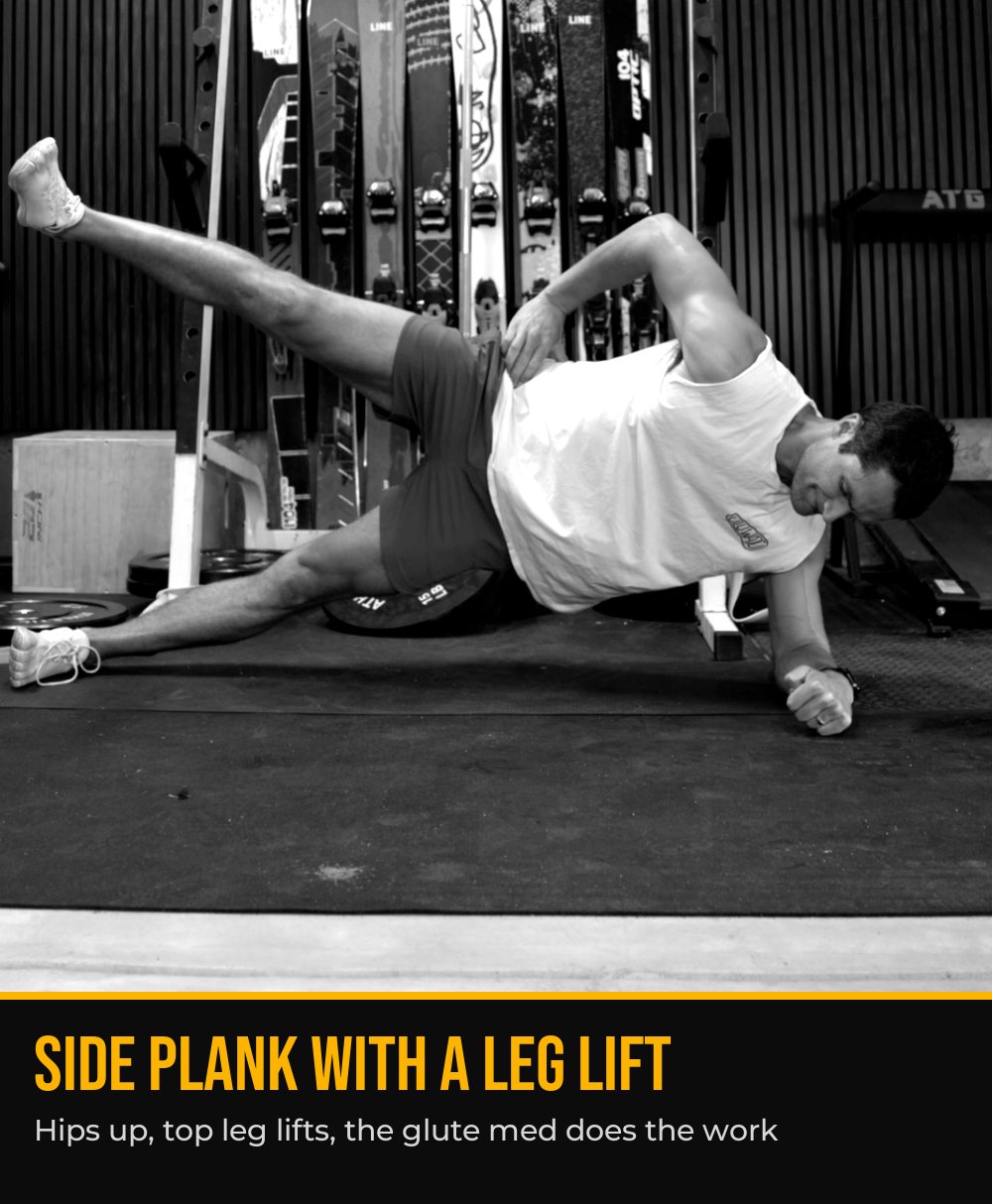
Standing hip abductions: band at the ankles, stand tall, and lift the leg straight out to the side without leaning. It's the same muscle as the side-lying leg lift from PT, but standing is how your hip has to work in real life, with the other leg holding you up. Then the side plank with a leg lift: on your forearm and the side of your foot, hips up, and lift the top leg. The top hip is doing abduction while the bottom hip and your trunk hold everything straight.
Side plank with a leg lift. The top hip abducts while the bottom hip and the trunk hold the line.
Start with: abductions, 3 sets of 15 per side. Side plank, 3 holds of 20 to 30 seconds per side with 8 leg lifts in each hold.
6. Adductors: the wall sit squeeze and the side-lying adductor iso
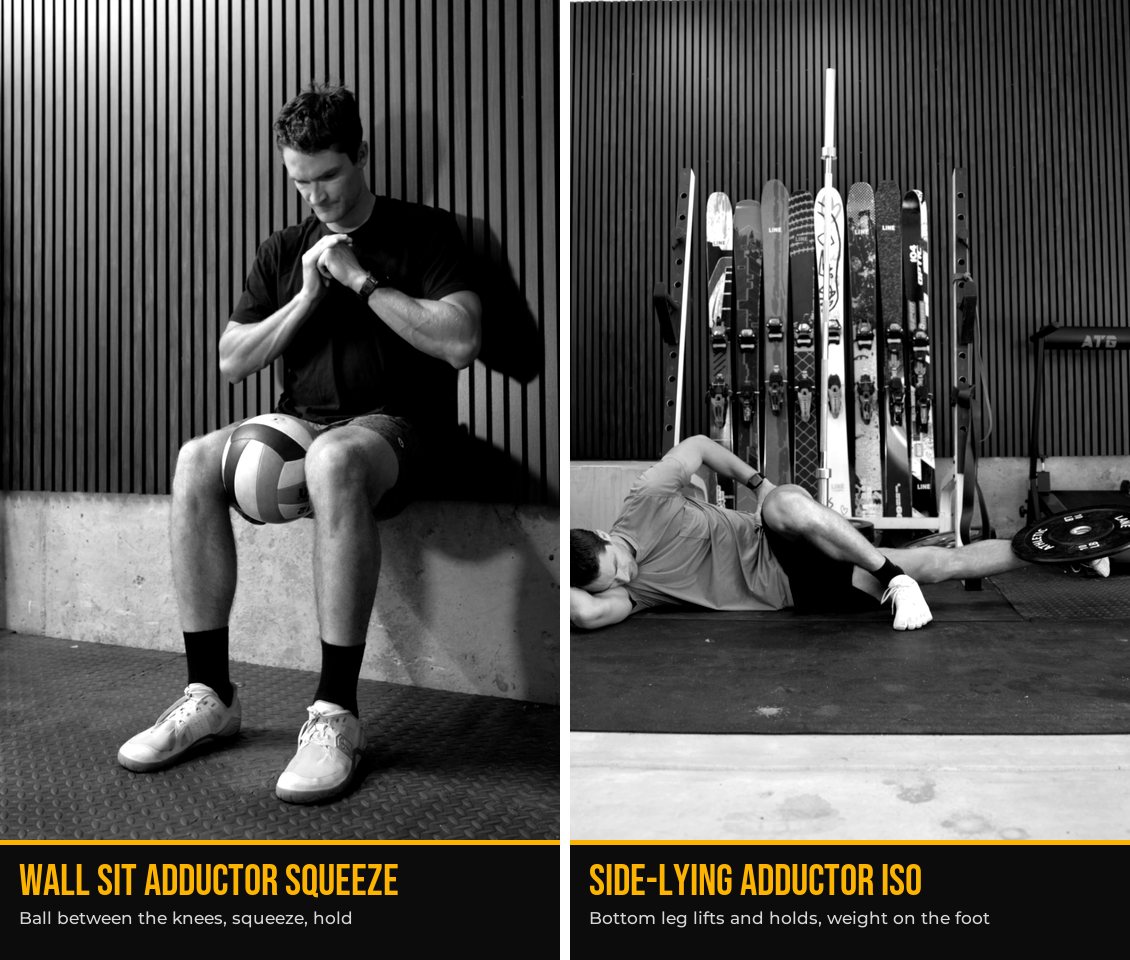
The adductors get stretched a lot and strengthened almost never, and they're half of what keeps your knee tracking straight. Two ways to train them. The wall sit adductor squeeze: back against the wall, thighs level with the floor, a ball between your knees, and squeeze it as hard as you can for the whole hold. And the side-lying adductor iso: lie on your side, cross the top leg over, lift the bottom leg off the floor and hold it there. A small weight resting on the bottom foot is the progression.
Left: the wall sit adductor squeeze. Right: the side-lying adductor iso with a weight on the foot.
Start with: wall sit squeeze, 3 holds of 30 seconds. Side-lying iso, 3 holds of 20 seconds per side.
7. Hip thrusts
Once all of the above is in place, the barbell hip thrust is where the glute max gets properly strong. Upper back on a bench, bar across the hips, drive up until your hips are level with your knees and squeeze at the top. It's the heaviest load your hips will ever move, and the glute max is the biggest muscle steering your thigh.
Start with: 3 sets of 10, a one-second squeeze at the top. Add weight every week it feels smooth.
How I'd put it together
Here's how my programs are laid out, and it's how I'd lay out your week. Day A is quads. Day B is the posterior chain, your hamstrings and glutes. Day C is hips and the accessory work: the hip flexors, the glute med, the adductors, plus a couple of the stretch-strength movements above. The feet, tibialis and calves are sprinkled through all three days as warm-ups, since they don't need a day of their own. So your hips get one day a week that's theirs, and then a little mobility work finds its way into every other session you do, because if you sit behind a desk all day, hip mobility is something you keep up, not something you fix once.
On the hip day, I'd pick two of the mobility movements and two or three of the strength movements. Twenty minutes, done. Same rule as always: pain stays at a 3 out of 10 or less while you're doing it, and your knee is back to normal by the next morning. That's exactly how the hip day in the free Weekly Routine above is written, so if you haven't grabbed it yet, that's the easiest place to start. And if you've got questions about any of it, send me an email.
Where this goes next
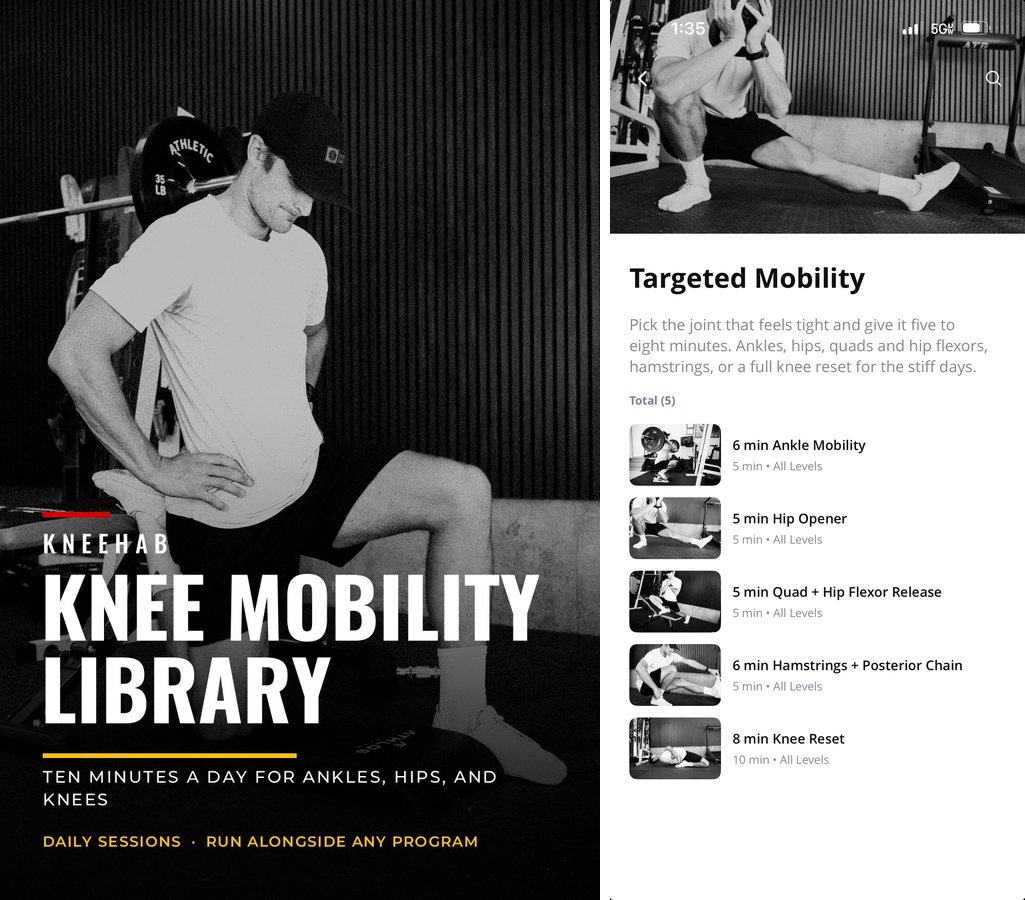
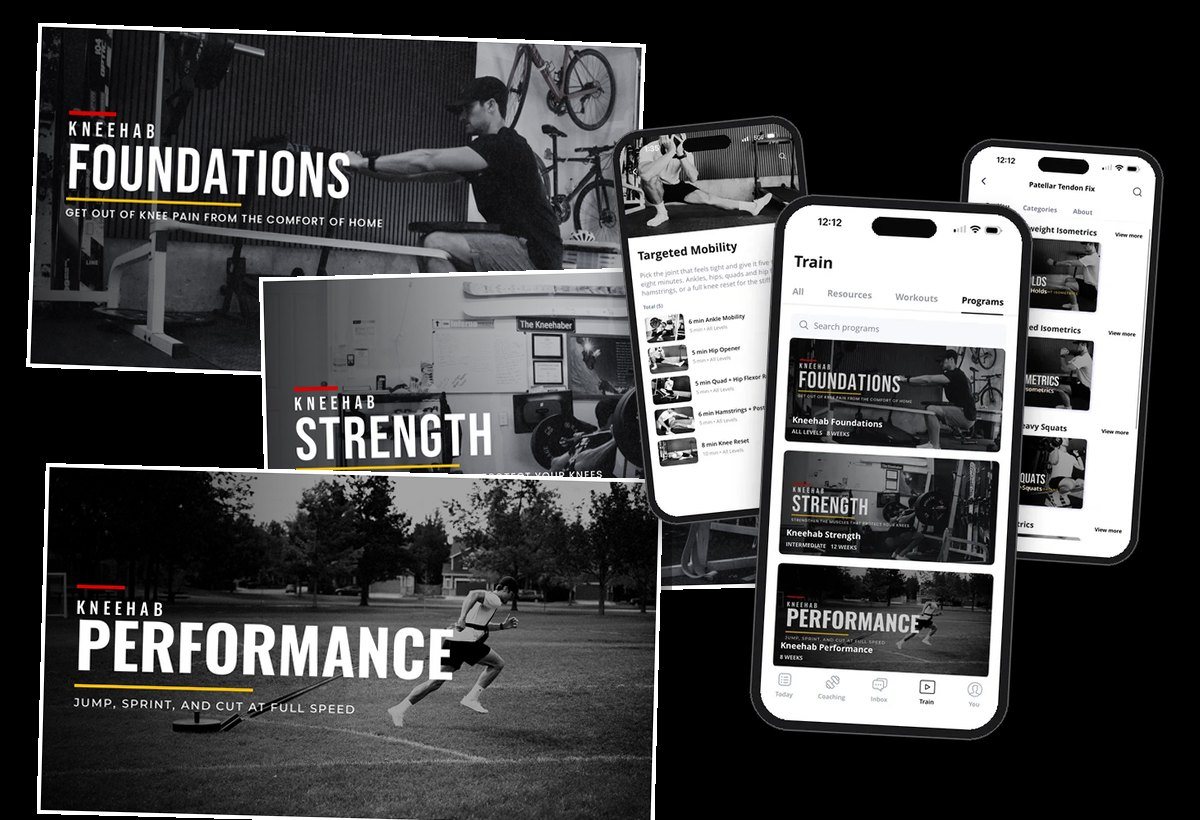
If the exercises in this post are starting to feel easy, or you'd rather have the whole week written out and progressed for you, that's what the Strong Knees System is built for, and two parts of it matter most for hips. The Knee Mobility Library is a set of short follow-along routines, ten minutes or less, with a hip opener, a quad and hip flexor release, and a full knee reset for the stiff days. You run them alongside whatever program you're on, which is the "mobility in every session" piece from above, done for you. And the strength programs have the hip day built in: the Day C work above, with the loads progressed week by week, so the range you open up in the library gets turned into strength in the program. Mobile and strong, in one app, with every exercise on video.
The Knee Mobility Library inside the Strong Knees System: five short routines you run alongside any program.The programs inside the Strong Knees System. Each one has a hip day in it.
Usually because the hip isn't steering it. The glute med and the deep rotators are supposed to hold your thigh stacked over your foot, and when they're weak, slow or tired, the thigh rotates in and the knee follows. Sometimes the ankle is part of it too: if your ankle can't bend forward, the knee goes looking for range somewhere else. Film yourself on a single-leg squat and a landing, train the hip exercises above alongside knees over toes work, and watch it change over a few months.
Can tight hip flexors cause knee pain?
They can be part of it. Short hip flexors from sitting tilt the pelvis forward, change how your thigh sits in the socket, and leave the knee to make up range the hip doesn't have. That's not the whole story for every knee, and I'm a strength coach, not a doctor, so if the pain is new or sharp, get it looked at. But in my experience, when the hips start moving and get strong, a lot of knees quiet down.
Should I stretch my hips or strengthen them?
Both, and ideally in the same movement. Stretching alone gives you flexibility you can't control. Strengthening alone makes you overly stiff. Start each exercise as a stretch, and once it feels easy, add weight and hold the position. That's the whole method.
How often should I train my hips?
One day a week that's theirs, plus a few minutes of mobility work in every other session. Two mobility movements and two or three strength movements, about twenty minutes, is what the hip day in my free Weekly Routine looks like.