The Pain Behind Your Kneecap: Runner's Knee, Chondromalacia and What's Actually Hurting
Connor Clayton · The Kneehaber ·
This post is about the vague, hard-to-pin ache around and behind the kneecap. Doctors call it patellofemoral pain, runners call it runner's knee, and if you've had a scan you may have been handed the word chondromalacia, which is a fancy way of saying the cartilage on the back of your kneecap looks soft or rough. It's one of the most common knee problems out there, so I want to walk through where it hurts, what's going on in there, what the research says about scans and training, and the plan I'd start with, sets and reps included. I hope it helps!
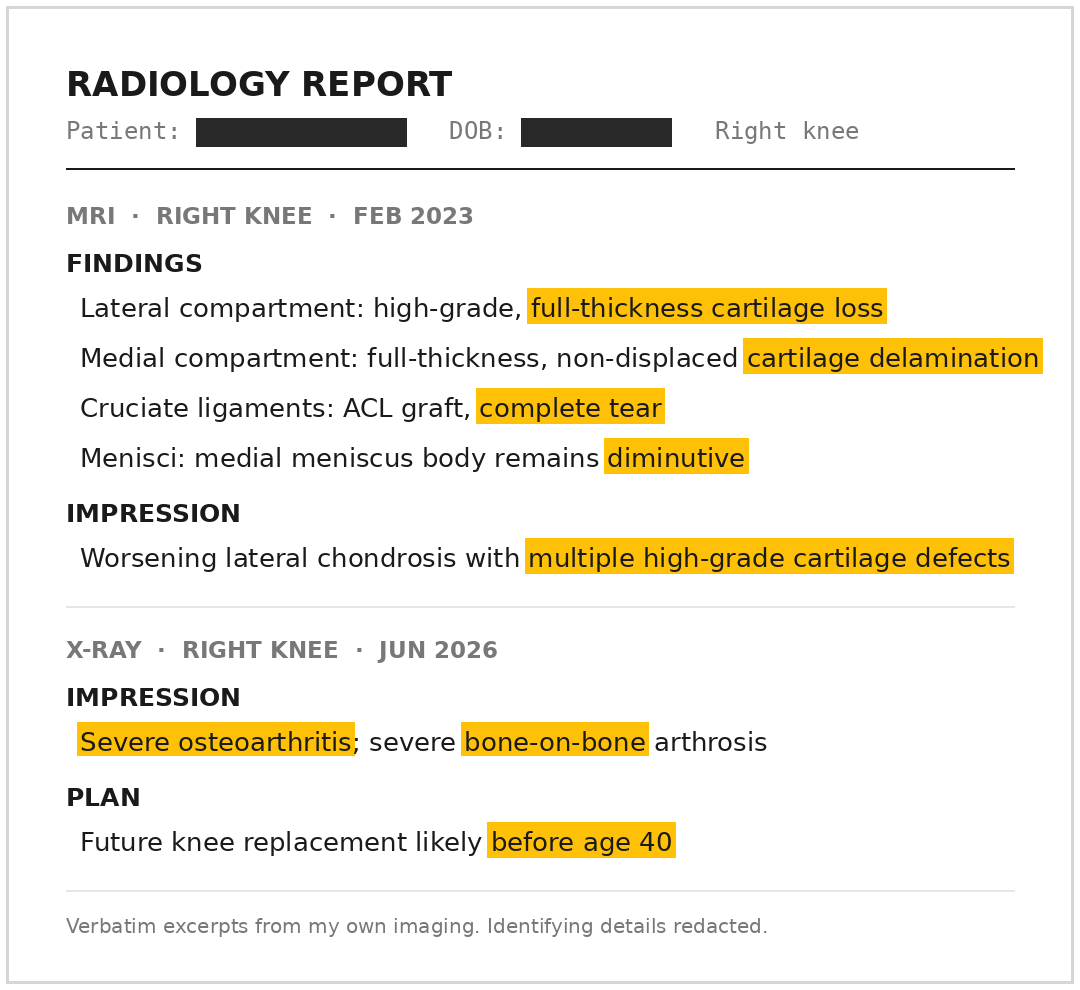
I also have some skin in this game. On paper my right knee is a mess: no ACL after four tears in eight years, barely any meniscus left, a 2023 MRI that reads "full-thickness cartilage loss," and an X-ray this year that says severe bone-on-bone arthritis.
My right knee on paper, straight off my own imaging reports.
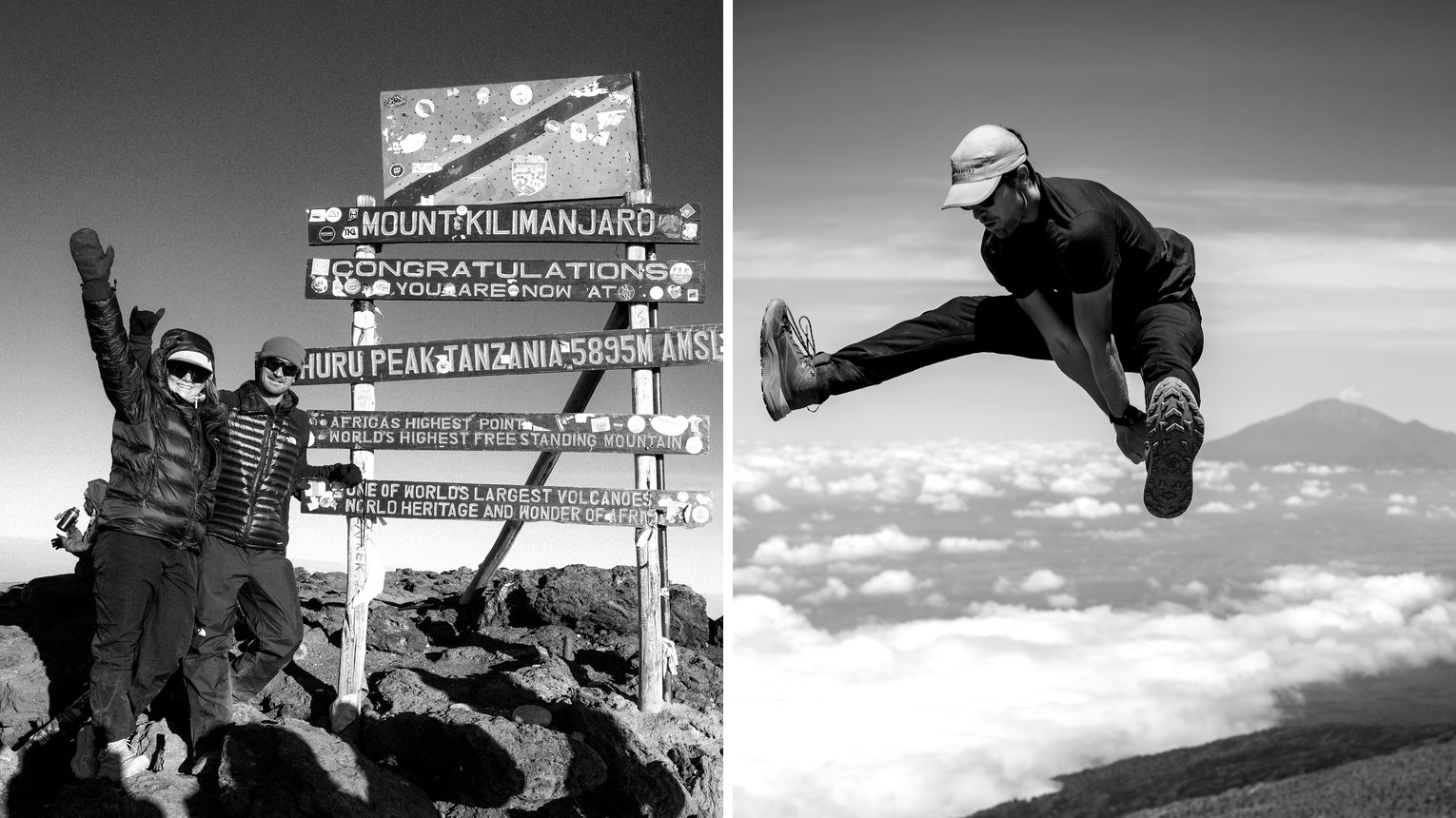
That same knee summited Kilimanjaro this September. I'm not telling you that to brag (okay, maybe a little). I'm telling you because what a scan says about your cartilage and what your knee can actually do are two very different things, and that's what this whole article is about.
At the top of Kilimanjaro with Rachel this September, and a goofy jump on the mountain. Same knee as the report above.
Quick note: I'm a strength coach, not a doctor. Nothing here is a diagnosis, and there's a section near the bottom on when to get your knee looked at.
Where it hurts and what sets it off
Ask someone with jumper's knee where it hurts and they point with one finger at the bottom tip of the kneecap. Ask someone with runner's knee and they usually cup a hand over the whole front of the knee and say "in there somewhere." It's an ache around or behind the kneecap rather than a sharp point. It comes on when your quads are working under more load than your knee can handle right now, and for a lot of people that means going down stairs, deep squats and lunges, running downhill, and kneeling. The other classic sign is pain after sitting with the knee bent for a long time, like a movie or a flight (some physios call it the theater sign). A grinding or crunching noise under the kneecap often comes with it, and I'll get to why the noise isn't the scary part.
That description is pretty much how the researchers define it too. The 2016 consensus statement from the people who study this for a living calls it pain around or behind the kneecap, brought on by activities that load the kneecap joint with the knee bent, like squatting, stairs and running. If your pain is a single sore spot right below the kneecap, that's more likely the tendon, and I wrote about that one in my patellar tendonitis article.
What's actually going on behind the kneecap
Let's name the parts, because the fix makes a lot more sense once you can picture it. Your kneecap (the patella) is a small bone that sits in a shallow groove at the end of your thigh bone. Your quads attach to the top of it, and a tendon runs from the bottom of it down to your shin. Its job is to work like a pulley, so your quads get better leverage to straighten the knee. Every time you bend your knee under load, the back of the kneecap gets pressed into that groove, and the deeper you bend, the harder it presses. That's why stairs, the bottom of a squat and running downhill are the things that hurt.
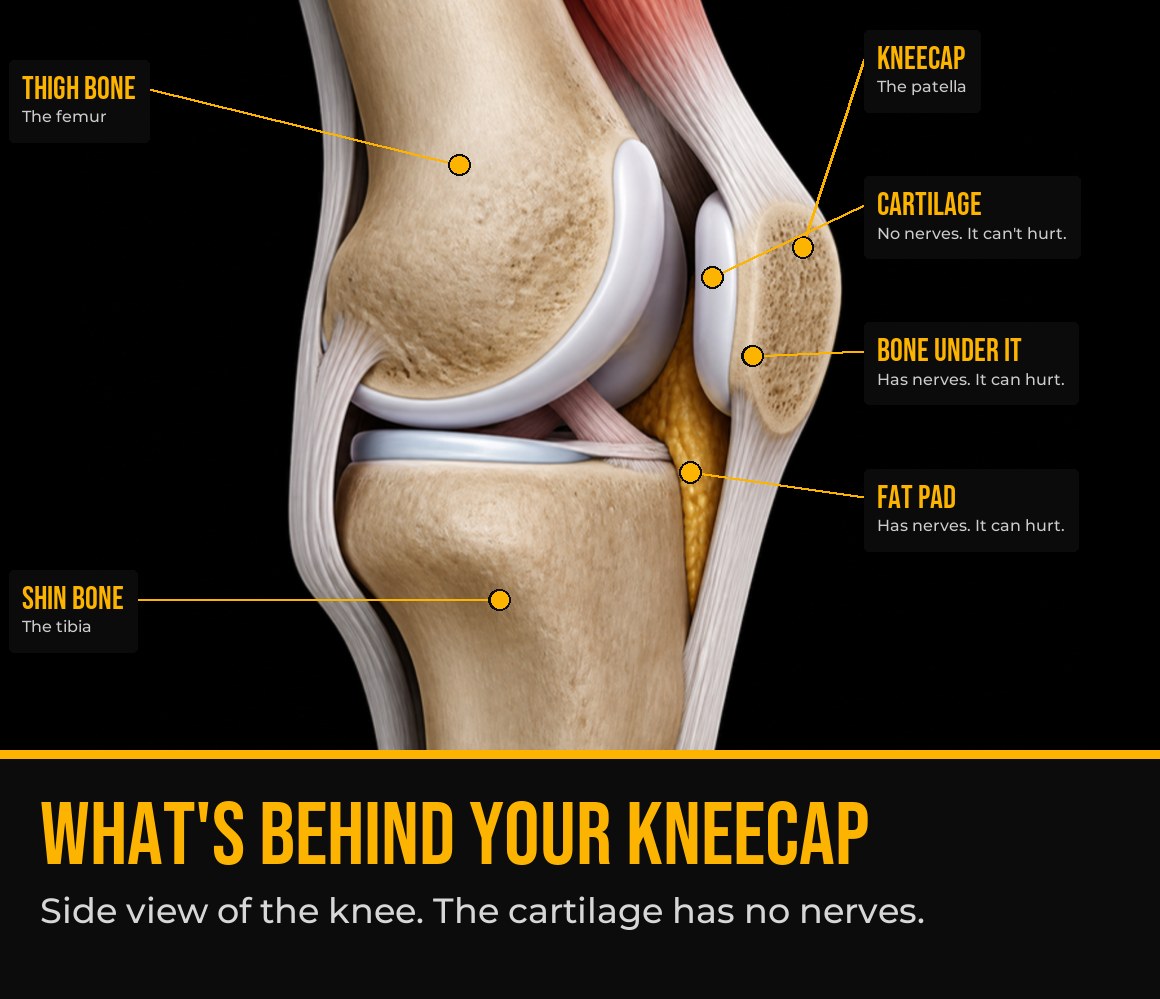
A side view of the knee. The white layer on the back of the kneecap is the cartilage, and it has no nerves. The bone under it and the fat pad below it do.
The back of the kneecap and the groove it sits in are both coated in cartilage, the smooth stuff that lets the two bones glide over each other. Under the cartilage is bone. Just below the kneecap, tucked in behind the tendon, sits a small pad of fat, and the whole joint is wrapped in a thin lining that makes the fluid your knee runs on. Keep those four in mind: cartilage, bone, fat pad and lining. Only some of them can hurt.
The cartilage has no nerves
Cartilage has no nerve supply and no blood supply. We know that from anatomy, and we also know it from one of the gutsiest experiments in sports medicine. In 1998 an orthopedic surgeon named Scott Dye had his own knee scoped without anesthesia and reported what he felt as a colleague probed each structure inside it. Probing the cartilage on the back of his kneecap produced no sensation at all. The fat pad and the joint lining were a different story. Those were the parts that hurt, and he could point to exactly where.
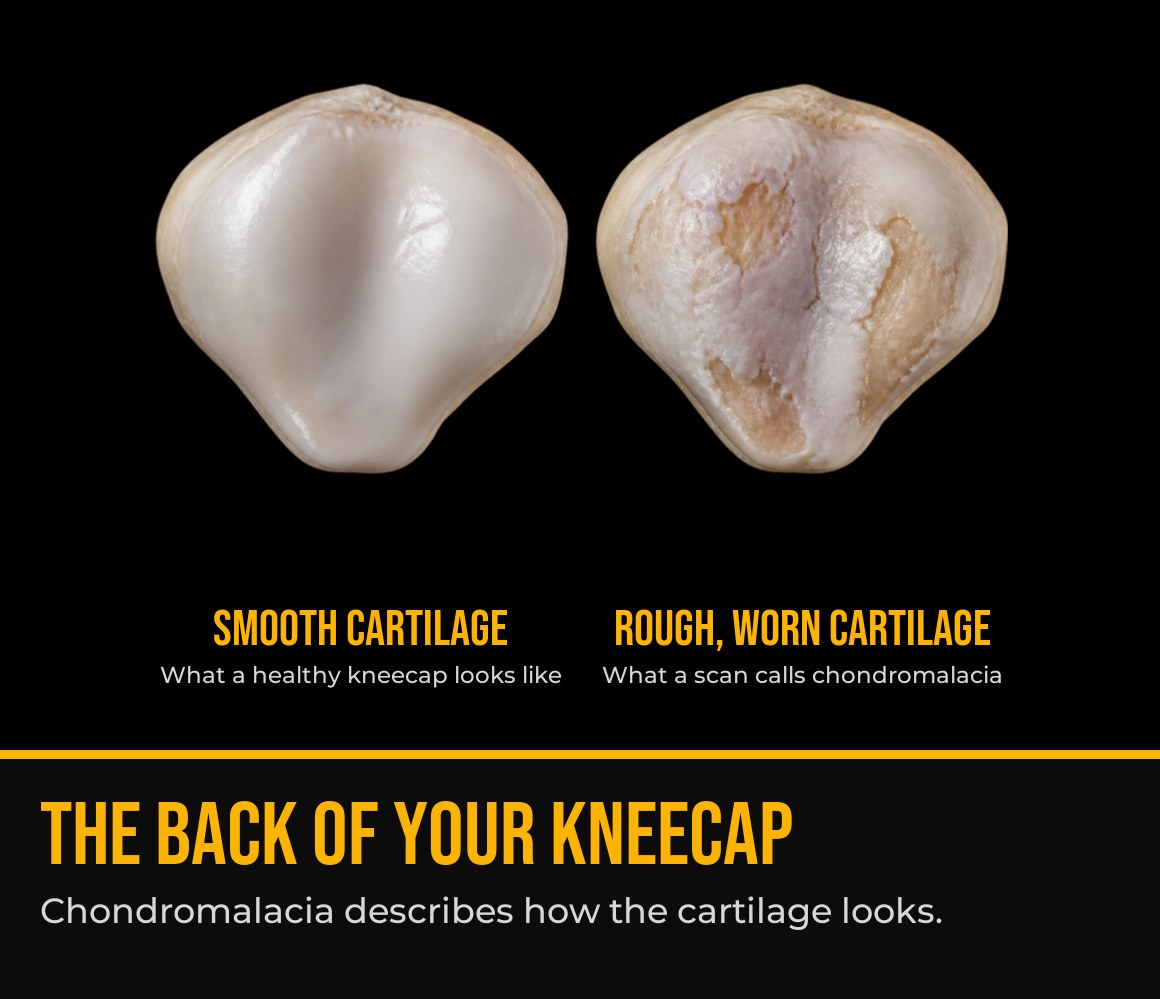
Chondromalacia is the word for cartilage that looks like the one on the right. It describes the surface. It doesn't say anything about pain.
So when a scan says your cartilage is "softened" or "fraying," that tells you what the cartilage looks like. It doesn't tell you where your pain is coming from. The pain comes from the parts that do have nerves: the bone under the cartilage, the fat pad and the joint lining, and all of them get irritated when the kneecap takes more load than it's ready for. Dye went on to lay out the way of thinking I find most useful here: a joint doesn't have to be damaged to hurt. It just has to be loaded past what it can keep up with.
Why the scan doesn't explain your pain
If cartilage changes caused pain on their own, every knee with rough cartilage would hurt. They don't, not even close. In a 2020 study, researchers put 115 adults with zero knee pain through a high-powered MRI, and 97 percent of the knees had something a radiologist would flag as abnormal. A big review of pain-free, uninjured adults found cartilage defects in roughly one in four of them, and the older the group, the higher that number climbed. Your scan is a photo of what your knee looks like. It can't measure what your knee can do, and it's a surprisingly bad predictor of how much it hurts. I went deeper on this in another article of mine, You Are Not Your MRI, where I walk through my own reports.
I'm not saying cartilage doesn't matter. Mine matters, and I'd like to keep what's left! But the cartilage story leads a lot of people to a dead end: if it's "damaged" and can't heal, the knee is done, and the best you can do is avoid using it. The research says something more encouraging. Cartilage has no blood supply, so it gets its nutrients like a sponge: it soaks them up from the joint fluid every time it's squeezed and released. In a Swedish study, people at high risk of knee arthritis, every one of them missing part of a meniscus, did four months of moderate exercise, and the quality of their knee cartilage improved on MRI compared with the group that didn't train. And a 2019 review of every trial it could find concluded that knee exercise doesn't harm cartilage in people with or at risk of arthritis, and may well help it. In the right dose, loading your knee is good for the cartilage.
Your knee needs to adapt to load better
So if the cartilage isn't what hurts, what happened? Dye's answer is that every joint has a certain amount of load it can handle without complaining. He calls it the envelope of function. Stay inside it, and the bone and the soft tissue around the kneecap do their work, recover overnight, and you never think about them. Go past it, with a sudden jump in running miles, a hilly race block, a new sport, a lot of deep squats after a winter off, or even a stretch of bad sleep and stress, and those parts can't keep up with the repair. The bone under the cartilage gets sore, the lining gets irritated, and the knee starts hurting on stairs. Nothing tore and nothing broke. You asked your knee for more than it was ready for.
Then comes the frustrating part. A sore knee makes you move less and avoid the deep bend, so your quads and hips get weaker, so the knee can handle even less, so more things hurt. Rest on its own doesn't fix that, because rest doesn't make the knee any stronger. The way out is to train at a level your knee is comfortable with and add a little every week, so it adapts. Focus on getting 1% better each week. A study that followed people with this pain for a year found the longer people had lived with it before starting treatment, the worse they did, so start now, not after another season.
For the runners: why your hips matter for knee tracking
This section is especially for those of you racking up the miles and dealing with runner's knee, because hip strength is a big part of keeping your kneecap tracking the way it should while you run.
The explanation you've probably heard is that your kneecap doesn't track right: it slides off to the outside of its groove and grinds on the edge. The usual fix is a strap, some tape, foam rolling the outside of your thigh, and a drill to "strengthen the VMO" so the inside of the quad pulls the kneecap back into line.
The imaging work from Chris Powers' lab adds an important piece. They put people in an MRI scanner while standing on one leg, which is a lot closer to what your knee does on every stride than lying on a table, and compared women with kneecap pain to women without it. The kneecap did sit further to the outside in the painful group. But when they looked at why, it wasn't the kneecap sliding off the thigh bone. It was the thigh bone rotating inward underneath the kneecap, because the hip wasn't holding it steady. So a lot of what looks like a kneecap problem is really the hip not doing its job.
On every stride the hip has to hold the thigh bone steady under the kneecap.
Weak hips show up alongside kneecap pain again and again. The interesting twist from a 2014 review is that when researchers tested people before they got hurt, weak hips didn't predict who would end up with it. So the hip weakness is probably more a result of the pain than the cause, which is good news, because you can train it back. And training it works. One review found that adding hip work to knee work beat knee work alone for pain, both in the short term and a year later, and another came to the same conclusion for pain and function. The 2018 consensus on treatment puts exercise at the core of the fix, specifically a mix of hip and knee exercises, and the Cochrane review, which is about as cautious as reviews get, found that exercise reduces pain and improves function compared with doing nothing. Your hips steer your knees. I wrote a whole article on hip strength and mobility for knee pain if you want the long version.
One more for the runners. A 2014 study found that shortening your stride so you take about 10 percent more steps per minute cut the peak force through the kneecap joint by 14 percent. Same pace, less pounding, and it costs nothing to try.
Grab the free Foundations guide first
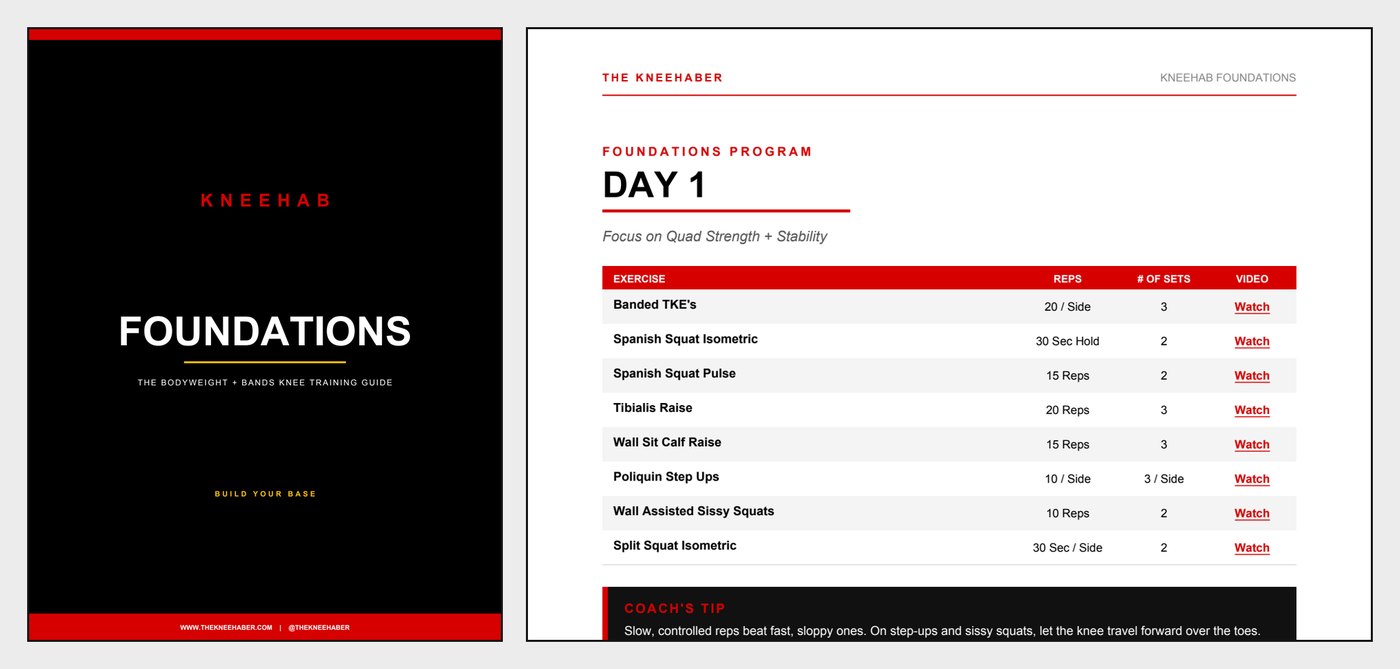
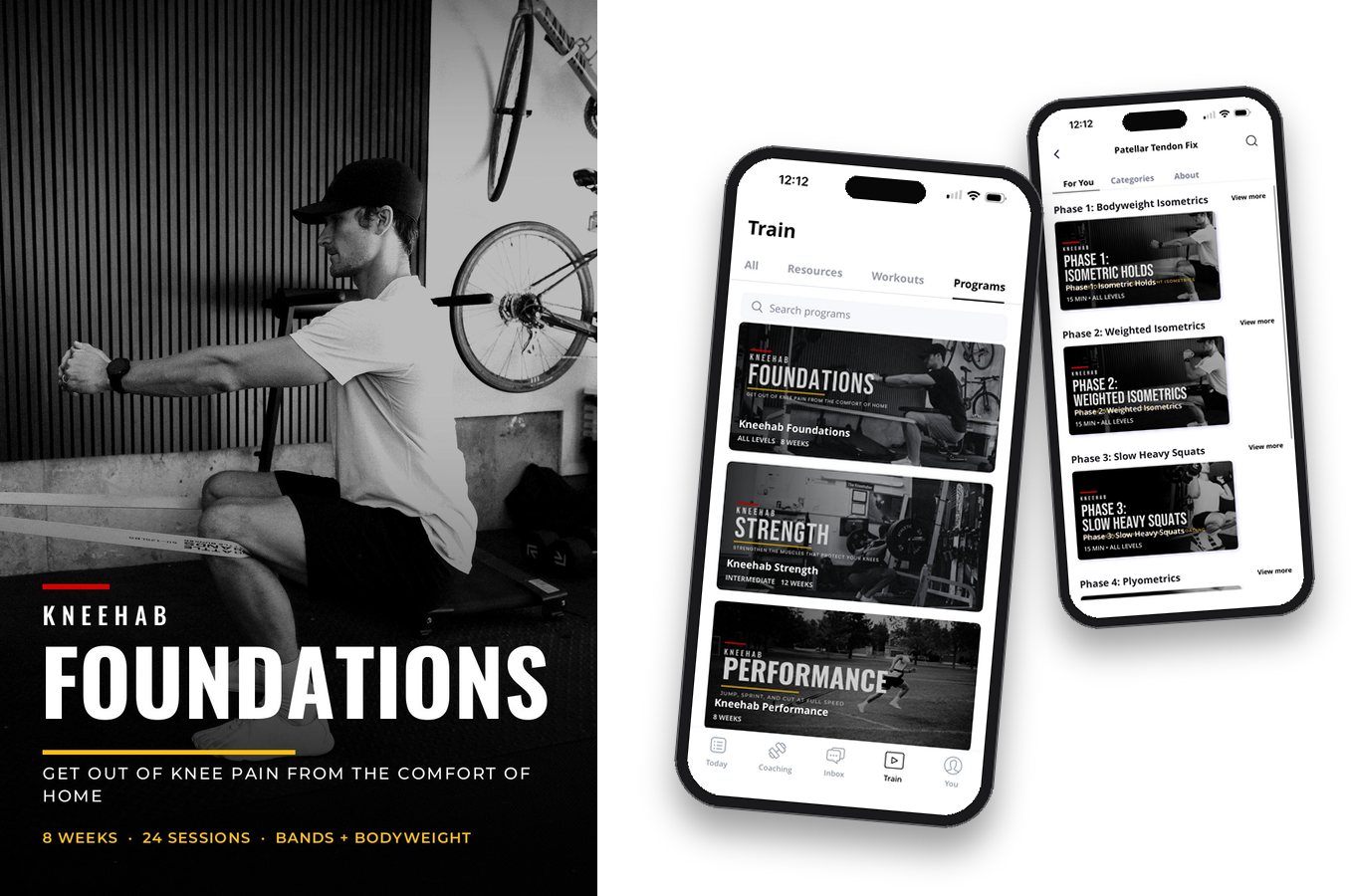
Everything in the plan below comes from my free Foundations guide: eight weeks, three days a week, nothing but bands, a slant board and your bodyweight, with sets and reps for every exercise and a video of me doing each one. Day 1 is quads, Day 2 is hamstrings and the back of the leg, and Day 3 is hips, which is exactly the mix the research above points at. Not everyone makes it to the bottom of a long article, so grab it now and read the rest with it open.
One heads-up if you've been told you have chondromalacia. A couple of the exercises in the guide take the knee into a deep bend (the wall assisted sissy squats on Day 1 are the main one). With a sore kneecap you want to work at shallower knee angles to start, so only go as deep as you can while the pain stays at a 4 out of 10 or less, and save the deep range for later. I'll show you the order I'd do it in below.
Free download
The Kneehab Foundations Guide
The plan from this article as an eight-week program: three days a week, nothing but bands, a slant board and your bodyweight, with a quad day, a hamstring day and a hip day. Every exercise has sets, reps and a video of me doing it, so you can start at shallow knee angles tonight and go deeper as your knee allows.
The PDF lands in your inbox in about a minute. You'll also get my weekly knee-training email, and you can unsubscribe anytime.
Three stages. The first calms the knee down while you keep training, the second builds the strength, and the third brings the deep bend and the downhill back on purpose. Pain decides when you move on. The rule in the Foundations guide is to keep pain at a 4 out of 10 or less during an exercise, and the next morning is the judge: if the knee feels the same or better the next day, the dose was right. If it's worse, back off the range of motion or the weight and go from there.
Stage 1: calm it down and keep training
The instinct is to stop everything. I'd recommend trimming instead of stopping. Take the stairs a little slower, cut the deep squats and the hill repeats for a couple of weeks, and keep everything else. Then train your quads at shallow knee angles. In one lab study, squats put the most stress on the kneecap joint in the deeper half of the bend and the least in the top 45 degrees, so a shallow bend lets you get real quad work in while the sore parts settle down.
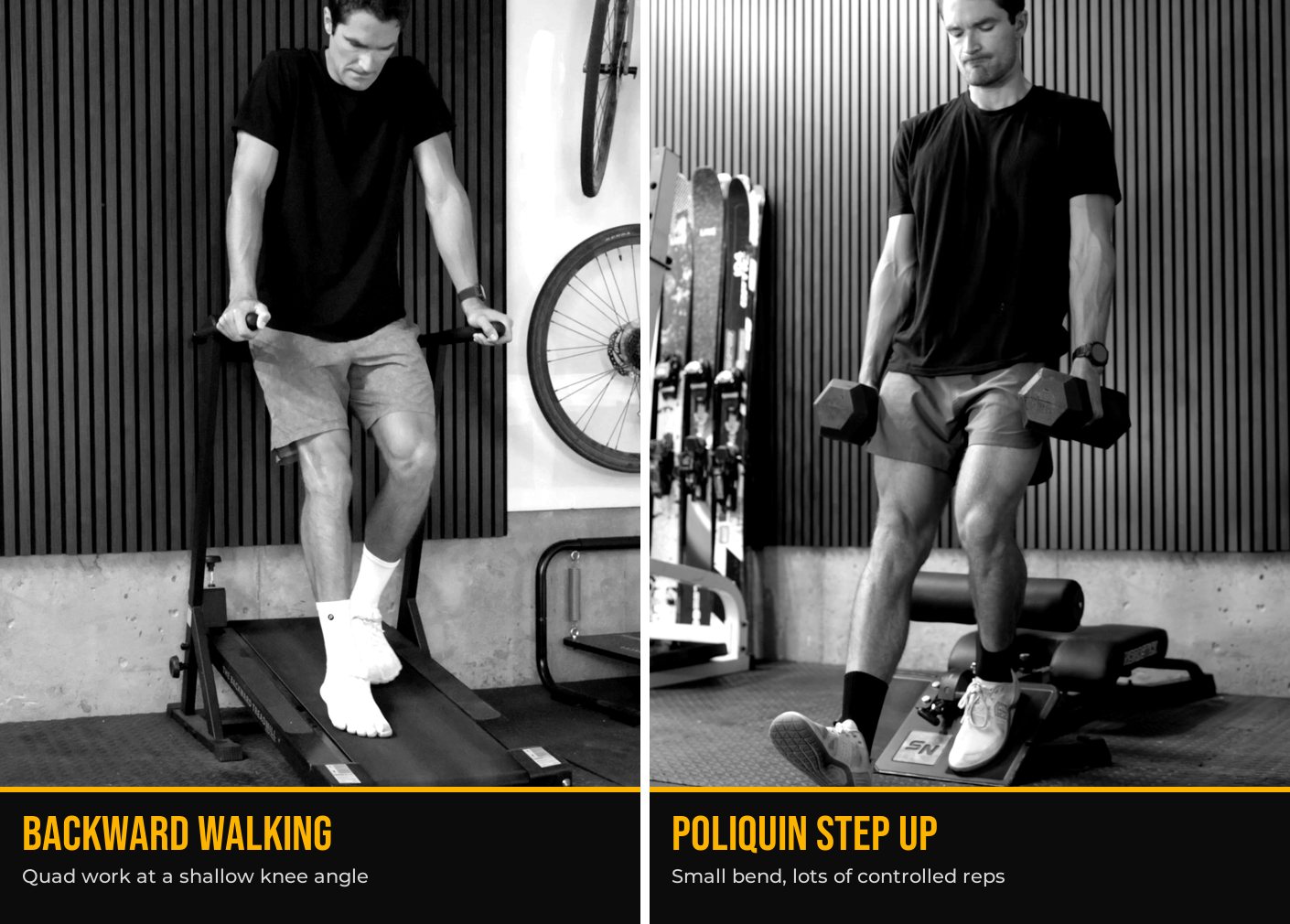
There are two exercises I'd highlight for this: backward walking and the Poliquin step up. Both work the quads at a shallow knee angle, and both are lots of small, repeated reps. That repeated squeeze and release is how joint fluid gets moved through the knee, which is how cartilage gets its nutrients, since it has no blood supply of its own. They also work the VMO, the teardrop muscle on the inside of the knee that helps keep the kneecap tracking well. I covered that one in my quads article.
Backward walking and the Poliquin step up: quad work at shallow knee angles, in lots of controlled reps.
Backward walking, or backward sled drags. Start with: 3 to 5 minutes before every session. No sled? A treadmill that's turned off works great, or walk backward up a gentle hill.
Banded TKEs. Start with: 3 sets of 20 per side. The quad straightens the knee against the band, and nothing bends past a comfortable angle.
Spanish squat hold. Start with: 2 holds of 30 seconds, at an angle where the knee feels worked but not irritated. Deeper is harder, so start high and go deeper as it gets easier.
Wall sit. Start with: 2 holds of 30 to 45 seconds at a comfortable angle. Holds also tend to calm pain down, which I covered in my flare-ups article.
Poliquin step ups. Start with: 3 sets of 10 per side with just your bodyweight, heel raised on a wedge or slant board, letting the knee travel out over the toes.
Tibialis raises. Start with: 3 sets of 20. The muscle on the front of your shin helps you brake on every downhill step.
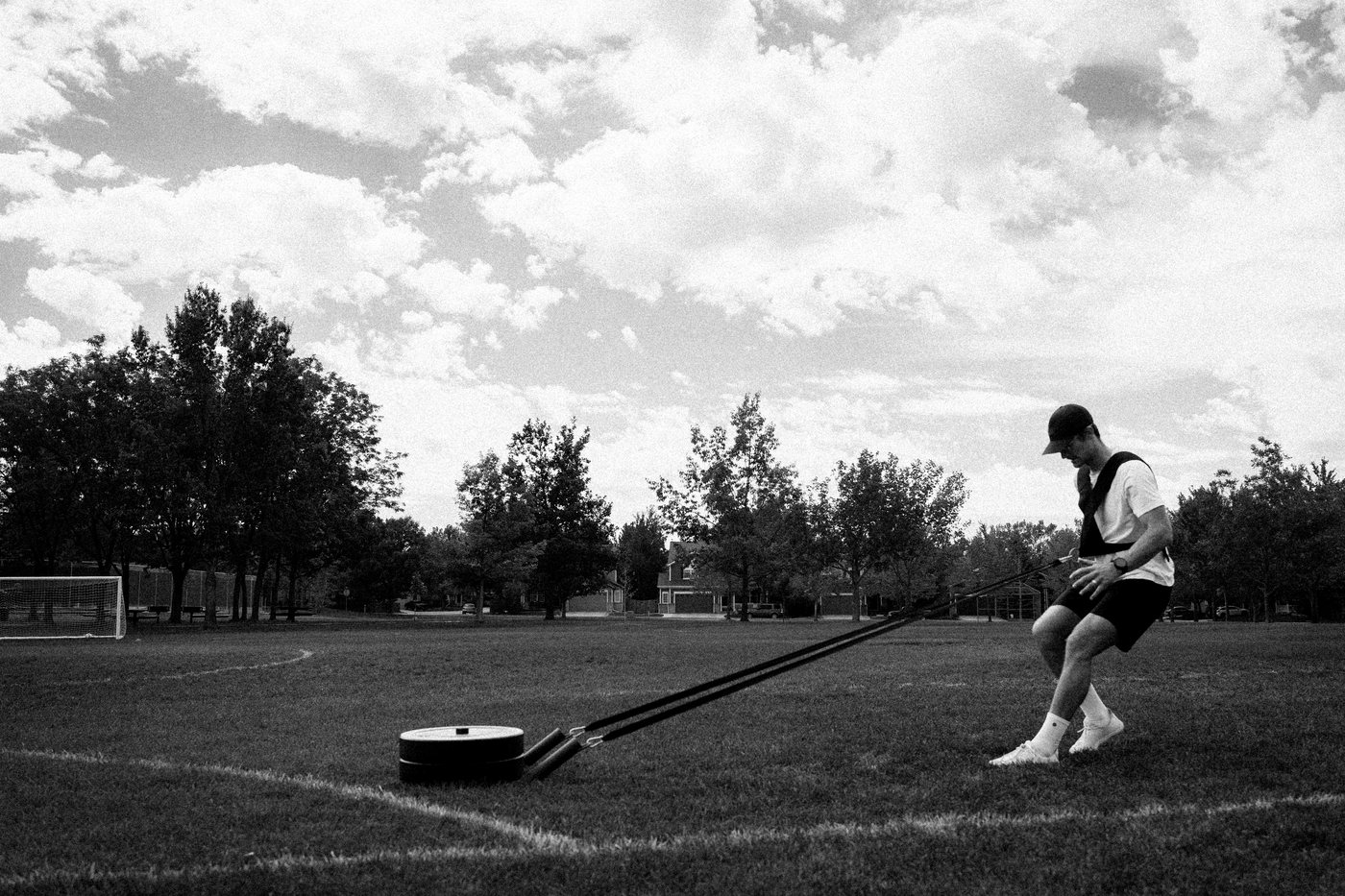
Backward sled drags: the heavier version of backward walking, still at a shallow knee angle.
Stage 2: build the quads and the hips
Once the knee is calmer on stairs, start building strength. This is Day 1 and Day 3 of the Foundations guide, with one change for a sore kneecap: go a little shallower on everything for the first couple of weeks and add range as the knee allows. Two quad sessions and one hip session a week is a great start. Keep the backward walking, TKEs and Poliquin step ups from Stage 1 and add these.
Standing hip abductions. Start with: 3 sets of 10 per side. This is the muscle on the side of your hip that keeps the thigh bone from rolling inward under the kneecap, which is exactly what the standing MRI study caught happening.
The guide has a few more hip exercises on top of these. Give this stage at least six to eight weeks. Pain usually settles well before the strength shows up, and the strength is what keeps the pain from coming back. Remember, restraint is the hardest trick in the book.
Stage 3: bring the deep bend back
This is the stage that gets skipped, and it's a big reason the pain comes back the first week of ski season. If you only ever train the shallow range, the deep range never gets any stronger. Once the stairs feel fine and Stage 2 is feeling strong, go back to the deep squat, the lunge and the downhill on purpose, under control, so your knee gets used to a full bend under load again. This is where knees over toes training comes in, and I wrote about why it's the opposite of what you've been told.
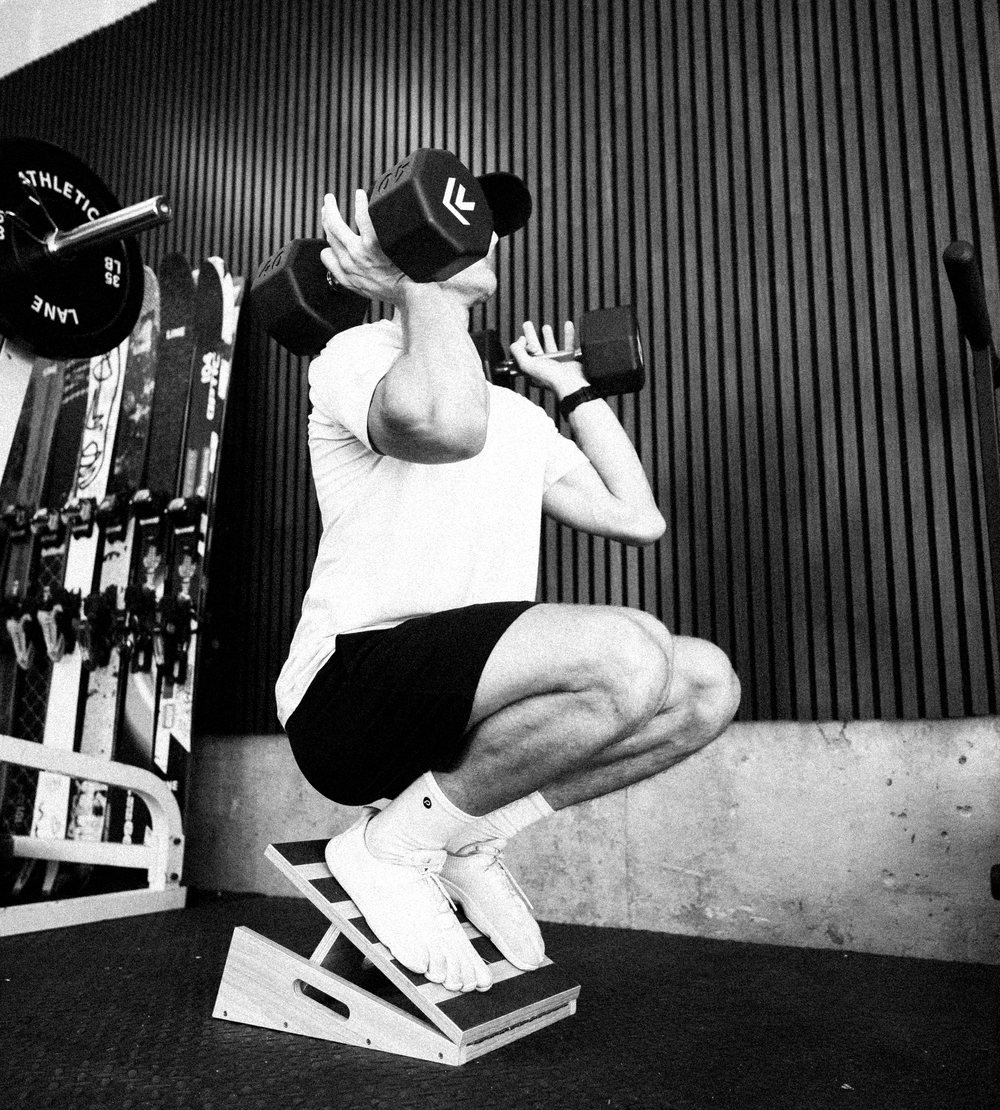
A deep slant board squat. This is where Stage 3 is headed, a little deeper each week.
Slant board squats. Start with: 3 sets of 10, slow on the way down, going a little deeper each week. This is also when the guide's wall assisted sissy squats come back in.
Step downs. Start with: 3 sets of 6 to 8 per side off a low box, slow. This is the going-down-stairs movement, practiced under control.
Skater hops. Start with: 3 sets of 8 hops per side, landing soft and quiet.
Runners, this is where you add the hills back, one short one at a time. Skiers, this is where the wall sit gets a plate on your lap. The last step is doing the thing you were worried about, under control, and finding out your knee can handle it. Patience is key.
When to get it looked at
Again, I'm a strength coach, not a doctor, and a few things here aren't a program problem. If your knee locks or catches so you can't straighten it, if it swells up, goes hot or red, if the kneecap has slid out of place or the knee gives way, if it hurts at night or at rest regardless of what you did that day, or if you're a teenager with a limp, get it looked at before you start any of this. The same goes if you've done eight to twelve honest weeks of the plan and nothing has changed. A grinding noise on its own, without pain or swelling, isn't on that list. Noisy knees are common, and the noise on its own isn't what's hurting you.
A few questions I get about kneecap pain
Is chondromalacia the same as arthritis?
Not quite. Chondromalacia describes the cartilage on the back of the kneecap looking soft or worn. Arthritis is a bigger picture of the whole joint changing over time. My own reports say severe arthritis and full-thickness cartilage loss, and that knee still skis, lifts, runs and hikes. Both respond to the same things: strong quads, strong hips, and a knee that has been built up gradually to handle a full bend under load.
Should I stop running or squatting?
I'd trim rather than stop. Shorter runs on flat ground with a quicker stride, shallower squats with a slow tempo, and backward walking to warm up. Then add the depth and the hills back a little at a time as the next-morning test allows. Staying active at a level your knee can handle works better than stopping completely.
Where to go from here
Start Stage 1 tonight. Walk backward for five minutes, do a couple of shallow holds, and notice how the knee feels in the morning. The free guide has the whole eight weeks mapped out, and it's where I'd start.
If you'd rather have it built out for you session by session, that's exactly what the Strong Knees System is. Foundations is the first program in it, and it's a good fit for this knee: eight weeks of bands, holds and backward walking to build up what your knee can handle. After that comes Strength, then Performance. That's six programs and over 40 weeks of training that start with bands and finish with jumping and sprinting, with every exercise on video so you never have to guess.
Foundations inside the Strong Knees System app: the eight weeks from the free guide, built out session by session, with Strength and Performance waiting after it.
Every exercise with a video of me doing it, plus the sets, reps and hold times, so "shallow" and "slow" are never a guess.
Foundations first, then Strength, then Performance, so when the kneecap settles down you keep building instead of starting over.
The Knee Mobility Library alongside it for the stiff mornings and the long sits.
Thanks for reading all the way down here. If you have a question about your knee, send me an email at [email protected] and I'll do my best to help. Keep showing up, keep loading it, and remember: you can't lose if you don't quit.