Knee Flare-Ups: Why Isometrics Are the Best Thing You Can Do to Calm the Pain Down
Connor Clayton · The Kneehaber ·
Let's talk about flare-ups, because they're going to happen. A knee that's getting stronger still has weeks where it gets cranky, and what you do in those few days decides whether it's a blip or a month off.
A flare-up usually just means you loaded the knee past what it was ready for that week. Annoying, but useful information. Maybe you added too much weight to a knees over toes movement too quickly. Maybe a hike had more downhill than you planned for, or you sat through a six-hour flight with the knee bent the whole time. The joint went past the line it could handle that day, and now the alarm is going off.
So this post is about what a flare-up actually is, why isometrics are the best thing you can do to calm one down, the holds I reach for, and why the ice pack is rarely the answer. I hope it helps!
Quick note: one of the links in this post is an affiliate link. If you buy something through it, it costs you nothing extra and it helps keep this website alive.
Hurt isn't the same as harm
Pain is an alarm, not a damage report. A smoke alarm tells you there might be a fire. It doesn't tell you how big it is, or whether it's just toast. Your knee works the same way: the nerves around the joint fire when tissue gets squeezed or stretched past a threshold, and then your brain decides how much pain to make out of that signal, based on everything else going on, including how much sleep you got and how scared you are of the knee.
That's why a flare-up that feels dramatic can have very little going on inside the joint. In a 2020 study, researchers put 230 knees from adults with no knee pain at all through an MRI and found something "abnormal" in 97 percent of them: meniscus changes, cartilage changes, tendon changes, all in knees that felt fine. It's the same story in the low back, where a review of scans from people with no back pain found disc bulges in about half of pain-free 40-year-olds and two thirds of pain-free 60-year-olds. You are not your MRI. A knee can look rough on a scan and work great in real life, because the structure and the feeling are only loosely connected. So when your knee flares, the most useful first thought isn't "what did I break," it's "what did I ask it to do this week that it wasn't ready for yet."
There's a trap on the other side of this, which is rest. Rest feels responsible. Sitting on the couch with an ice pack on your knee feels like treatment, and it isn't. More on ice further down, because that one deserves its own section. The pain settles, you relax, and then you go back to the same stairs or the same run with a knee that has less capacity than before, because a joint you stop loading gets weaker. The alarm also learns something from rest: that the movement you avoided was dangerous. That's how a two-week flare turns into a knee you're still protecting a year later.
Why isometrics are the best thing you can do in a flare-up
An isometric is a hold. You get into a position, you hold it, and you sit through the burn. Nothing moves. For a knee that's flared up, holds have three things going for them that nothing else does.
They load the knee with no movement and no impact. The thing that irritates a painful tendon and a painful knee is reps: bouncing, landing, going down stairs, getting to the bottom of a fast squat. An isometric hold gives your quad and your patellar tendon real work without any of the movement. You get to keep training the exact muscles that protect the knee while keeping the knee, and the pain, quiet.
They turn the pain dial down. In the study that put this on the map, athletes with patellar tendon pain did five 45-second holds at about 70 percent of their max effort. Their pain dropped straight away and stayed down for 45 minutes afterwards. A follow-up study ran it for four weeks in season and found the holds beat regular reps for pain relief. A 2020 trial didn't find the same effect, so I won't promise it for every knee, but I've felt it on mine more times than I can count, and I see it with clients every week. It's also why I like holds as a warm-up. A round of wall sits before a run or a leg day often buys you a calmer knee for the whole session.
They switch the quads back on. A painful or swollen knee shuts the quad down. It's a reflex, and it's why your leg feels like it belongs to someone else after a bad week. A hard hold is the simplest way to wake the muscle up again, which matters, because a quad that's switched off leaves the joint doing the work.
And because there's no impact, isometrics are knee-friendly enough to do every day. During a flare-up I'd rather you do five minutes of holds daily than one big session on Saturday.
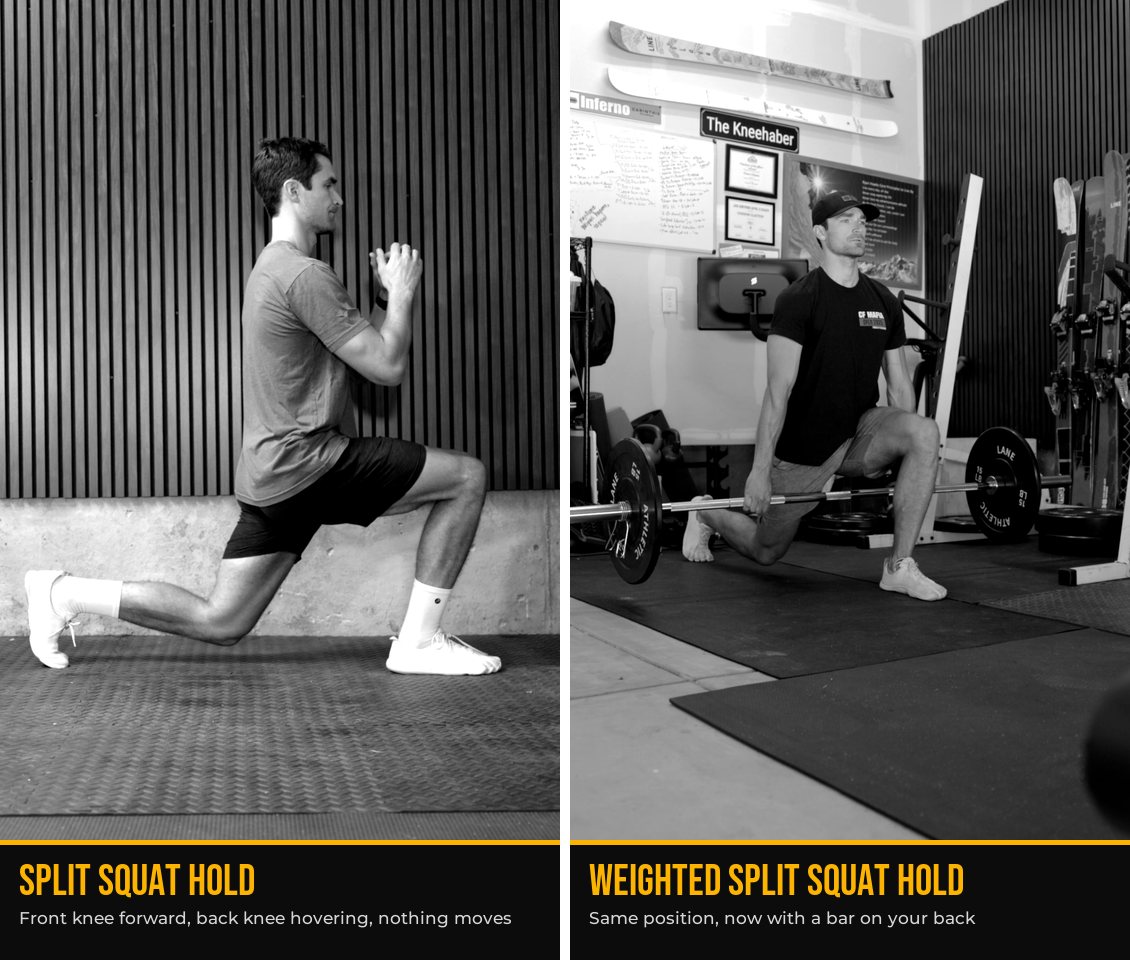
The split squat hold, bodyweight first and then with a bar. Front knee forward, back knee hovering, and nothing moving.
Grab the free Isometrics guide first
Everything below comes from my free Kneehab Isometrics guide: the holds as two 15-minute routines, the four rules, what to do in a flare-up week, and a video of me doing every hold. If you'd rather have it on your phone than piece it together from this post, grab it here and keep reading.
Free download
The Kneehab Isometrics Guide
The holds from this article as two 15-minute routines: Routine A for the quads and tendon (the pain-relief holds) and Routine B for the hips and backside (the support crew), with the four rules of isometrics, what to do in a flare-up week, and a video of me doing every hold. A wall, two bands and a door anchor is all you need.
The PDF lands in your inbox in about a minute. You'll also get my weekly knee-training email, and you can unsubscribe anytime.
Holds work when you do them a certain way. Four rules.
Find your angle. The knee has a depth where the hold feels like work and the pain stays at a 3 out of 10 or less. In a flare-up that's usually shallower than sitting at 90 degrees, so start high on the wall and let depth come to you. The angle moves deeper over a couple of weeks on its own.
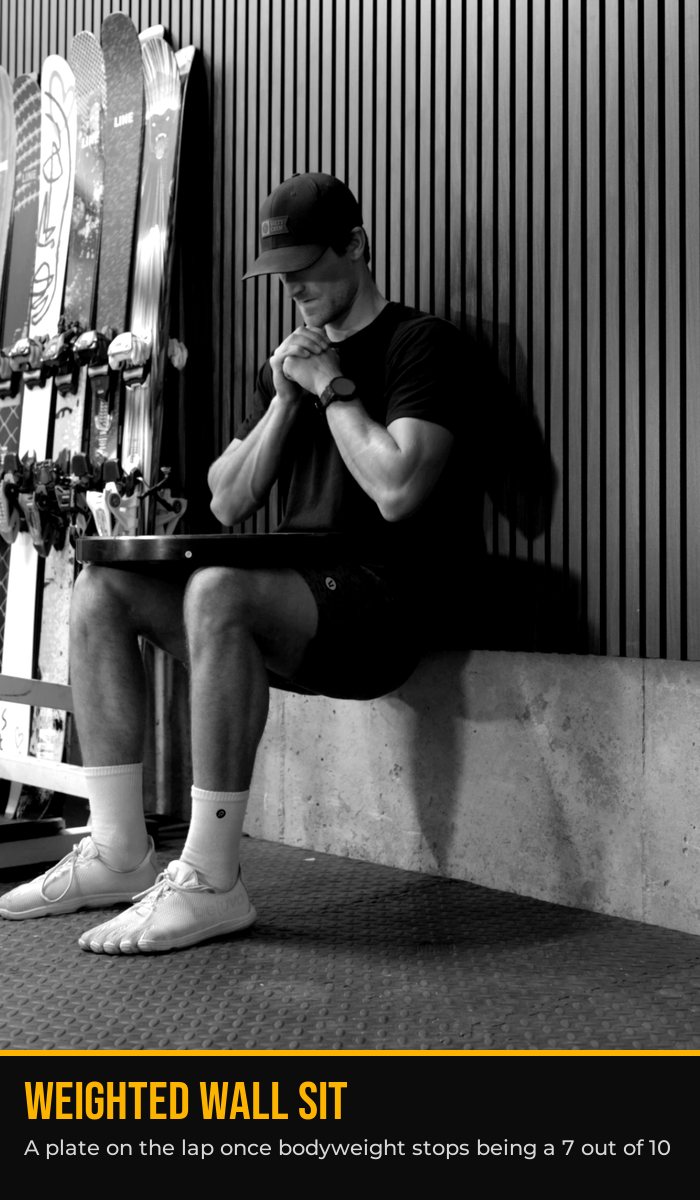
Work at a 7 out of 10. A hold you can hold forever isn't doing much. You want the quad shaking a little by the end. The pain-relief research used holds at about 70 percent of max effort, so a 7 is where I'd start while the knee is flared up. Once it calms down, push harder. A tendon gets stronger when it's pushed close to its max, and that's the tendinitis side of things, which I cover in my patellar tendonitis post. If a bodyweight wall sit is easy, a plate on your lap makes it a real exercise again.
Wall sit with a plate on the lap. Once bodyweight stops being a 7 out of 10, this is how it stays one.
Hold for 30 to 45 seconds. Long enough for the tendon to get the message, short enough that your form doesn't fall apart. Breathe the whole time. Four or five holds with a minute of rest in between.
Keep the pain at a 3 or below. Some sensation is fine. Sharp pain that changes how you're standing means you're too deep or too heavy for today. Back the angle off and try again.
My favorite isometrics for knee pain flare-ups
These are the holds from Routine A in the guide, the pain-relief session. I want you to know why each one is there, because that's what makes you reach for the right one on a bad day. Every one links to a video of me doing it.
1. Wall sit
The simplest hold there is, and you can adjust the angle an inch at a time, which is why it's where I'd start anyone whose knee is hot right now. Back flat on the wall, slide down until the quads are working and the knee is quiet, and hold. Here's the wall sit, and here's the weighted version for when bodyweight gets easy.
Start with: 2 to 3 holds of 30 to 45 seconds.
2. Spanish squat hold
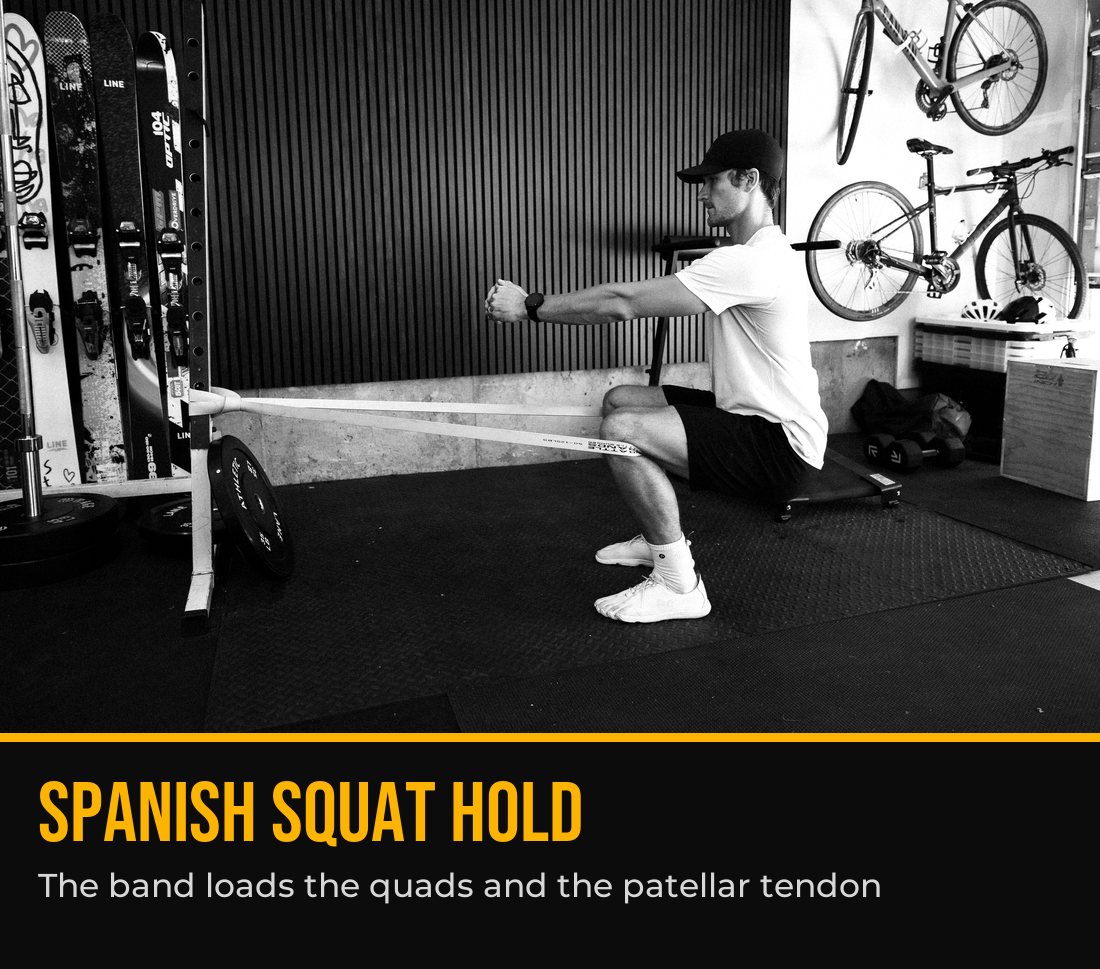
A thick band behind the knees, anchored low in front of you, and you sit back against it. The band pulls your shins forward, which puts the load straight into the quads and the patellar tendon and takes the hips out of it. It's the gold standard hold for a sore patellar tendon, and the one I'd never skip. Here's how I set it up.
Start with: 2 to 3 holds of 30 to 45 seconds.
Spanish squat hold. The band pulls the shins forward so the quads and the patellar tendon take the load. My first stop for a sore tendon.
3. Split squat hold
One leg at a time, front knee forward, back knee hovering an inch off the floor. Single-leg strength is what stairs and hills actually ask of you, and this is the hold that trains it without any impact. The photo up top shows the bodyweight version and the barbell version. Here's the split squat hold, and here's the weighted one.
Start with: 2 holds of 30 seconds per side.
4. Poliquin step up hold
Heel elevated on a slant board or a plate, you lower a few inches into the step up with the knee forward over the toes, and you pause right there. It's a short range, it's the position that hurts when stairs hurt, and it hits the inside of the quad hard. Watch the pain on this one. If the front of your knee is where it hurts, this position puts a lot of pressure right there, so keep the 3 out of 10 rule, shorten the range, and leave it out for a week if it argues with you. Here's the hold.
Start with: 2 holds of 20 to 30 seconds per side.
5. Single-leg bent-knee calf raise hold
The one people skip. Your calf shares every landing with your knee, and the deep calf muscle only works with the knee bent. If the calf is weak, the knee absorbs the difference. One leg at a time, knee bent, up on the ball of the foot, and hold at the top. Here it is.
Start with: 2 holds of 30 seconds per side.
Routine B in the guide is the support crew: a glute bridge hold, a lying adductor hold, a side-lying banded abduction hold, a banded hip flexor iso and single-leg balance. Those holds don't calm the knee down directly. They keep the hips doing their job of controlling the thigh bone, so the knee isn't paying for weak hips on top of everything else. In a flare-up week, Routine A is the medicine. Routine B is why the flare-up gets rarer.
Two or three 15-minute sessions a week is plenty when things are calm, alternating A and B. In a flare-up, Routine A every day for a week, then back to normal.
Ice, RICE, and what I do instead
When I was dealing with patellar tendonitis, I'd come home from any activity and go straight for the ice. It made the knee feel better for an hour, and I thought that meant it was healing. It wasn't. Ice numbs the pain, and that's genuinely all it does. A review of the icing trials found exactly that: it takes the edge off the pain, and the evidence that it does anything for healing is thin.
It gets more interesting than that. The whole idea of RICE (rest, ice, compression, elevation) came from a sports doctor named Gabe Mirkin in 1978, and he has since written that ice and complete rest delay healing rather than speed it up. The research since then leans his way. In a study on people who did a hard eccentric workout, the ones who iced afterwards recovered slower than the ones who didn't. In animal studies, icing after a muscle injury slowed the repair, held back the new blood vessels and delayed the clean-up of damaged fibers, because inflammation is part of how healing works. Most of that research is on muscle injuries, not knee flare-ups, so take it as a direction rather than a verdict on your knee. It's enough that sports medicine has moved on, though: the 2020 update to RICE tells you to avoid anti-inflammatory treatments, ice included, and to start loading early instead.
Here's where I land. If a bag of frozen peas gets you through an evening, go for it. It's a painkiller, and a painkiller has its place. Just don't mistake it for treatment, and don't let it be the reason you skip the thing that actually helps. What a cranky knee needs is blood flow, because blood is how nutrients get to a tendon that doesn't have much supply of its own, and you get that from loading it, not cooling it. The holds above do exactly that.
Bonus remedy: floss bands
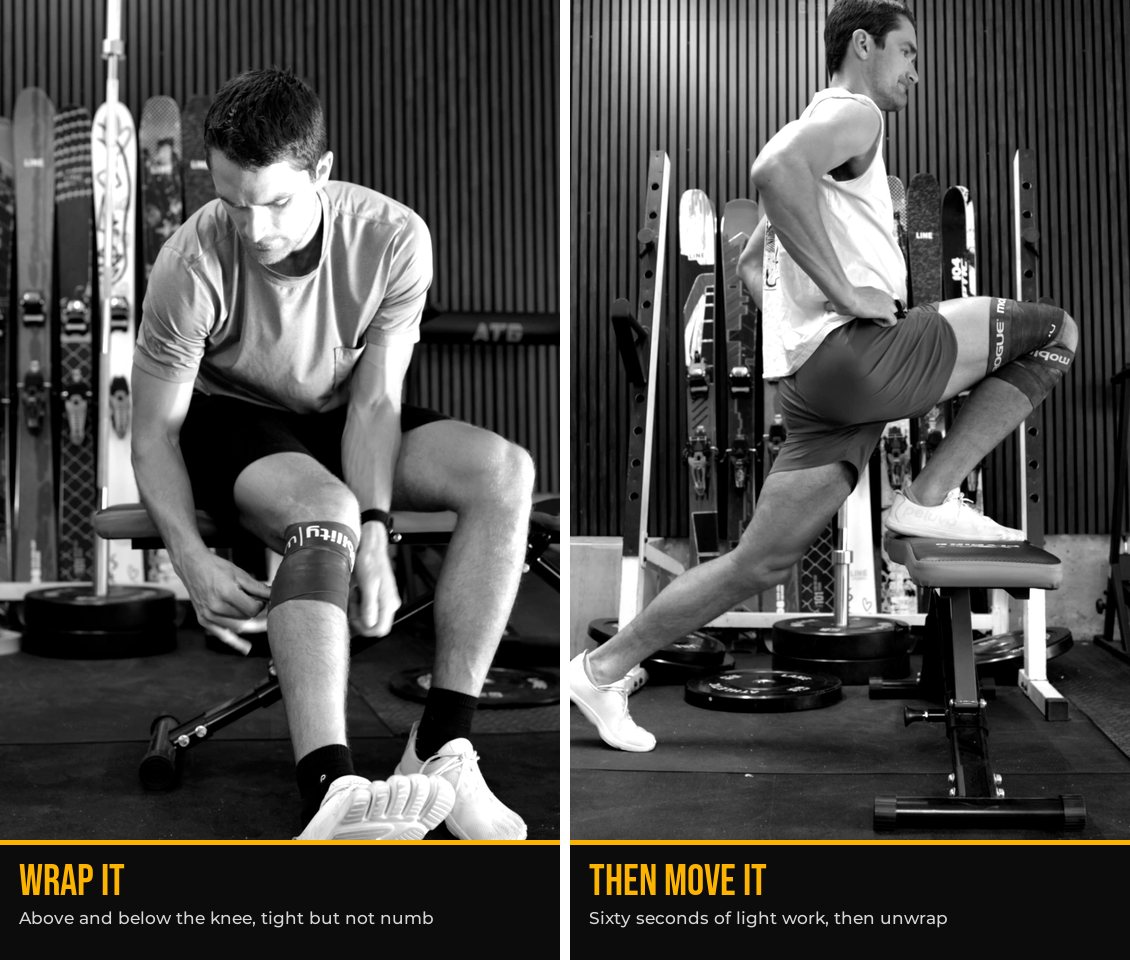
The other thing I use when my knee flares up is a floss band. I wrap it above and below the knee, tight enough that the joint feels squeezed but not so tight that anything goes numb, then do about 60 seconds of light work: a few easy split squats, a shallow wall sit, some slow knee bends. Then I unwrap it. While the band is on you get a little blood flow restriction effect, and when it comes off the knee floods with blood. It feels incredible on a stiff knee, it's my favorite trick for the morning after a big day, and you can do it on the floor at home. Here's a short video of how I floss my knees.
Wrap above and below the knee, then sixty seconds of light work. The band comes off and the knee floods with blood.
The next-morning rule
This is the only rule you need to decide whether yesterday was too much. Compare the knee this morning to yesterday morning. Same or better, the dose was right, and you keep going. Worse, you went past the line, so you back off one step for a session, which usually means a shallower angle, less weight, or fewer sets, and build back up from there.
During the session itself, I use a traffic light. Pain at a 0 to 3 out of 10, keep going. A 4 or 5, shrink the exercise: less depth, less load, slower. A 6 or above, stop that movement for today and finish with the things that feel fine. That's it. "Listen to your body" sounds wise and tells you nothing. Numbers and a morning check tell you what to do.
I spent years ignoring the next-morning signal and wondering why I kept getting hurt. Let my mistakes be useful to you.
When it's not a flare-up
I'm a strength coach, not a doctor, so here's the line I hold with every client. Everything above is for the knee that's grumpy after too much too soon. Get it looked at by a professional if the knee swelled up fast after a specific incident, if it locks or catches or gives way, if the joint is hot and red, if it hurts at night or at rest as much as it does under load, or if it keeps getting worse week after week even as you back off. Those aren't load-management problems, and the right move is a proper look, not a wall sit.
Where this goes
Holds are what you do to calm a knee down. They're not what makes a knee strong enough that it stops flaring up. That takes slow, heavy strength work and then teaching the knee to be springy again, and it takes months, not a long weekend. The Isometrics guide gets you through the bad week. If you want the months after it written out for you, with a video of me doing every exercise, that's what the Strong Knees System is for.