Torn Meniscus: Why Training Comes First (and How I Train on Almost None)
Connor Clayton · The Kneehaber ·
This one is about the meniscus: what it actually does, why a tear on your MRI is usually not a countdown to surgery, and how I train on a knee that has almost none left. I hope it helps!
I barely have any meniscus hanging on these days. The last time I sat down with an orthopedic surgeon about my right knee, he told me that if I ever went back under for it, he'd just take what's left of the meniscus out. So I'm writing this as someone who skis, lifts, runs and summited Kilimanjaro on a shock absorber that's mostly gone. I'm a strength coach, not a surgeon, so none of this is a diagnosis. It's what the research says, and what I do about it.
If you've just been told you have a torn meniscus, the first thing I'd want you to know is that your knee can do a lot without a perfect meniscus, as long as the muscles around it are strong.
What the meniscus actually does
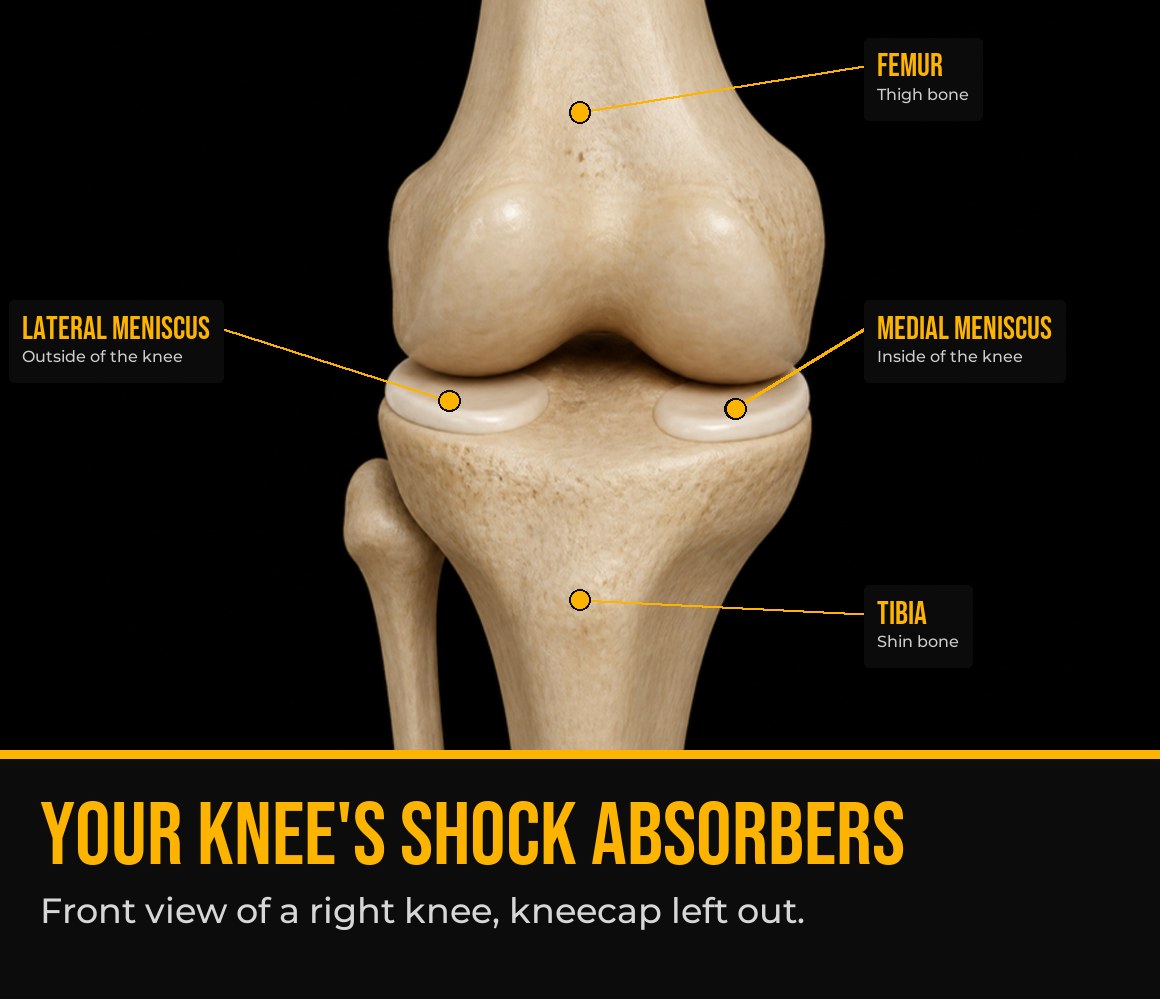
Your meniscus is the shock absorber that sits between your thigh bone (the femur) and your shin bone (the tibia). You've got two of them in each knee: one on the inside (the medial meniscus) and one on the outside (the lateral meniscus). They're C-shaped pads of tough, rubbery cartilage, and every time you walk, squat, run or land, they cushion the two bones and spread your bodyweight out so it isn't all going through one small spot.
The two menisci sit between your thigh bone and your shin bone, one on the outside of the knee and one on the inside.
They work a lot like the cushioned sole of a running shoe. Take the sole away and every step lands a lot harder on what's underneath, which in your knee is the cartilage on the ends of the bones.
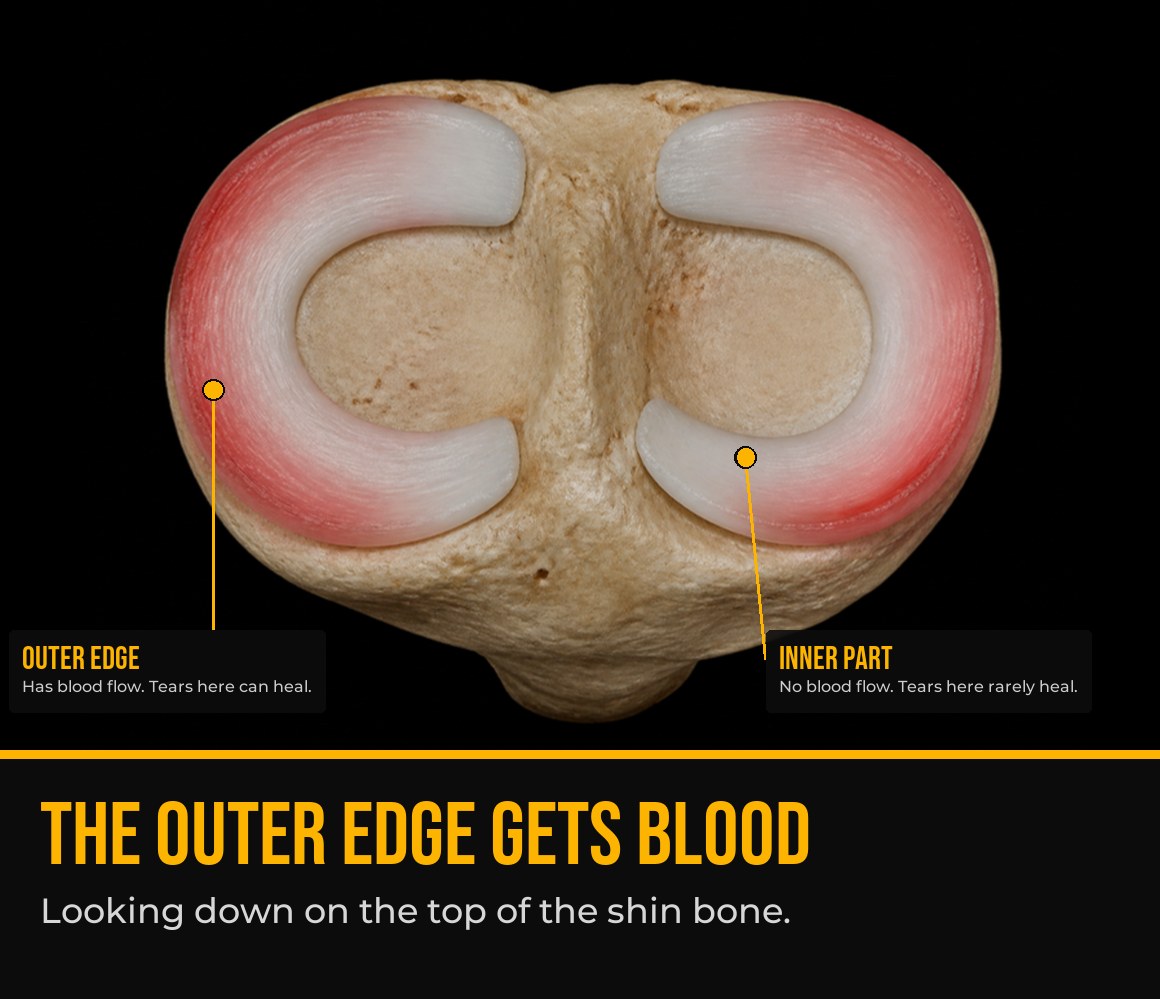
Whether a tear can heal mostly comes down to blood flow, and only the outer edge of the meniscus gets any. Arnoczky and Warren mapped it back in 1982 and found blood vessels in roughly the outer 10 to 25 percent. The rest of it gets fed the way cartilage does, by the joint fluid that gets pushed in and out when you move. So a tear on the outer edge can genuinely heal, because blood can get to it. A tear in the inner part mostly can't, because there's no blood flow in there to do the repair.
Looking down on the top of the shin bone. The red outer edge is the only part with a blood supply.
The inner part doesn't have many nerves either. One study that looked for them found the nerve endings mainly in the outer third. So you can have a tear in there and not feel much from it at all. Where it turns into a problem is when the meniscus stops doing its job as a cushion. More of your bodyweight goes straight through the cartilage, and if that cartilage wears down far enough you end up with what people call bone on bone. That's where a lot of the pain and the issues come in.
One thing I wish more people knew: a tear doesn't have to heal to stop hurting. The pain settles as the knee calms down and the muscles around the joint take on more of the work. It also means movement is literally how the meniscus gets its nutrients. Resting a painful meniscus completely is usually how you make things worse.
Two different injuries wearing the same name
Typically, when a meniscus tears, it happens in one of two ways. They get the same name on an MRI report, but they're pretty different injuries.
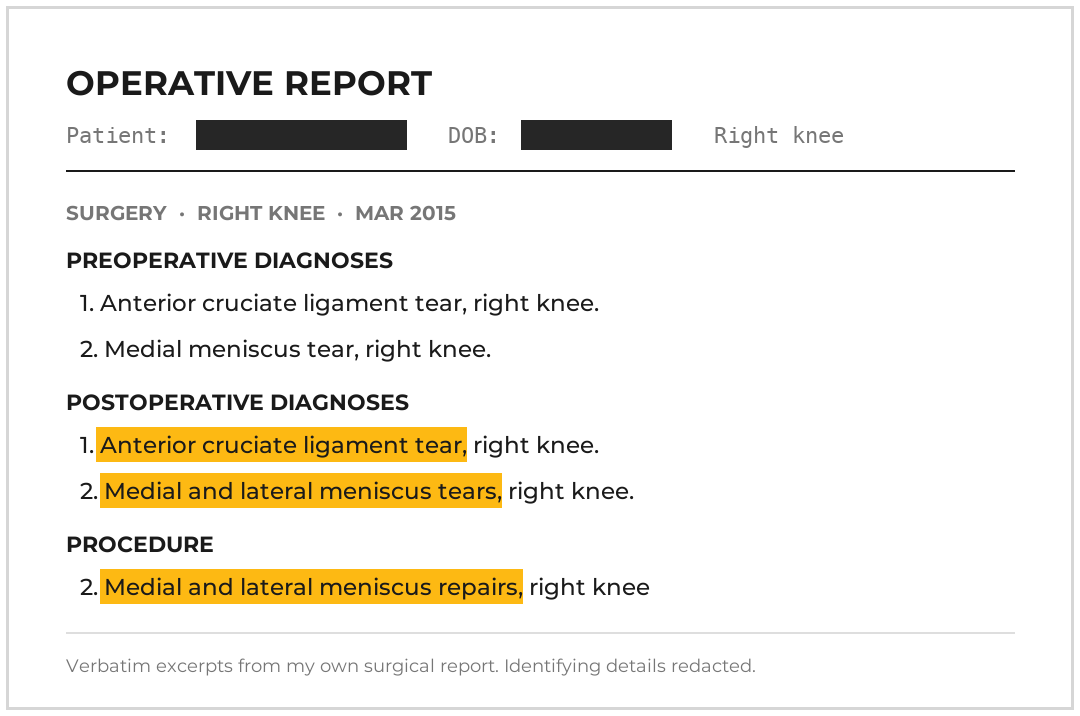
The traumatic tear. With a traumatic tear, there's typically a plant and twist under load (skiing, hockey, a cut in soccer). You feel a sharp pain, and the knee swells up a lot within a day. A specific event injures the meniscus, and it often comes with an ACL tear or other ligament damage. Every time I've torn my meniscus, it's been alongside an ACL tear. They kind of go hand in hand. My first ACL surgery was in March 2015, and the surgical report lists tears in both menisci. In 2016 I skied a full season on a torn ACL, and what should have been a two-hour reconstruction turned into seven hours because the surgeon found my lateral meniscus and my LCL torn too (the whole saga is in My Story). In a young knee, a tear like that is usually worth trying to repair, because the meniscus protects the cartilage behind it for the next fifty years.
From my first ACL surgery in 2015. The ACL and both menisci, all in one go.
The degenerative tear. Maybe you're a little bit older, and there's no single incident you can point to. This one is gradual. Your meniscus has been taking wear and tear from everything you've done for the last 40 years, and at some point it starts to fray, the same way skin wrinkles and hair goes gray. A lot of people have one of these tears and don't even know it, because it doesn't hurt. Englund and colleagues scanned the right knee of 991 people aged 50 to 90 in Framingham, Massachusetts, picked without any regard to knee problems. Depending on age and sex, between 19 and 56 percent of them had a meniscus tear, and 61 percent of the people with a tear had felt no pain, aching or stiffness in the previous month. It isn't only an older-knee thing either. A 2020 study scanned 115 uninjured, sedentary adults with a median age of 44 and found a meniscus tear in 30 percent of the knees.
It's the same story as low back pain and disc bulges. A review of scans from 3,110 people with no back pain found a disc bulge in 30 percent of the 20-year-olds and 84 percent of the 80-year-olds. Wear and tear shows up on a scan long before it shows up as pain, and a lot of the time the pain never shows up at all.
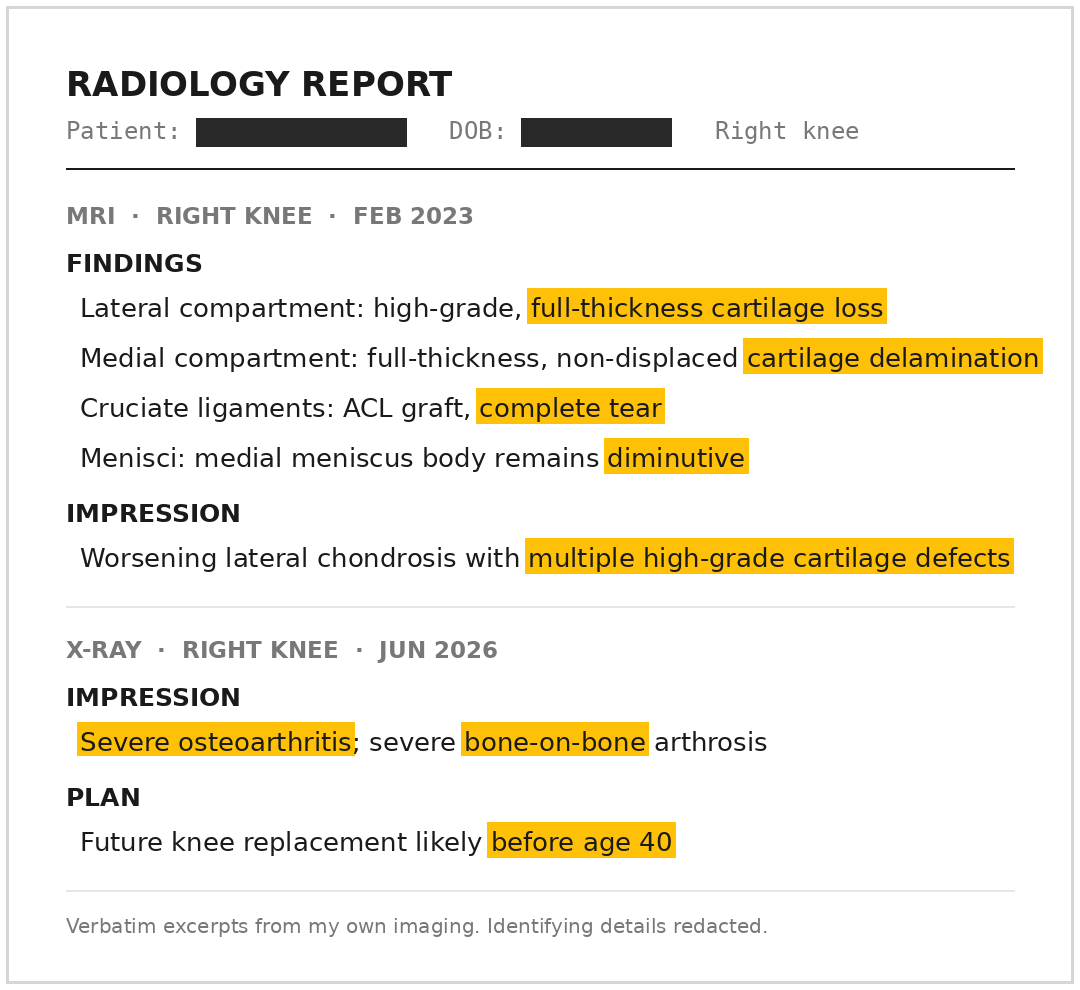
This is what I've got going on with my own knee, straight off my imaging reports. "Diminutive" is the radiologist's way of saying there isn't much meniscus left, and that's before you get to the cartilage and the ACL. Because of the movement I do and the way I train my knees, I'm still able to live pain-free with all of that (at the moment, at least!). I wrote a whole article on this idea: You Are Not Your MRI.
My right knee on paper. It's the same knee I ski, lift and run on.
They did fake knee surgery on 146 people. It worked.
Everyone with a meniscus tear should know this one. In 2013 a Finnish group published a trial in the New England Journal of Medicine where 146 people aged 35 to 65 with a degenerative medial meniscus tear and no arthritis got either real arthroscopic surgery (trimming the torn piece out) or a fake one: the incisions, the instruments, the full operating room, and nothing removed. At one year there was no difference between the groups. The same was true at two years, and when they looked again at five years, the people who'd had the real surgery had no advantage in pain or function and a slightly higher rate of arthritis showing up on X-ray. The fake surgery worked as well as the real one.
Then exercise went head to head with surgery, three times. Katz and colleagues in the US randomized 351 people with a meniscal tear and mild to moderate arthritis to surgery or physical therapy, and found no significant difference at six and twelve months. A Norwegian trial put 140 middle-aged people with a degenerative tear through surgery or twelve weeks of supervised exercise. There was no meaningful difference at two years, and the exercise group had stronger thighs at three months. A Dutch trial of 321 people found physical therapy no worse than surgery at two years, and at five years it still held, with the same rate of arthritis progression in both groups. In every one of those trials some of the exercise group had surgery anyway (30 percent in the American one, 19 percent in the Norwegian one), and they lost nothing by starting with training.
Put it all together and the picture is pretty clear. A 2015 review of the trials found a tiny benefit from arthroscopy for pain at three to six months, gone by one to two years, alongside real harms like blood clots and infection. By 2017 an expert panel in the BMJ issued a strong recommendation against arthroscopic surgery for nearly all people with degenerative knee disease, meniscus tears included. What the evidence says is: train first.
I want to be careful with the boundaries here, because I don't want to overclaim. This is about degenerative tears. A traumatic tear in a young athlete, a knee that truly locks, and a tear at the root (where the meniscus anchors to the bone) are different conversations. And repairing a meniscus, where it gets stitched so it stays in the knee, is a different operation from cutting the worn piece out. What the research went after is the trimming of worn tissue in middle-aged knees, and that isn't the same thing as all meniscus surgery. Your surgeon is the one to tell you which kind of tear you have.
Why I'll try to never fully remove my meniscus
There's a solid second reason to go with physical therapy and strengthening your knees before going under the knife. Every bit of meniscus that gets removed leaves less cushion, and more of the load lands on the cartilage underneath. Englund's group tracked 155 people for sixteen years after a meniscectomy (surgery that removes part or all of the meniscus) and found arthritis on X-ray in 43 percent of the operated knees, with the bigger removals doing worse.
So even though the last surgeon I talked to said he'd take my meniscus out if I ever went back in for ACL surgery, I'm pretty sure that whatever meniscus I have left, I'd like to do my best job of keeping. The way I do that is by getting the muscles around the joint strong enough to do more of the shock absorbing. A strong quad slows your bodyweight down before the meniscus has to.
The flip side is just as important: loading your knee isn't the enemy. In a Swedish trial, people who'd had part of their meniscus removed a few years earlier did four months of moderate exercise, and the cartilage in their knees got measurably healthier on MRI, with the people who moved the most improving the most. Cartilage adapts to the load you give it, and so does muscle. Your knees only get strong in the positions you train in. If you avoid bending them, you're not protecting them. You're making them weak because you're not using them.
That's the whole reason my free Strength guide exists. It's the middle stage of everything below, written out as actual sessions: three days a week of squats, step ups, RDLs, Nordics and hip thrusts, with sets and reps for everything and a video of me doing every exercise. If you want to start training around a meniscus tear, this is where I'd start.
Free download
The Kneehab Strength Guide
Stage 2 from this article as a PDF you can pull up at the gym: three days a week of squats, step ups, RDLs, Nordics and hip thrusts, with the sets and reps for everything and a video of me doing every exercise.
The PDF lands in your inbox in about a minute. You'll also get my weekly knee-training email, and you can unsubscribe anytime.
Three things you've probably been told that aren't true
"Squats wear out your meniscus." It's the other way around. Loading is how the meniscus gets its nutrients and adapts, and the cartilage study above was done on knees that had already lost some meniscus. What causes problems is adding depth and weight faster than your knee can adapt. Squatting itself isn't the problem.
"Clicking means it's getting worse." Painless clicking and popping is normal in a lot of knees, torn meniscus or not. If there's no pain, swelling or locking with it, the sound on its own doesn't mean damage.
"Once it's torn, deep squatting is off the table." Depth comes back a little at a time. I squat deep, ski park and run on a meniscus that's mostly gone. The order you bring things back in, and the patience it takes, are what the rest of this article is about.
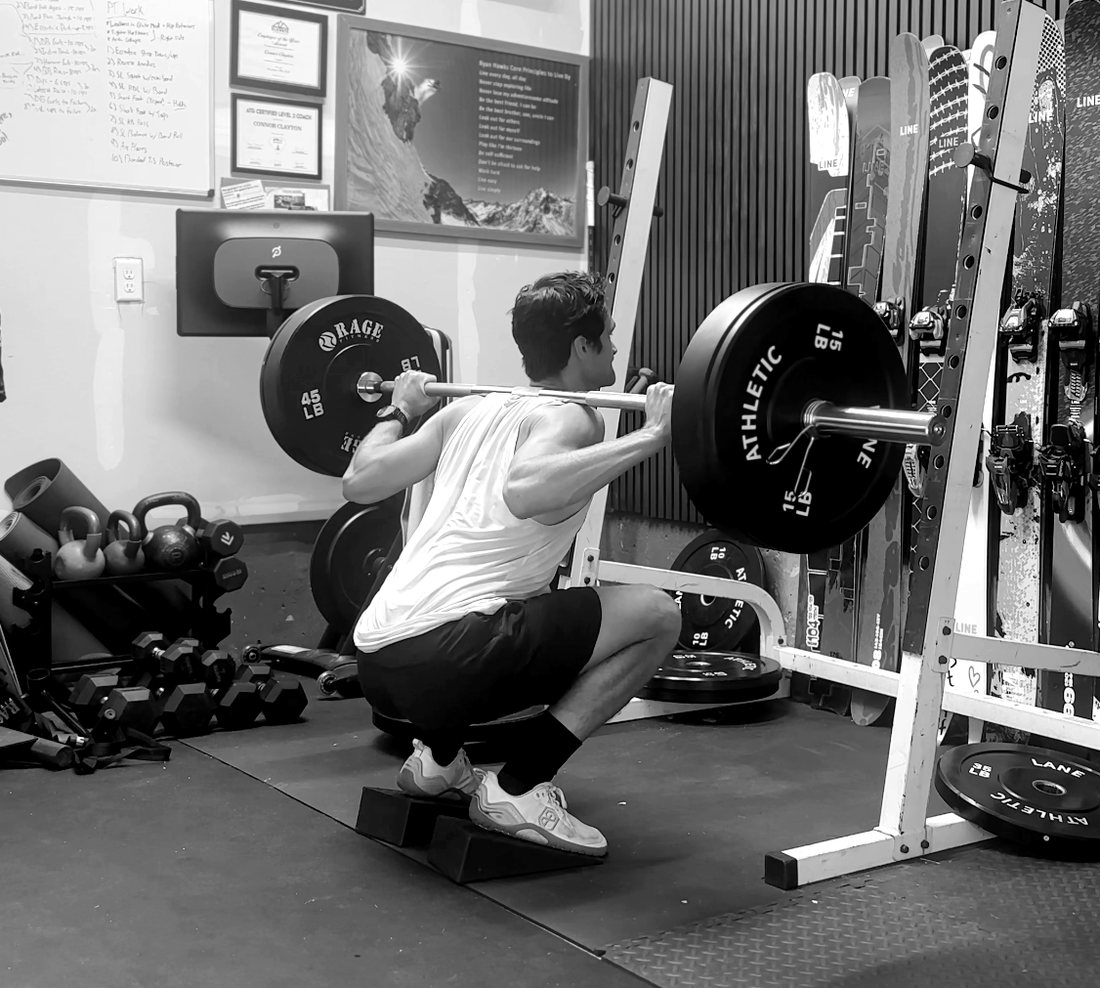
A deep barbell squat with my heels raised, on a knee with almost no meniscus left. Depth like this gets built up gradually.
How to train a knee with a tear on the scan
A full three-day routine you can use every week to help strengthen your knees and prevent meniscus pain.
I'm writing the exercises out here in the article so you can see how it all fits together. If you'd rather have a PDF you can pull up on your phone at the gym, download the free Strength guide here.
It's the same three stages I use for every knee, with the same rule all the way through: pain stays at a 4 out of 10 or less while you train, and the knee feels no worse the next morning. If it does feel worse, back off the range of motion or the weight and go from there. With a meniscus, the three things to bring back slowly are how deep you bend, twisting, and impact. Bending deep under load squeezes the back of the meniscus the hardest, and twisting on a planted foot is the classic way they tear. You don't avoid those forever. You bring them back in order: depth first, then jumping and landing, then twisting.
Stage 1: calm it down with bands and bodyweight
Two to three weeks, or however long it takes for the knee to pass the next-morning test. Everything in this stage is resistance bands and bodyweight. If your meniscus is flared up, the last thing you want to do is load it too quickly, so you start slow and work up from there. Keep the bending shallow to moderate, with no pivoting and no impact. This stage isn't rest, though. You're finding the ranges your knee is happy in and training them, so the quads, hamstrings and calves keep working while the joint settles down.
Walk backward. Start with 3 to 5 minutes to warm up, pulling a sled, on a treadmill that's turned off, or up a gentle hill. It works the quads with next to no impact and gets the joint fluid moving.
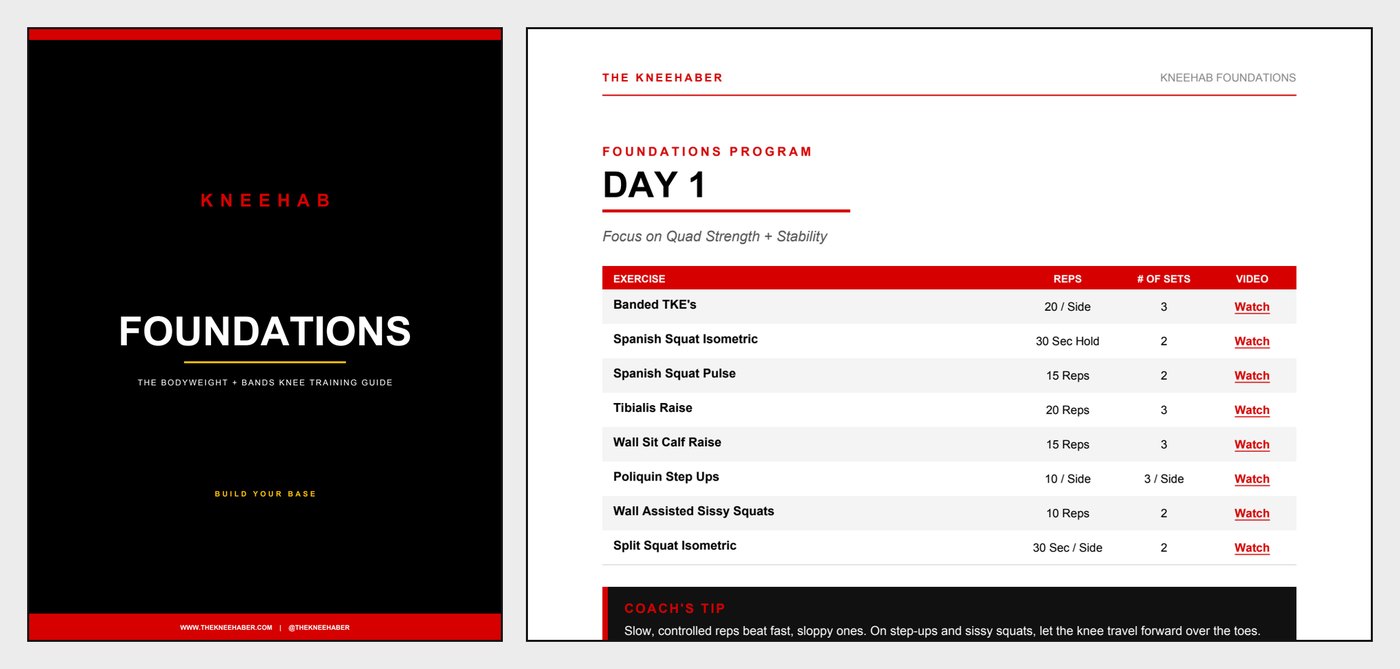
Banded TKEs. Start with 3 sets of 20 a side. This is more of a warm-up for the quad than a strength builder, and it's where I start any quad session.
Spanish squat holds. Start with 2 holds of 30 seconds, at a depth you can sit in without the pain climbing. If the knee is properly flared up, start with my flare-ups article.
Banded hamstring curls. Start with 3 sets of 10 a side. Strong hamstrings and glutes protect the knee by sharing the load.
Tibialis raises and knees-over-toes calf raises. Start with 3 sets of 20 and 3 sets of 15. Your calves and the muscle on the front of your shin take the first hit every time your foot lands, before any of it gets to the knee.
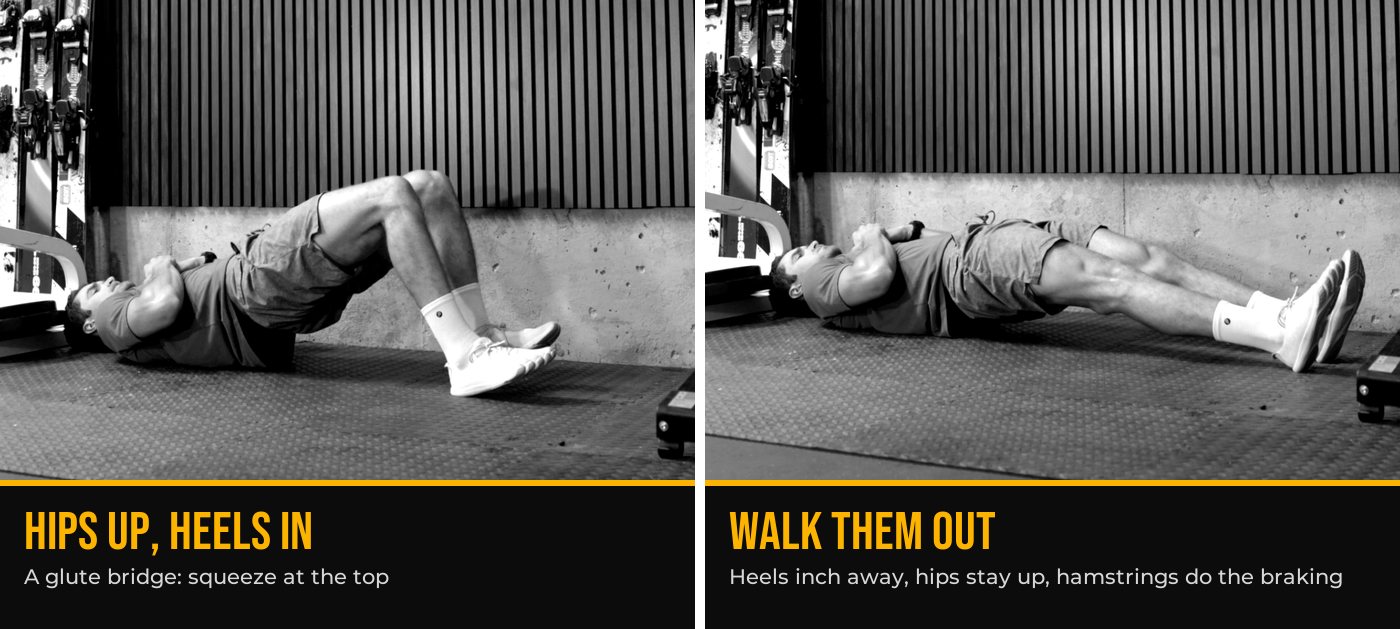
Glute bridge walkouts: bodyweight hamstring work with no deep bend, no twisting and no impact.
This stage is basically my free Foundations guide: three days a week, just bands and bodyweight, with a video for every exercise. If you want it as a PDF, start here.
Stage 2: build the strength that protects your meniscus
This is the Strength guide, so I'll lay it out the way the guide does: three days a week (I like Monday, Wednesday and Friday) for twelve weeks. One day for the quads, one for the posterior chain (hamstrings, glutes and calves), and one for single-leg work and the hips. Every day opens with a short warm-up for the feet, calves and tibialis. The guide has that written out, so I'll stick to the main lifts here.
The first month is light and all about form. In the second month you add 5 to 10 percent to the main lifts whenever the knee passes the next-morning test, and in the third you keep going. Start slow, learn the movement, dial in the form, then the range of motion, then the weight. And load doesn't have to mean a barbell. One dumbbell, then two dumbbells, is a progression.
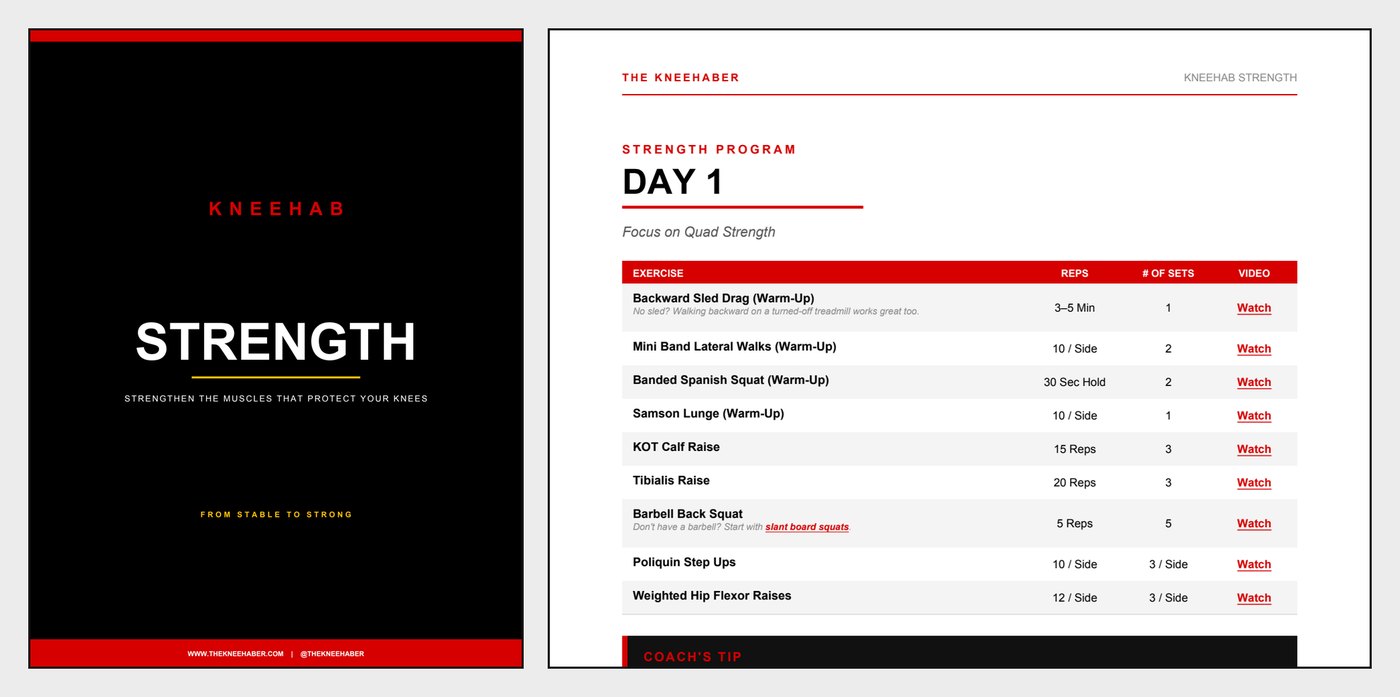
The free Strength guide: all three days, with sets, reps and a video for every exercise. Download it here.
Day A, quads.
Barbell back squats. Start with 5 sets of 5. No barbell yet? Start with slant board squats holding a dumbbell. How deep you go is the thing to be patient with. Go as deep as the 4 out of 10 rule allows and let the range grow a little every week. This is the lift that brings deep squatting back, and it's why I'd rather have strong quads than a perfect scan.
Poliquin step ups. Start with 3 sets of 10 a side. The knee travels forward over the toes, the bend stays shallow, and nothing twists.
Poliquin step ups. Lots of controlled reps at a shallow bend build the quad without any deep bending or twisting, and all that repeated loading is what moves joint fluid through the knee.
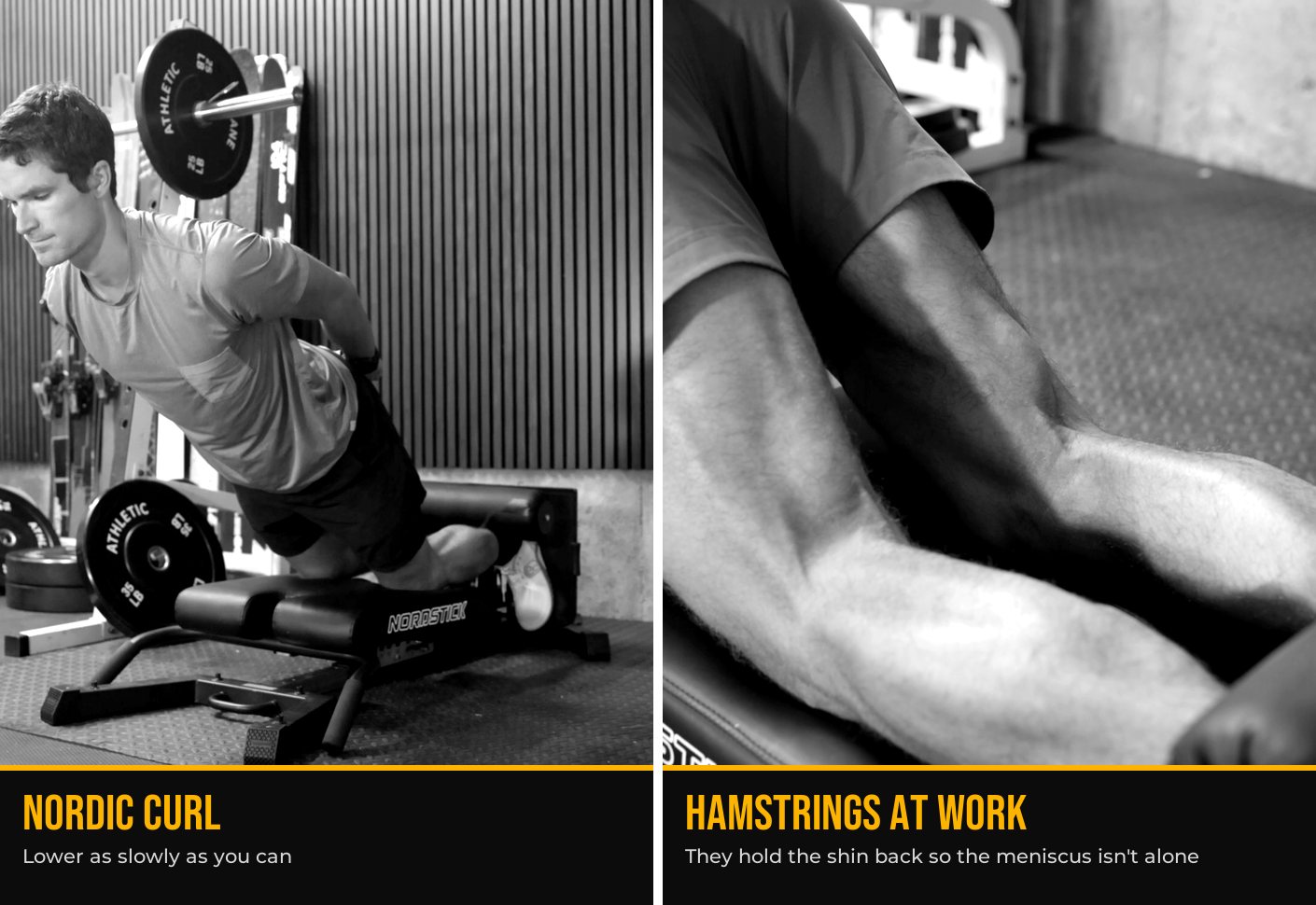
Day B, posterior chain. Hamstrings matter for the meniscus more than they get credit for. They pull the shin bone back and keep it from sliding forward under the thigh bone. In a knee without an ACL, like mine, that sliding is a real problem: one lab study found that the force on the inner meniscus doubled once the ACL was cut. Strong hamstrings take some of that job off the meniscus. It's the same reason they're so important for the ACL itself, and I wrote about that in my hamstrings article.
Barbell RDLs. Start with 4 sets of 8, slow on the way down. Dumbbells work fine.
Barbell hip thrusts. Start with 3 sets of 10. Strong glutes take load off the knee on every step down a hill, which is a big part of how I walked down 14,000 feet of Kilimanjaro on this knee with zero pain.
Nordic curls, and a close-up of the hamstrings doing the lowering.
Day C, single leg and hips.
Curtsy lunges. Start with 3 sets of 8 a side. The hip takes the sideways load so the knee doesn't have to.
Horse stance squats. Start with 3 sets of 12. Wide stance, knees over the toes, hips open. It feels awkward at first, and that's normal.
Kickstand squats. Start with 3 sets of 10 a side. All of the load goes through one leg, without the balancing act and without any twisting.
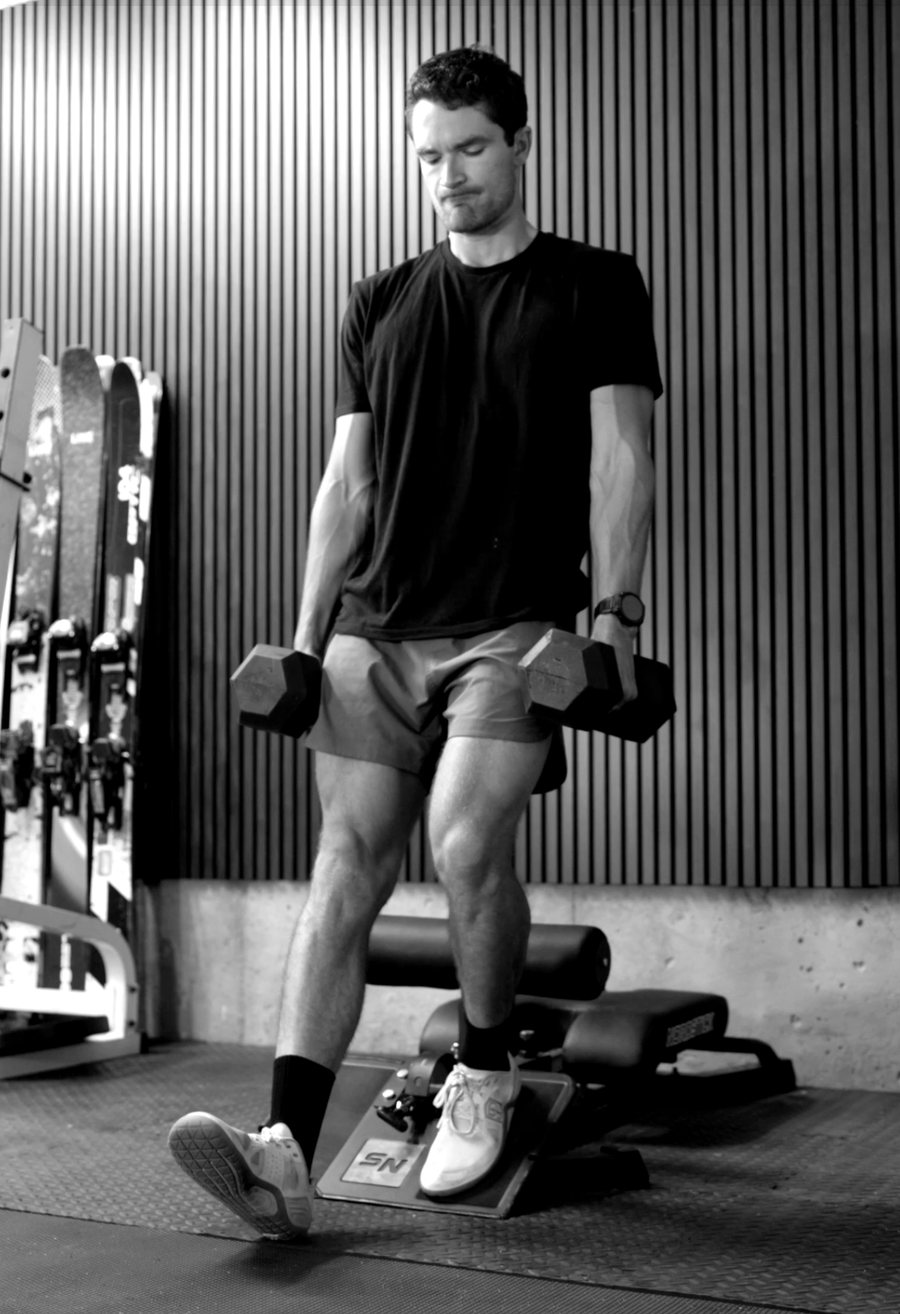
There are two more I'd add for a knee with a tear specifically. Eccentric step downs, 3 sets of 8 a side, lowering for three seconds, because slowing your own bodyweight down on one leg is exactly what a knee with a tear needs to get good at again. And front foot elevated split squats, 3 sets of 8 a side, which bend one knee deep with the foot planted and nothing rotating. Train your weaker leg first.
Stage 3: earn back depth, jumping and twisting
The finish line is a knee that squats deep, lands and changes direction without you having to think about it. I bring things back in three steps, and each step has to pass the same next-morning test before the next one starts.
Deep range first.ATG split squat holds (start with 3 holds of 30 seconds a side) and bottom-half squats (3 sets of 10), working toward full depth if your sport asks for it.
Then jumping in a straight line.Pogo hops (3 sets of 20), box jumps (3 sets of 5, and step down instead of jumping down) and broad jumps (3 sets of 5, sticking every landing).
Then sideways and twisting, in small doses.Lateral hops (3 sets of 10 a side), skater hops (3 sets of 8 a side), and finally a lateral bound into a single leg jump, which is basically a cut with the brakes on. After that it's cutting on grass, if you play a sport that cuts.
The twisting is the piece that gets skipped the most, and it's a big reason people get cleared and then flare up the first time they play. Train it, a little at a time. Patience is key, and restraint is the hardest trick in the book. In the trials where training matched surgery, settling a flared-up degenerative tear took around three months of consistent work, and the people who trained first and later chose surgery lost nothing by waiting.
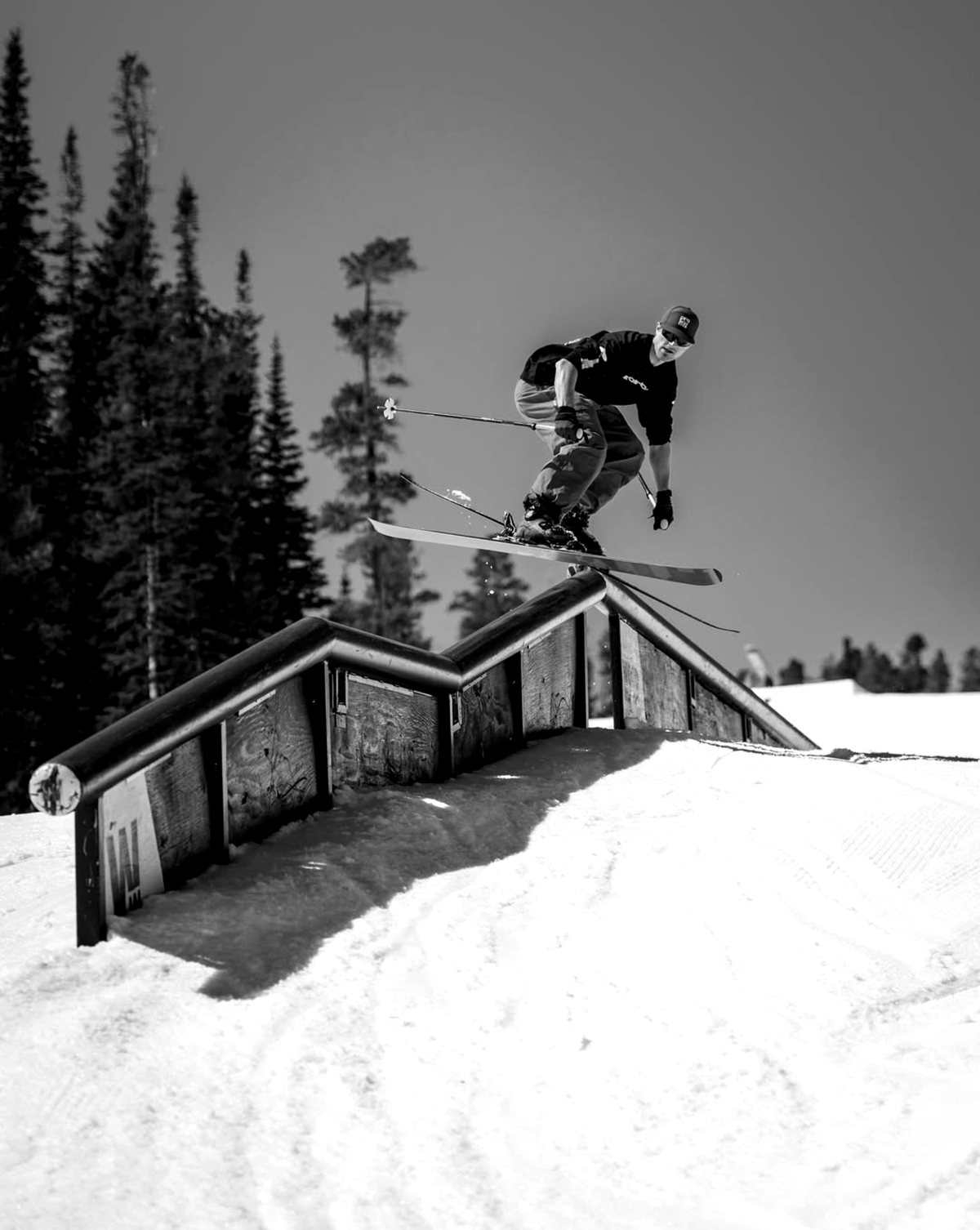
Park skiing on the same knee. The muscles around it do a lot more of the work these days.
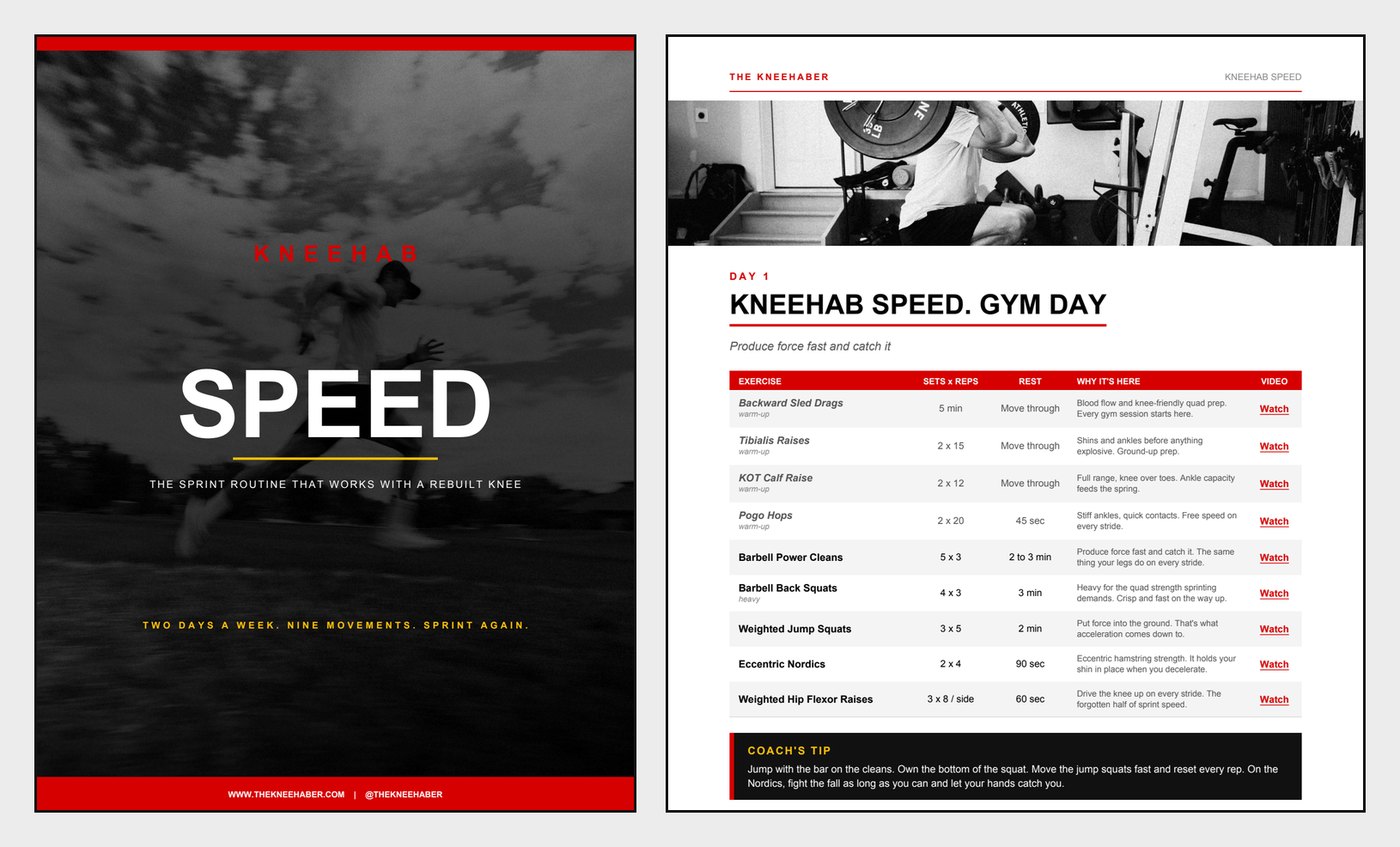
When you're ready to sprint again, my free Speed guide is the next step: two days a week, one in the gym and one on the field. You can grab it here.
I'm a strength coach, not a surgeon, and the meniscus has the single most important mechanical red flag in the whole knee. If the knee truly locks, as in physically stuck and unable to straighten, that can be a flap of torn meniscus flipped into the joint like a doorstop, and that's a job for a surgeon, not for step ups. A catching or clicking feeling is a different thing. In the Finnish trial, people with those "mechanical symptoms" did no better with the real surgery than with the fake one. Stuck is the word that matters.
The same goes if you're a young athlete with a fresh plant-and-twist injury and swelling within a day. Get it looked at promptly, because a repairable tear has a clock on it. A root tear, where the meniscus has pulled off its anchor to the bone, is a surgeon's conversation too. In one five-year study, 87 percent of people who managed a medial root tear without surgery did poorly and 31 percent ended up with a knee replacement. Repeated giving way, a knee that swells up big and fast after an incident, night pain, fever, redness or heat all need a professional's eyes first. Then come back and train.
The train-first plan I actually run
If your MRI says "meniscus tear" and there was no big injury, the trials above all point the same way: start with a progressive training plan, and keep your doctor in the loop. That's not me being anti-surgery. It's what the best evidence says, and it's how I treat my own knee: keep the muscles around it as strong as I possibly can, for as long as I can.
There's a catch with train-first, though. It only works if you actually train: three days a week, for months, progressing the weight and the range on a schedule instead of on a feeling. You need a system, and that's exactly what the Strong Knees System is. The three stages above are three programs in the app, and every exercise in them has a video of me doing it.
Foundations, Strength and Performance in the app: Stage 1, Stage 2 and Stage 3, with the weight written in for every session.
Foundations is Stage 1: eight weeks, 24 sessions, bands and bodyweight. It wakes up the muscles that protect your knees, in your living room.
Strength is Stage 2: twelve weeks, 36 sessions, gym or home setup. Quad day, posterior chain day, hip day, every week progressing on the last. It's the guide above with the weight written in for every session.
Performance is Stage 3: eight weeks, 24 sessions, gym and field. Plyometrics, landing, sprinting and cutting at full speed. It's where the twisting comes back.
Plus Kneehab Ski, the Patellar Tendon Fix and the Knee Mobility Library, all included.
Michael sent me this a year after a 40 percent meniscus removal: "Went through a 40% meniscus removal in May 25. Found your program in late June 25. Diligently following your recommendations to this day. My knee feels very strong." That's a knee getting stronger around a meniscus that's 40 percent smaller, and it's the same thing I'd want for you.
Sometimes, if the tear is out on the edge where the blood supply is. Tears in the inner part mostly don't knit back together, and that's okay, because a tear doesn't have to heal to stop hurting. In the fake-surgery trial the torn tissue stayed put in half the patients, and they did just as well as the people who had it trimmed out.
Can I squat with a torn meniscus?
Yes, at a depth and a weight that pass the next-morning test, then a little deeper and heavier as the knee allows. Squatting is how the muscles around the joint get strong. What flares a meniscus up is depth and weight added faster than the knee can adapt, and twisting on a planted foot before it's ready.
How long does it take?
About three months of structured training for a flared-up degenerative tear to settle, going by the trials. Getting all the way back to deep squats, jumping and cutting is more like six months of the three stages above, and the knee keeps getting better for as long as you keep training it.
If you've got a question about your own knee, email me at [email protected]. And if you take one thing from this, let it be that a tear on your MRI doesn't decide what your knee can do. Train the muscles around it, be patient with the depth and the twisting, and remember that you can't lose if you don't quit. Thanks for reading!