Want to Prevent ACL Tears? Strengthen Your Hamstrings
Connor Clayton · The Kneehaber ·
Here's a fun fact for anyone who doesn't know: I've been living without an ACL in my right knee for the past four years, and it doesn't slow me down. I ski, I lift, I run and I play sports, all on a knee that's missing the ligament everyone's heard of. To be clear, I'm not suggesting anyone live without one. Mine is the result of four tears and some stubborn decisions, and here's the whole story if you're new here. But living with that one taught me something I never learned in rehab, and it's the reason this business of mine exists.
What it taught me is that the muscles around your knee can do a big share of what the ACL does, and your hamstrings do the biggest share of all. So this post is about your hamstrings: what they do for your ACL, what the research says about it, what it means if you're living without an ACL like me, and the hamstring exercises I'd recommend, from the ones you can do on your living room floor to the ones that need a gym. I hope it helps!
Quick note: some of the links in this post are affiliate links. If you buy something through one, it costs you nothing extra and it helps keep this website alive.
What your ACL does, and why your hamstrings matter so much
Your ACL (anterior cruciate ligament) runs through the middle of your knee and has two main jobs. It stops your shin bone from sliding forward underneath your thigh bone, and it controls how much your shin rotates when you plant and turn. Every time you stop hard, land from a jump or cut to change direction, your shin wants to slide forward, and the ACL is what holds it back.
Here's the part that matters. Your hamstrings attach below the back of your knee, and when they fire they pull your shin backwards, which is the exact same job as the ACL. Your quads do the opposite: when they fire hard with your leg close to straight, they pull your shin forward. So when your hamstrings turn on at the same time as your quads, the two cancel out and the shin stays put. When the hamstrings are late or weak, there's nothing to cancel it out, and the ACL experiences too much force.
Strong hamstrings share the work with the ACL, and that's how they can help to prevent ACL tears: by taking stress off the ACL. Or, if you're someone living without an ACL like me, they take on all of the work themselves. That's why my hamstrings get trained every single week, and it's why I think they're the most important muscle for protecting your ACL.
So if your knee's feeling loose, or you're coming back from an ACL reconstruction, or you just never want to find out what an ACL tear feels like, your hamstrings should not be an afterthought at the end of leg day. They should be one of the first things you train.
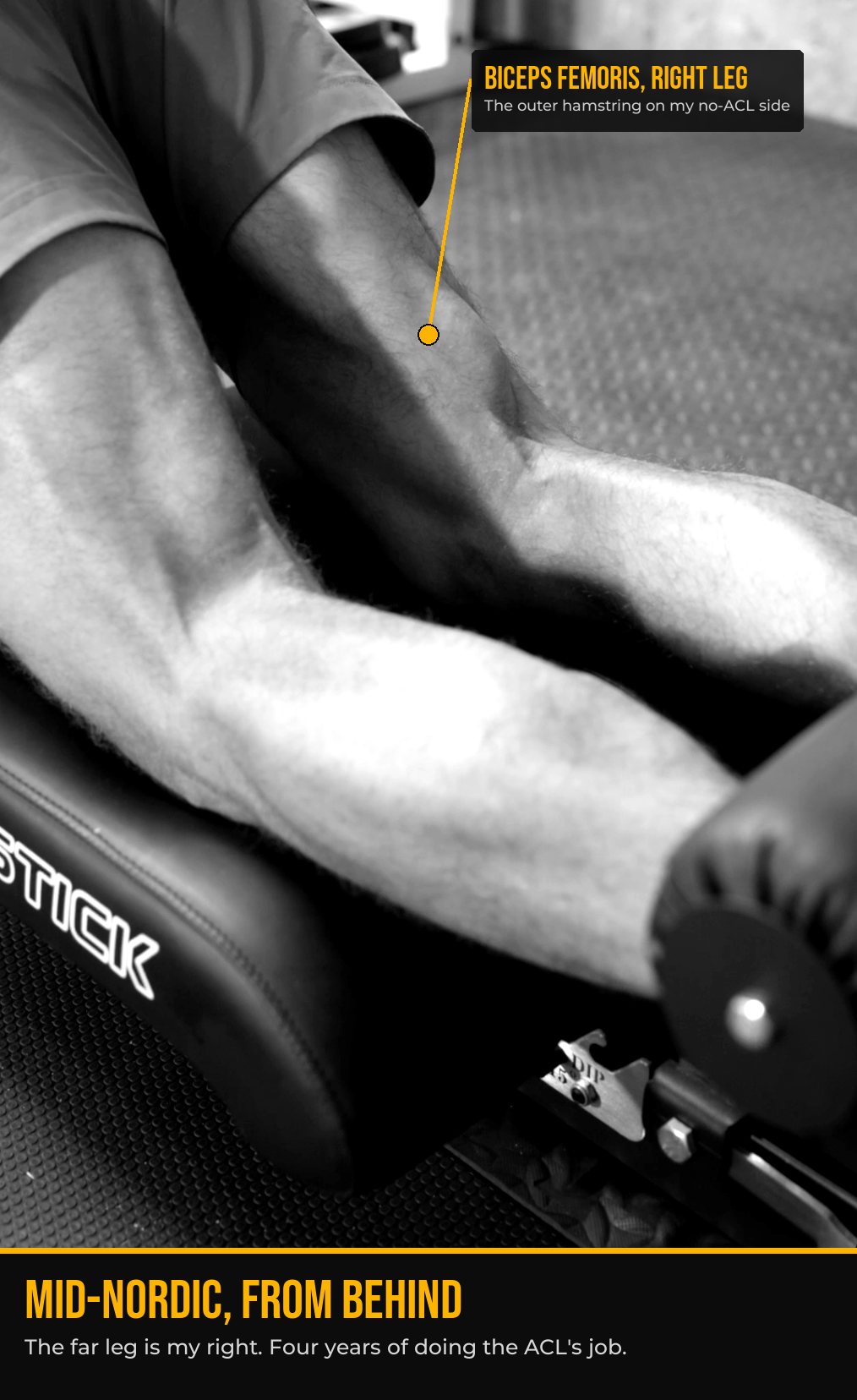
Here's what that looks like in real life. This photo is from the middle of an eccentric Nordic curl, taken from behind. The outer hamstring on my right leg (the biceps femoris, on the side with no ACL) has grown noticeably bigger than the one on my left. I like to think that's four years of it doing the ACL's job.
Mid-Nordic, from behind. The biceps femoris on my right leg, the one with no ACL, is the big one.
What the research says
I don't want you to just take my word for it, so here's some of the research, with links if you want to go deeper. (All of them open in a new tab.)
The hamstrings and the ACL are a team. This has been known for a long time. Back in 1987, researchers showed that putting stress on the ACL automatically fires the hamstrings, like a reflex, and that in knees with a damaged ACL the hamstrings were still being recruited to hold the joint together. A few years later, a lab study of the squat found that adding hamstring force reduced how far the shin slid forward and how much it rotated, and that after the ACL was cut, the hamstrings took load off the reconstructed graft. The title of that paper is "Hamstrings: an anterior cruciate ligament protagonist," which is about as clear as research titles get.
Weak hamstrings show up before ACL tears. In a study of female athletes, the women who went on to tear an ACL had hamstrings about 15 percent weaker than the matched men, while their quad strength was no different from the men's. In other words, strong quads with hamstrings that couldn't keep up. That's the exact pattern I'd want to fix in anybody's knee, torn ACL or not.
Training programs cut ACL injuries in half.A review that pooled all of the previous reviews on ACL injury prevention programs found that they cut ACL injuries by about 50 percent, and non-contact ACL injuries in female athletes by about two thirds. Those programs are a mix of strength work, landing practice and balance, and hamstring strengthening is a piece of nearly all of them.
The Nordic programs. You'll see me mention the Nordic hamstring curl a lot in this post, so here's why. Over the last 20 years, a lot of soccer, rugby and other team-sport researchers ran the same experiment: give one group of athletes the Nordic hamstring curl a couple of times a week on top of their normal training, give the other group nothing extra, and count the hamstring injuries. A 2019 review pooled 15 of those studies, 8,459 athletes in total, and found that the teams doing Nordics had about half as many hamstring injuries. To be clear, those are hamstring strains, not ACL tears. But it tells you two things: the Nordic is a proven way to build the muscle that protects your ACL, and a few sets a week is enough to do it.
Lowering under load builds longer, stronger hamstrings.A study of elite soccer players found that the players with short hamstring muscle fibers, or weak eccentric hamstring strength (the lowering half of a rep), were about four times more likely to strain a hamstring that season. And a follow-up training study showed that ten weeks of Nordics, or ten weeks of hip extensions, lengthened those fibers. That's why the lowering half of every hamstring rep gets so much attention in my programs. More on that below.
If you're living without an ACL: copers are real
This is the part I wish someone had explained to me after my fourth tear. In the research, people who tear their ACL and go on to function well without surgery are called copers. They're real, there are a lot of them, and researchers have been studying them for over 25 years (here's a review of that research if you want the overview).
One of the original studies screened 93 people with a fresh ACL tear using a few hop tests and some simple questions about the knee giving way. About four in ten passed the screen, and of the ones who then tried to get back to high-level activity without surgery, nearly eight in ten made it back without their knee giving out. When researchers looked at how copers move, their knees bent, loaded and fired their muscles almost exactly like uninjured knees did. The people who struggled (the non-copers) were the ones whose hamstrings fired late and who stiffened the whole knee up instead. Later work showed that the right training could move people toward the coper side. And in a randomized trial that followed people for five years, the group that rehabbed first and only had surgery if they needed it did just as well as the group that had surgery right away, and about half of them never had the surgery at all.
None of that is me telling you to skip surgery. I'm a strength coach, not a doctor, that's a decision for you and your surgeon, and plenty of people in that rehab-first group did end up needing the surgery later. What it tells you is that the muscles around your knee can adapt and do a big share of what the ACL used to do, and your hamstrings are the most important muscle for that. Four years in, mine hold my shin where the ACL used to, and I've written about what living without an ACL actually looks like if you want the details. If there's one thing I'd want every ACL-deficient knee to have, it's strong hamstrings.
Before you go any further: grab the free guide
Not everyone reads to the bottom of a post like this, so here's the thing I'd want you to leave with. My Kneehab Strength guide is free, it's a weekly routine (three sessions a week), and it has the hamstring work in this post programmed in, along with the quads, glutes, calves and feet that make a knee strong. Put in your email and I'll send it over.
Free download
The Kneehab Strength Guide (free)
A free weekly routine: three sessions a week of the lifts the Kneehab Strength program is built on, with eccentric Nordics, RDLs and hip thrusts programmed in (and hamstring slides as the swap if you're not there yet), a warm-up for every session, a 12-week plan for adding weight, and a video of me doing every exercise.
The PDF lands in your inbox in about a minute. You'll also get my weekly knee-training email, and you can unsubscribe anytime.
The hamstring exercises I'd recommend, from home to gym
Here's how I'd build your hamstrings, starting with what you can do on the floor at home and working up to the gym. Each one links to a video of me doing it, with the sets and reps I'd start with. You don't need all of them. Pick two, one from the lowering side and one from the lifting side (more on that below), and get consistent.
1. Glute bridges, then feet-elevated glute bridges
The simplest place to start. Lie on your back, heels close to your hips, and drive your hips up until your body is a straight line from your shoulders to your knees. Here's a quick demo. The closer your heels are to your hips, the more glute it is. Slide them a little further away and the hamstrings have to help hold the bridge. Once that's easy, put your feet up on a bench or a couch (feet-elevated glute bridge), which puts even more of the work into the hamstrings, and eventually do it one leg at a time.
Start with: 3 sets of 15, with a squeeze at the top. Move to the feet-elevated version when that's pain-free, and to one leg at a time when 15 feels easy.
2. Glute bridge walkouts
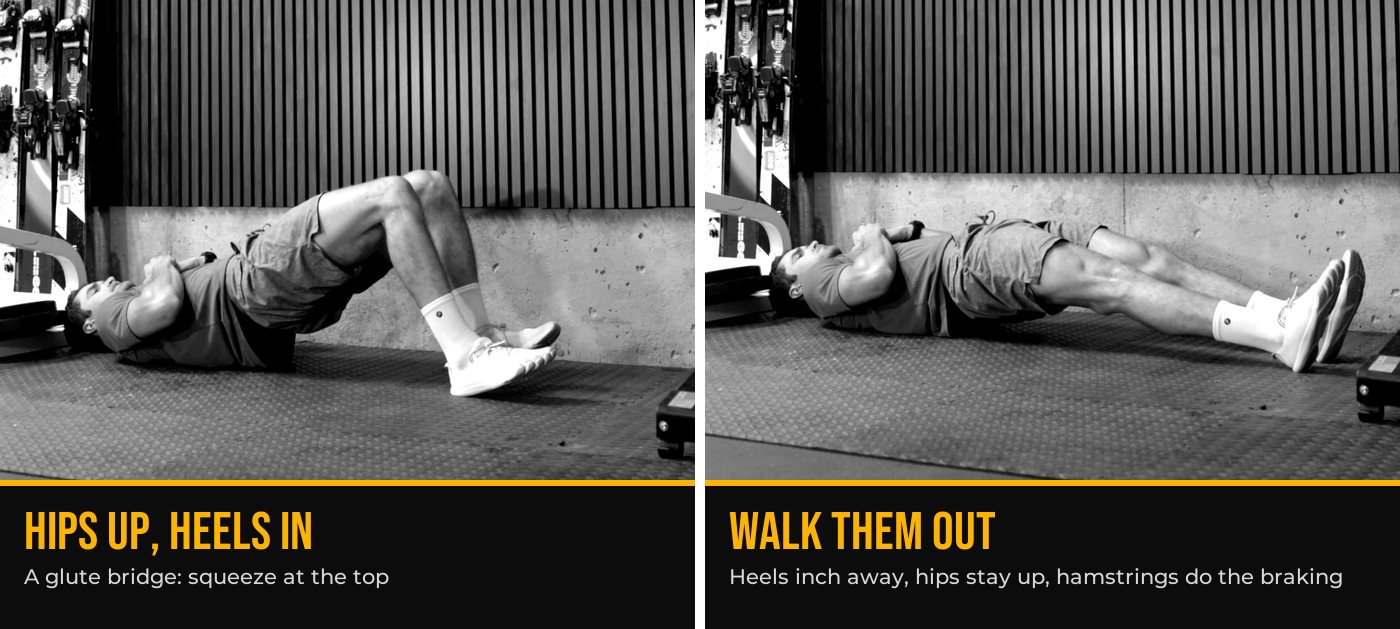
Still no equipment, and this is where the hamstrings really start braking. Get to the top of a glute bridge, keep your hips up, and walk your heels out an inch at a time until your legs are nearly straight, then walk them back in. Here's a quick demo. The whole time your heels are moving away, your hamstrings are lengthening under load, which is exactly what they have to do when you plant your foot and your body keeps going.
Hips up, heels in. Then walk them out an inch at a time while your hamstrings do the braking.
Start with: 3 sets of 6 to 8 walkouts, slow on the way out.
3. Hamstring slides
Same idea, with a bigger range of motion. Put your heels on a pair of sliders, or a towel on a hard floor, or socks on a wood floor, bridge your hips up, and slide your heels away from you under control, then pull them back in. Here's a quick demo. If a Nordic is too much right now, this is the swap I program instead, because it trains the same slow lowering with a fraction of the load.
Start with: 3 sets of 8 to 10. Make the slide out take three or four seconds.
4. Banded hamstring curls and banded RDLs
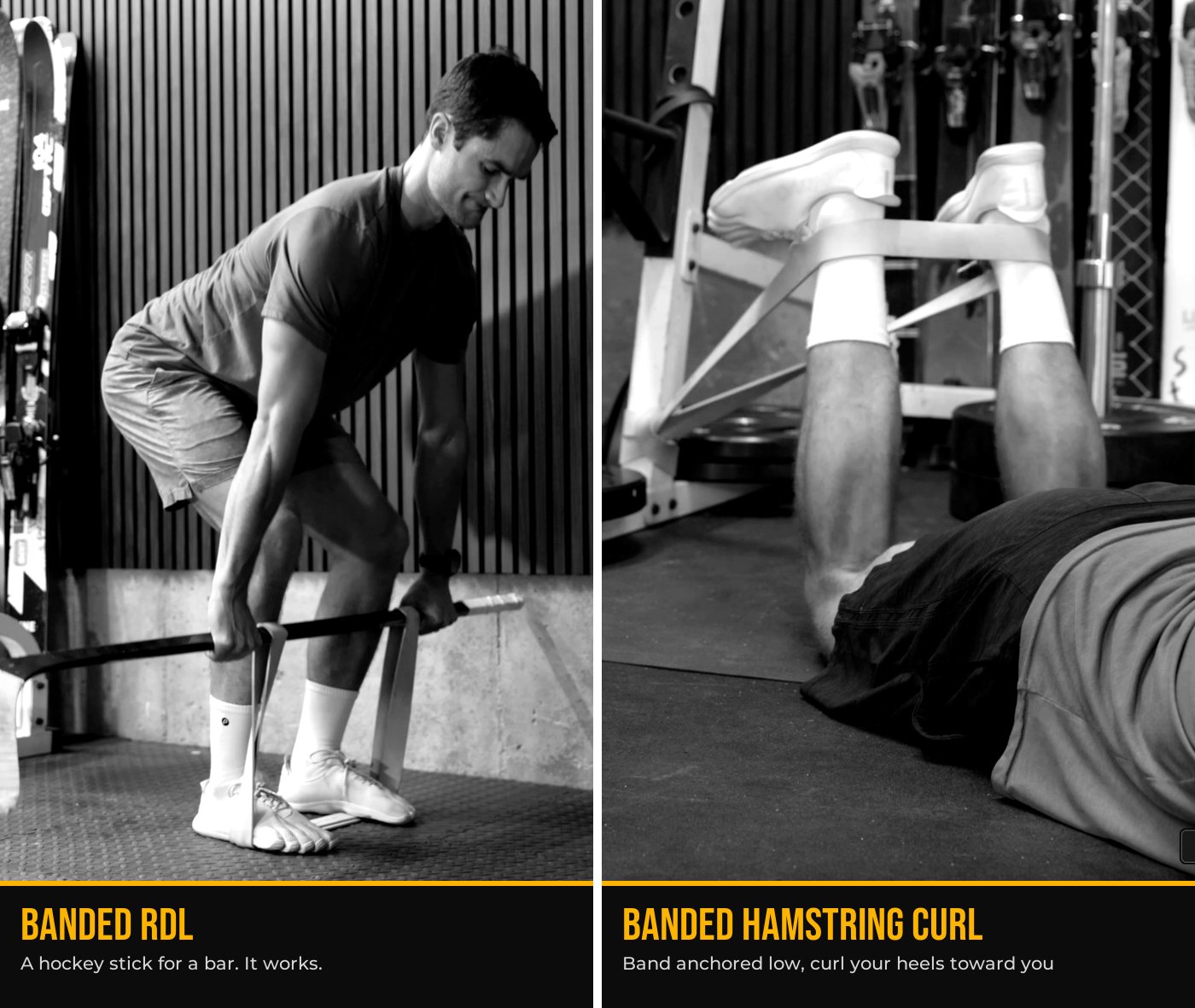
One big resistance band opens up two more at-home options. For banded hamstring curls, anchor the band low, lie face down with it around your ankles, and curl your heels toward you. That's the lifting half of the hamstring's job with real resistance, and it's the closest thing to a curl machine you can do at home. For a banded RDL, stand on the band, hold the other end (or loop it over a bar, or in my case a hockey stick), push your hips back with a soft bend in your knees until you feel the stretch in your hamstrings, then drive your hips forward to stand up. Here's the single-leg version I use a lot. The bands I use are from Battle Bunker. They're my go-to for quality and durability.
Two at-home band exercises. A hockey stick makes a fine bar, and yes, it makes for a funny photo.
Start with: curls, 3 sets of 15 per side. Banded RDLs, 3 sets of 10 to 12, slow on the way down.
5. RDLs with dumbbells, kettlebells or a barbell
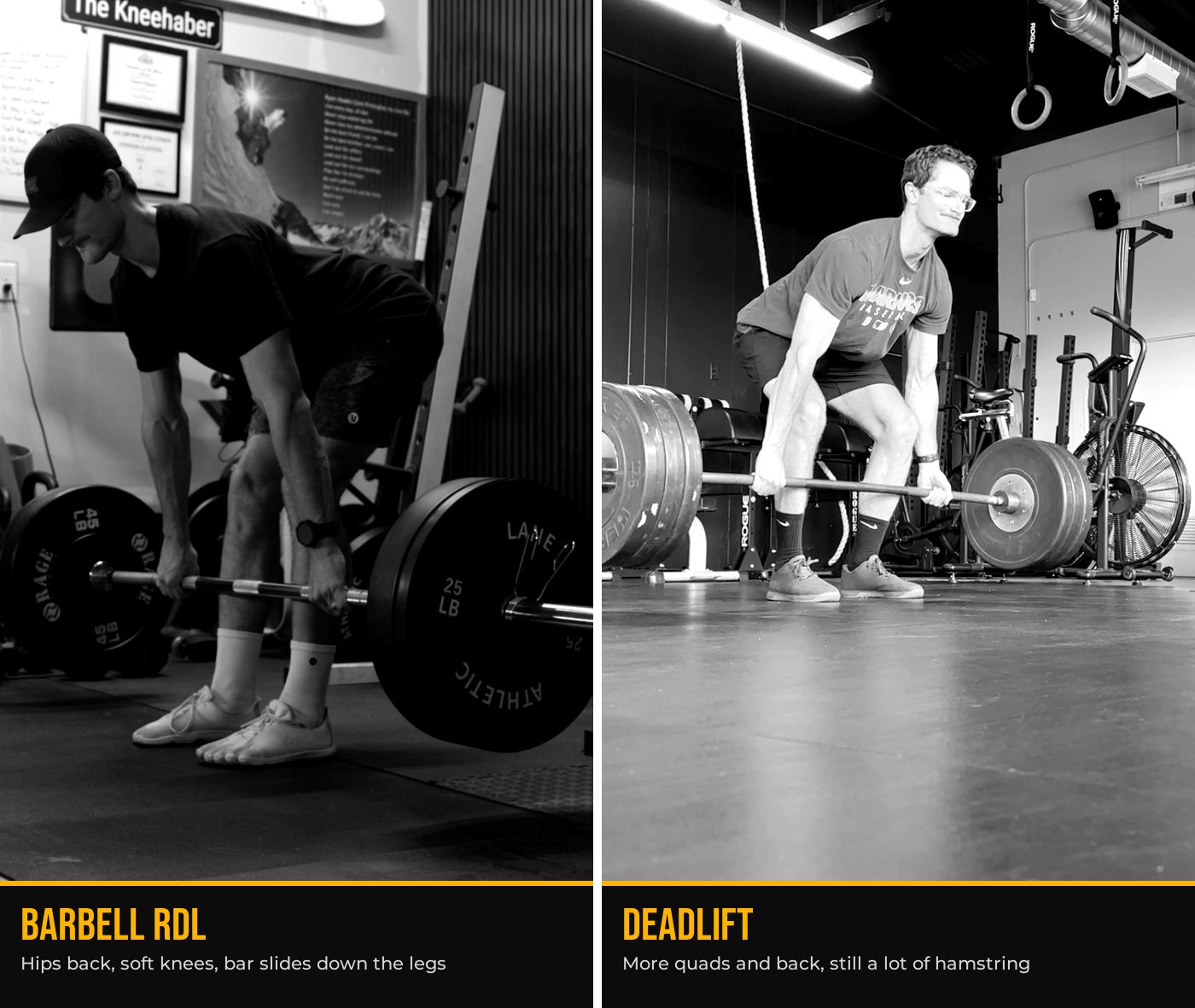
The Romanian deadlift is the hamstring exercise I'd never take out of a program. It's a hinge: feet under your hips, a soft bend in your knees, and you push your hips back and let the weight travel down the front of your legs until your hamstrings tell you to stop, then you stand up by driving your hips forward. The lowering half is where the magic is, so make it slow. Here's a quick demo with dumbbells, here's the barbell version for when you want to load it heavy, and here's a single-leg RDL for balance and for finding out which side is weaker (there's always one). Dumbbells or kettlebells at home get you a long way. The barbell is where the real strength comes from once you've earned it.
A regular deadlift off the floor is a great hamstring exercise too, and if you already deadlift, keep it. The difference is where the work lands. A deadlift starts from the floor with more knee bend, so your quads and your back take a bigger share of it. An RDL starts from the top, keeps the knees soft and takes the hamstrings into a deep stretch under load on every rep, so for the stretch-strength side of things, RDLs are better overall. I keep both around.
The RDL (left) lives in the stretch. The deadlift (right) starts from the floor and shares the work with the quads and back.
Start with: 3 sets of 8 to 10, three seconds down. Add weight when every rep is smooth.
6. Nordic hamstring curls, at home or on a Nordic bench
The one with all the research behind it, and the one that did the most for my knee. Kneel with your ankles locked under something that won't move, keep your hips open, and lower your body toward the floor as slowly as you can, using your hamstrings as the brakes, then push yourself back up with your hands and do it again. Here's how I do eccentric Nordics, and here's the full Nordic for once you can control the whole way down. I wrote a whole post on Nordics and ACL protection, and there's a step-by-step technique page too.
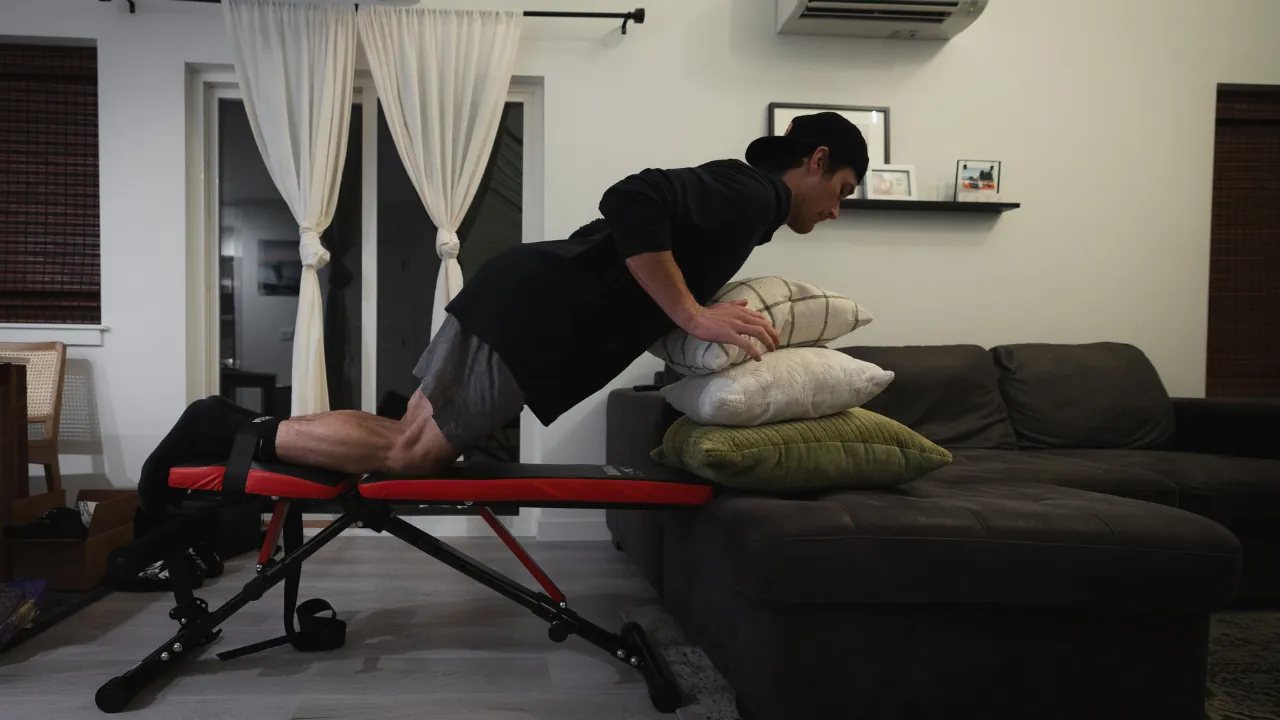
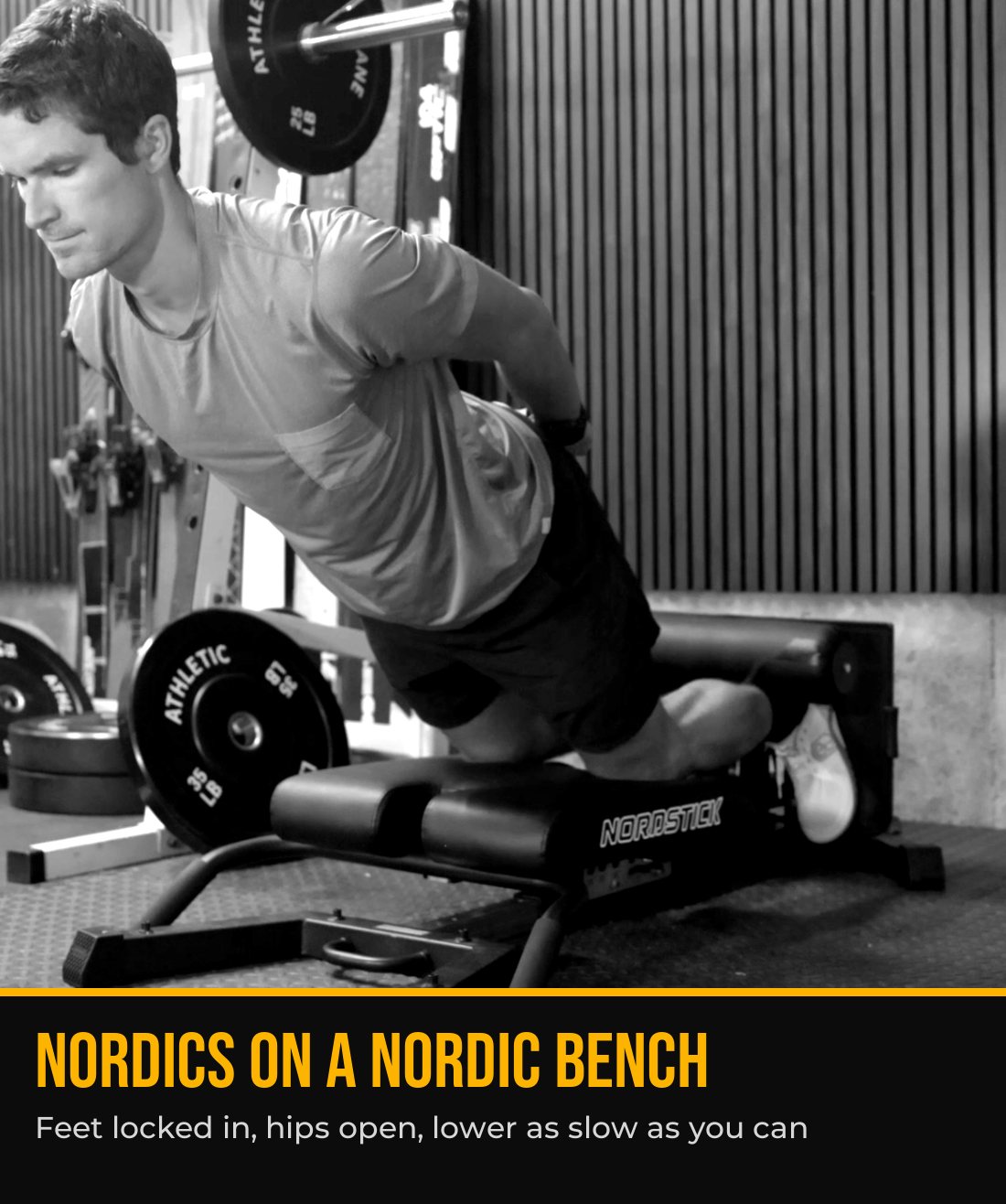
You don't need a bench to start. My first setup was a strap over a weight bench and a pile of pillows to lower onto, and it worked for a long time. These days I train on a Nordstick NordBench Pro, which stores away easily and doubles as a back extension, and if you'd rather go the ATG route, ATG's Nordic bench is the one I'd point you to. Either way, a bench makes the setup faster and the lowering smoother, which means you'll actually do them.
My first Nordic setup: a weight bench, a strap and a pile of pillows to lower onto.The setup now. Feet locked in, hips open, lower as slow as you can.
Start with: 2 sets of 3 to 5 slow lowers, twice a week, and add a rep a week. If you can't control the lowering yet, do hamstring slides instead and come back to it.
7. Machine hamstring curls, seated or lying
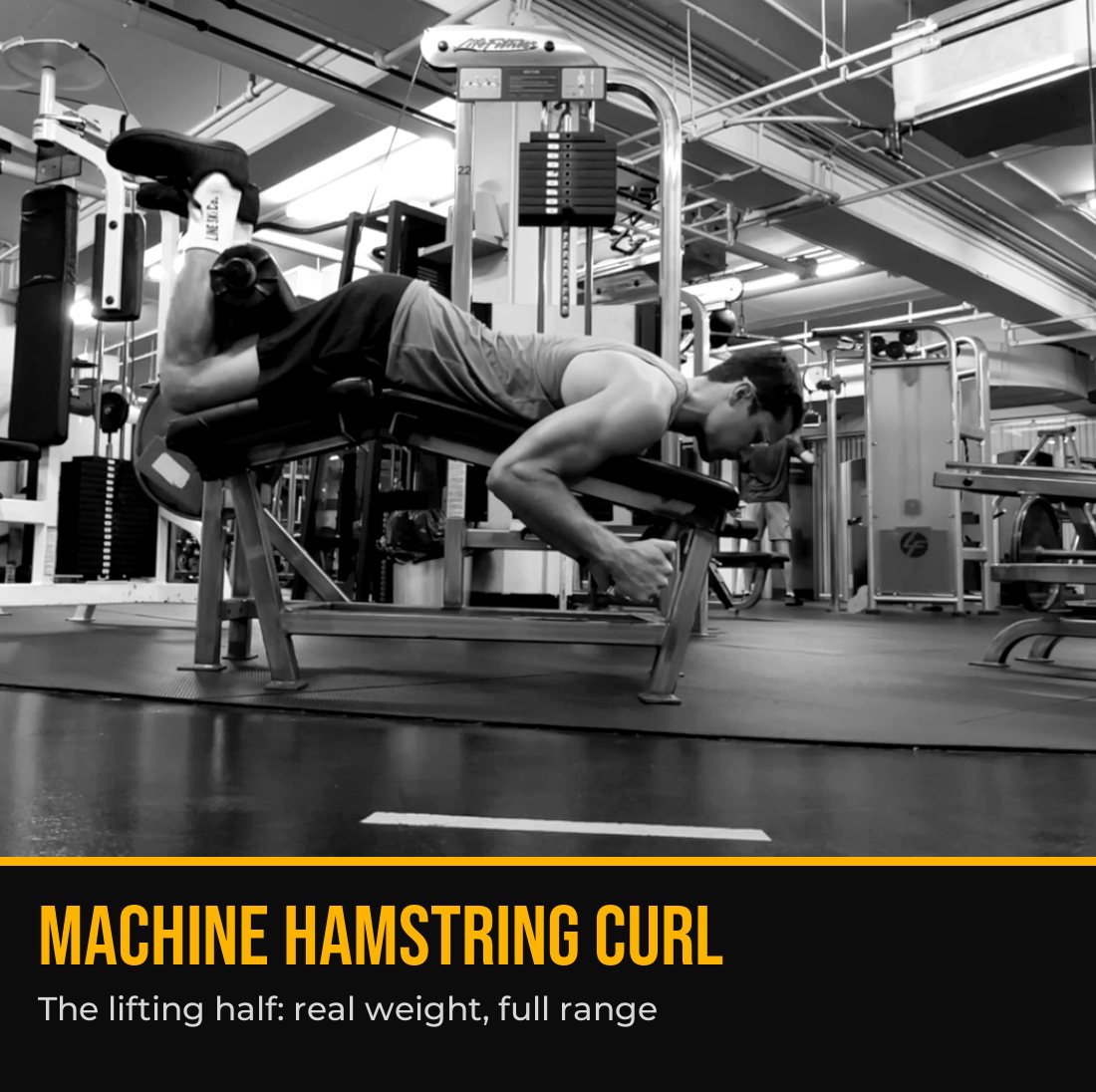
If you have a gym, the hamstring curl machine (seated, or lying face down) is the easiest way to load the lifting half of the hamstring's job with real weight through a full range of motion. There's nothing fancy about it. Pick a weight you can curl all the way up with control, lower it slowly, and add weight over time. This is where the hamstring power that athletes care about gets built.
The lifting half with real weight: a lying hamstring curl at the gym.
Start with: 3 sets of 10 to 12, two seconds up, three seconds down.
Eccentric vs concentric: brakes and power
Every rep has two halves. The concentric half is the lifting half, where the muscle shortens: curling your heels in, standing up out of an RDL. The eccentric half is the lowering half, where the muscle lengthens while it's still working: lowering yourself in a Nordic, letting the weight travel down your legs in an RDL, walking your heels out in a bridge.
The eccentric half is what the hamstring is doing in the exact moment an ACL gets hurt. Your foot plants, your body keeps going, and the muscle has to lengthen while it brakes. Eccentric Nordics train exactly that, and the research above shows they make the hamstring fibers longer and stronger in that lengthened position. Think of it as building your brakes. That's the half that matters most for ACL prevention, and it's why Nordics, RDLs, slides and walkouts take up most of this post.
The concentric half builds power: the hamstring's ability to pull hard and fast. That's the curls, banded or machine, and it matters more the more athletic you are. If you sprint, jump, cut or ski, you want both. The lowering half protects the knee, and the lifting half makes it fast. Gym programs tend to cover the lifting half and skip the lowering half, so if you take one thing from this post, add the lowering half.
How I'd put it together
Two hamstring slots a week is plenty. One lowering-focused exercise (Nordics once you've earned them, slides or walkouts until then, and RDLs either way) and one lifting-focused exercise (a curl, banded or machine). Three sets each, slow on the lowering half, and add a little load or a rep every week. Do that for a few months and your knee gets a backup system it didn't have before. If you've got questions about any of it, send me an email.
Where this goes next
The exercises above will build hamstrings that do their share of the ACL's job. What makes it stick is the order you add them in, how fast you add weight, and whether your quads, glutes, calves and feet come along for the ride, because a knee is only as strong as its weakest link.
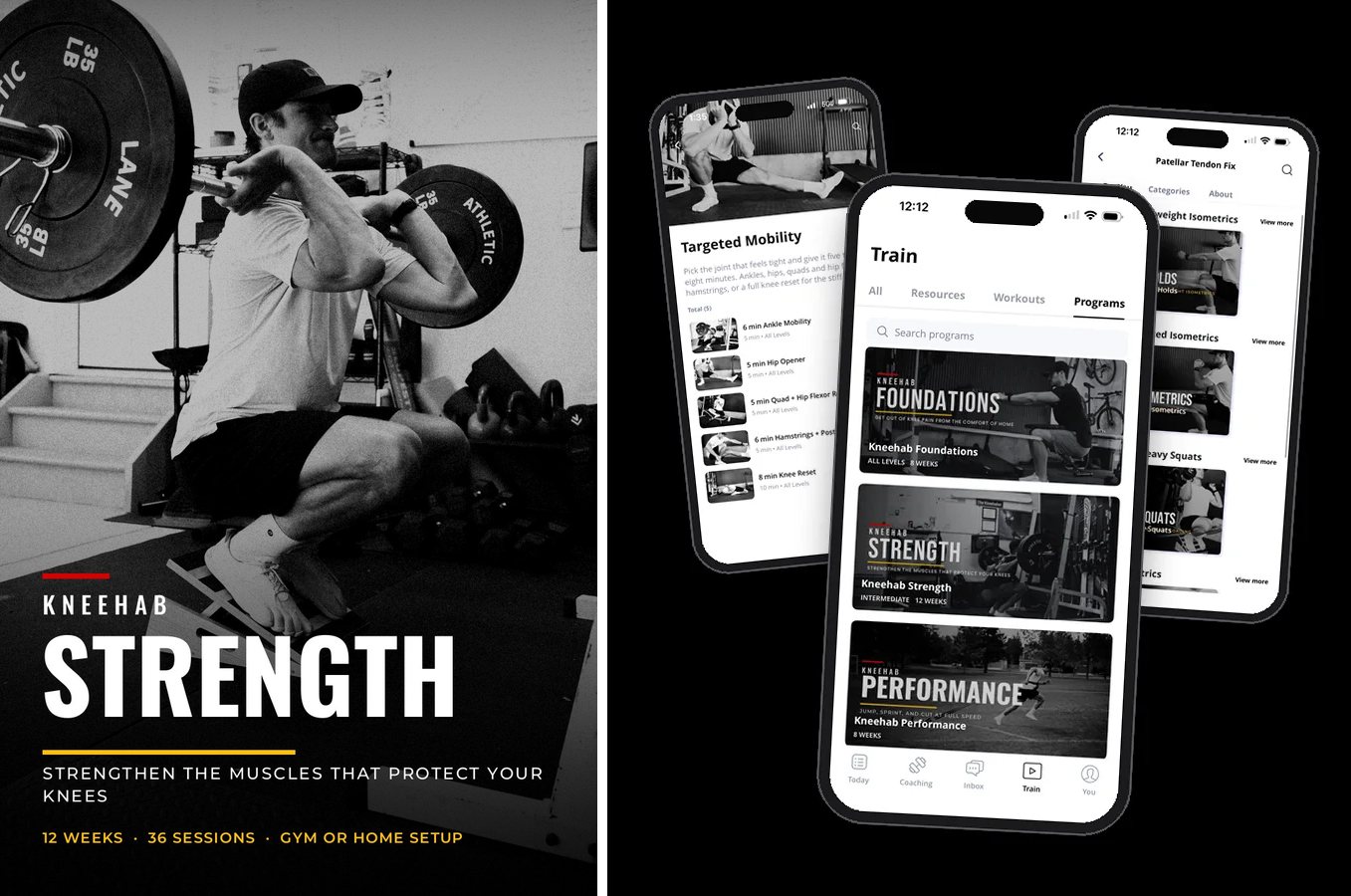
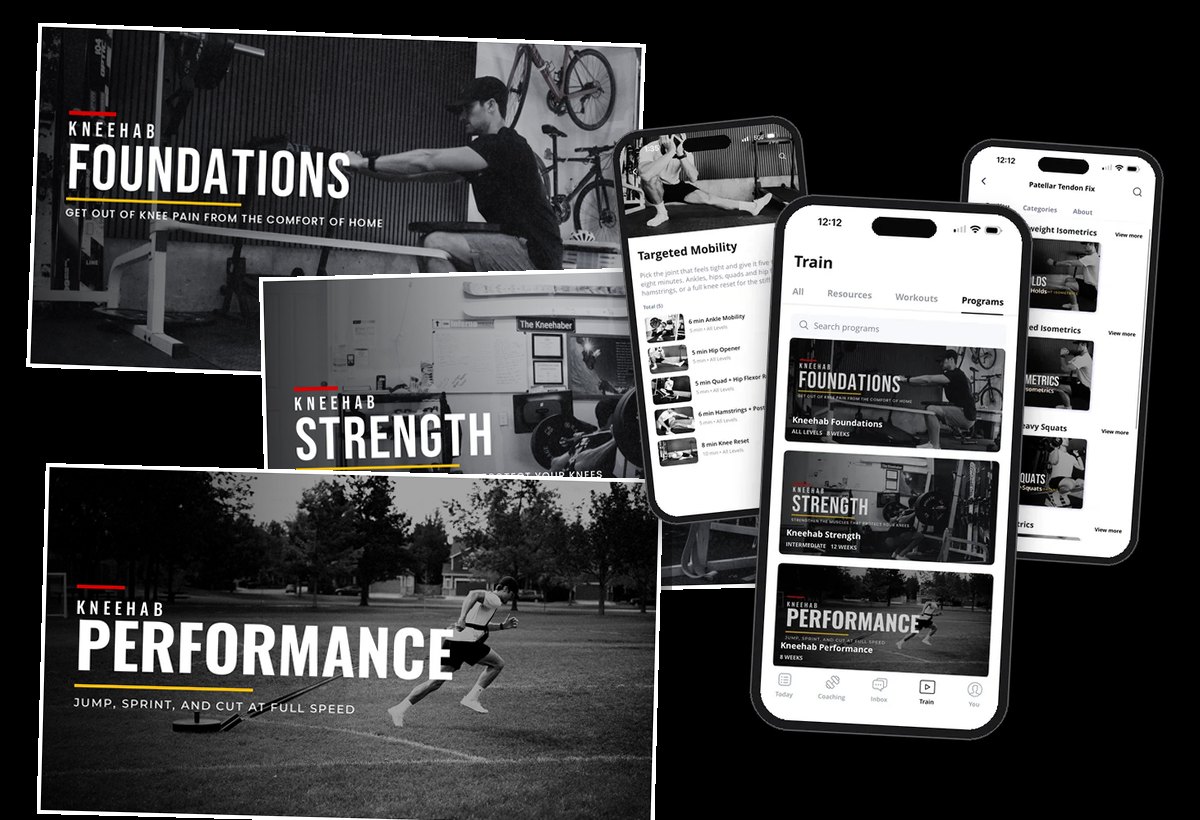
That's what the Kneehab Strength program inside the Strong Knees System is for. It's 12 weeks and 36 sessions, three days a week with dumbbells, kettlebells and a barbell if you have one. Eccentric Nordics, RDLs and hip thrusts are all in there, every week builds on the last, there's a deload built in so your joints adapt instead of flare up, and every exercise is on video with the sets and reps written out. You open the app, you see what's on the menu for the day, and you go train. If the exercises in this post are starting to feel easy, this is the next step.
Kneehab Strength: 12 weeks, 36 sessions, every exercise on video inside the Strong Knees System app.Three of the programs inside the Strong Knees System. Strength is where the hamstring work in this post lives.
They can lower the risk, and they can't make it zero. The prevention programs in the research cut ACL injuries by about half, and hamstring strength is a big part of why. Contact injuries, bad landings and bad luck still happen. But a knee with strong hamstrings has a muscle doing the ACL's job alongside the ligament, and that's the best insurance I know of.
Do hamstrings still matter after an ACL reconstruction?
More than ever, in my experience. A reconstructed ACL is a graft that takes a long time to fully mature, and the hamstrings are what protect it in the meantime. Follow your surgeon's and your physical therapist's timeline for when to load them, and once you're cleared, make them a priority.
How often should I train my hamstrings?
Twice a week is my answer for just about everyone. One lowering-focused slot and one lifting-focused slot, three sets each. Nordics in particular don't need more than two sessions a week. The programs that cut hamstring injuries in half ran them a couple of times a week.
Do I need a Nordic bench?
No. A strap over a weight bench, a partner holding your ankles, or your feet under a couch all work, and hamstring slides get you most of the benefit if a Nordic is too much right now. A bench just makes the setup faster and the lowering smoother. I started on a makeshift setup and it did the job.