You Are Not Your MRI: What a Scary Knee Scan Really Means
Connor Clayton · The Kneehaber ·
This post is about a piece of paper that scares a lot of people out of training: the radiology report. If you've got one sitting in a drawer with a scary word on it, this one's for you. I hope it helps!
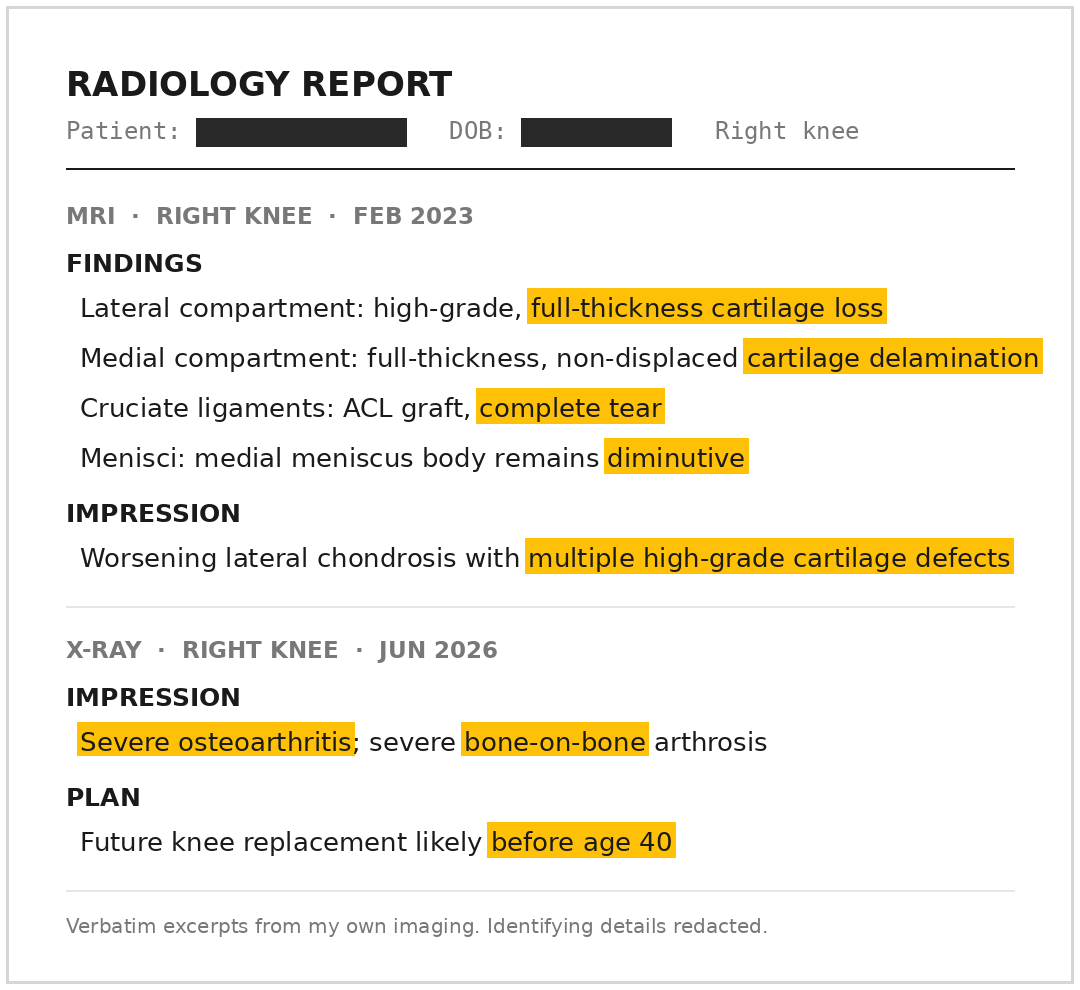
Here's a look at my MRI report. As you can tell, it's pretty ugly, and it sets the stage for the rest of this article.
Verbatim excerpts from my own imaging. Identifying details redacted.
Full-thickness cartilage loss. Complete tear. Bone-on-bone. Knee replacement likely before 40. If you handed that report to almost anyone, they'd picture someone who can barely walk, who's done with sports and in pain all the time.
That's my knee. It's the same right knee that tore its ACL four times between 2015 and 2023, and these days there's no ACL in it at all (I wrote about that in another article of mine, Living Without an ACL). Around the time that X-ray was taken I was lifting, running, skiing and playing sports on the weekend, and a couple of months later it helped me summit Kilimanjaro. I feel strong, and most days I don't think about my knee at all. My report says knee replacement before 40. My life says I'm the strongest and most active I've ever been. Both are true, and I choose to train the one I can control.
Your scan is not your story
An MRI is a snapshot of what's inside your knee. It doesn't measure what you can do, how much you hurt or where you're headed. In a 2020 study, researchers put 115 adults with no knee pain and no knee injuries through a high-resolution MRI and found something "abnormal" in 97 percent of their knees. Thirty percent of those pain-free knees had a meniscus tear, and half of them had cartilage damage the radiologists graded moderate or severe.
That wasn't just one study. A review that pooled 63 studies and more than 5,000 pain-free, uninjured knees found cartilage defects in about a quarter of them overall, and in 43 percent of people over 40. In the Framingham study, 89 percent of people over 50 whose X-rays looked clean had something on the MRI anyway, and the number was about the same whether their knee hurt or not. And a New England Journal of Medicine paper from the same town found that 61 percent of the people walking around with a meniscus tear on their MRI had felt no pain, aching or stiffness at all in the previous month. If you've been told you have a meniscus tear, I wrote another article about that: Torn Meniscus: Why Training Comes First.
X-rays and the word arthritis aren't much better at predicting pain. In a national survey of almost 7,000 Americans, fewer than half of the people whose X-rays showed moderate to severe knee arthritis had any knee pain, and 85 percent of the people who did have knee pain showed no moderate to severe arthritis at all. A later review found that depending on the study, anywhere from 15 to 81 percent of people with arthritis on an X-ray actually hurt. What a scan shows and how your knee feels are only loosely connected.
Part of the reason is something I covered in another article of mine, The Pain Behind Your Kneecap: cartilage has no nerves in it. A surgeon named Scott Dye had his own knees scoped awake, with only the skin numbed, so he could report what each part felt like when it was prodded. When the cartilage on the back of his kneecap was touched, he felt nothing. So a worn patch of cartilage can't be the thing that hurts. What can hurt are the parts around it that do have nerves.
This isn't just a knee thing, either. Spine studies show that disc degeneration shows up in 37 percent of pain-free 20-year-olds and 96 percent of pain-free 80-year-olds. Those people had the findings on their scans and no back pain to go with them. It's a lot like gray hair, just on the inside of your body: a normal part of getting older that doesn't mean you're going to hurt.
I'm not saying scans are made up. Mine isn't. I've had four ACL tears and both menisci torn in that knee, and about half of the people who tear an ACL or a meniscus have arthritis in that knee 10 to 20 years later, so the arthritis in my report is real. What I'm saying is that a scan can tell you what your knee looks like, but it can't tell you what your knee is able to do. That part is still up to you, and it's the part I can help with.
What the words on the report do to you
What worries me more than any finding is what those words do to people. I've watched people get a report, read "bone-on-bone" or "full-thickness tear," and mentally retire. They stop moving because a piece of paper scared them. The frustrating part is that stopping is usually what makes things worse. A knee that doesn't get loaded gets weaker, the muscles that protect it shrink, and then the joint really is fragile. It's the sitting still that does that.
There's research on this too. A 2021 trial in the European Spine Journal gave half of a group of back pain patients a plain, factual walk-through of their MRI report, and reassured the other half that the findings were normal changes. They all had the same kind of scans. Six weeks later, the group that got the plain report had a more negative view of their own spine, less pain improvement and worse function.
Another study interviewed people with back pain and found that what a clinician said about their back stuck with them for years, and that being told to "protect it" turned into worry and guilt. And in knee arthritis specifically, researchers found that pain leads to avoiding activity, avoiding activity leads to weaker muscles, and weaker muscles are what actually limit what people can do. That's the loop I'm trying to help you break.
I've been on the receiving end of this myself. My last orthopedic surgeon looked at my report and told me I'd need a knee replacement before I'm 40. I'm 30 now. Sure, he said that, and I'm pretty damn confident I'm going to work as hard as I can to delay it for as long as possible. It very well could happen, and if it does, that's something I'll live with, and that's okay. But just because a surgeon told me that doesn't mean I'm going to shut down and stop doing the things I love to do. I'm still going to live my damn life, and you should too.
To be clear, I'm a strength coach, not a doctor, and I'm not telling you to ignore yours. There are real red flags, and I'll get to them below.
You're not stuck with bad knees
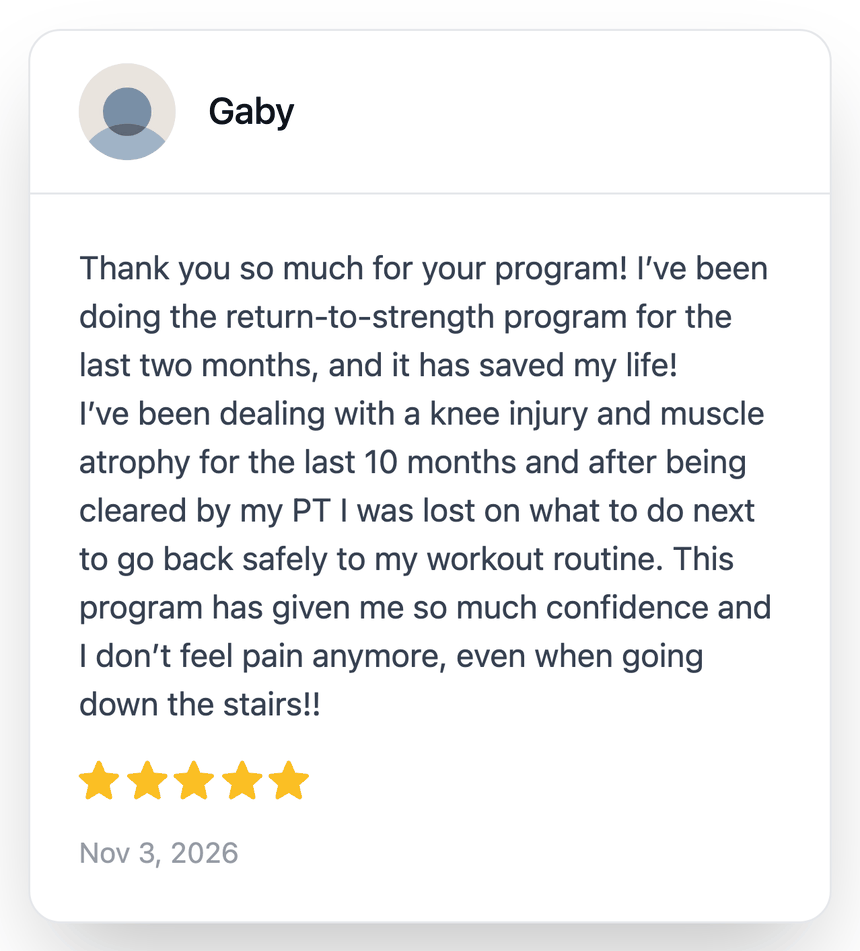
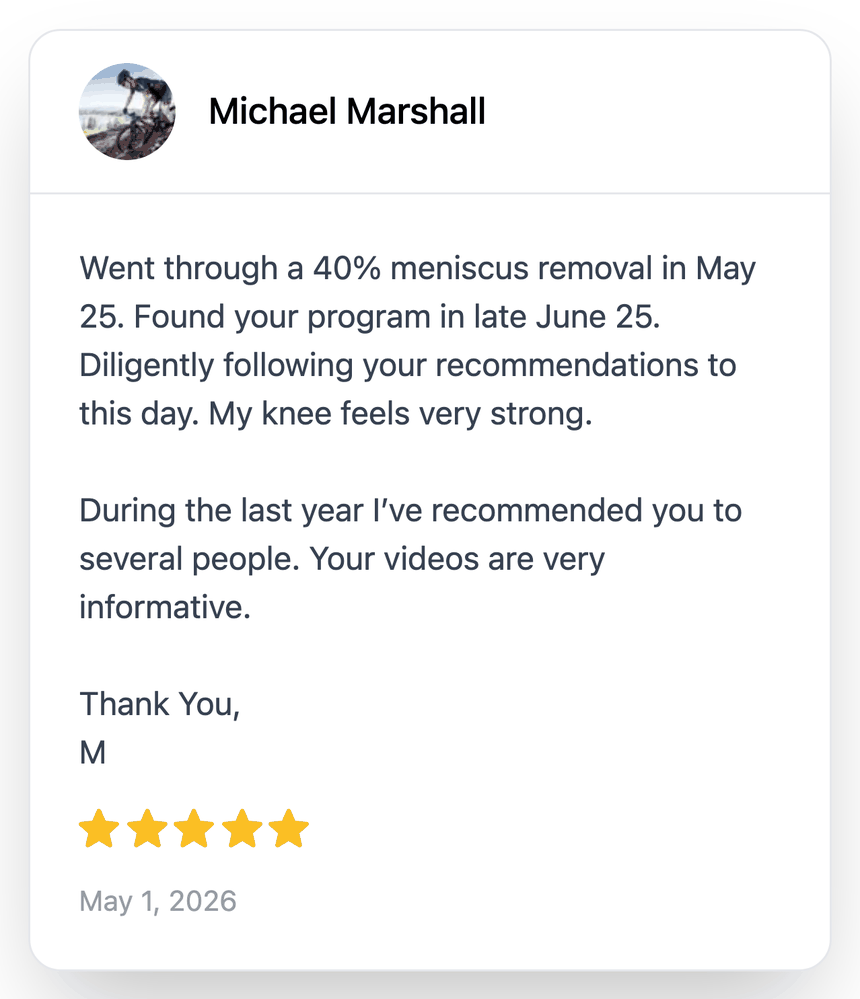
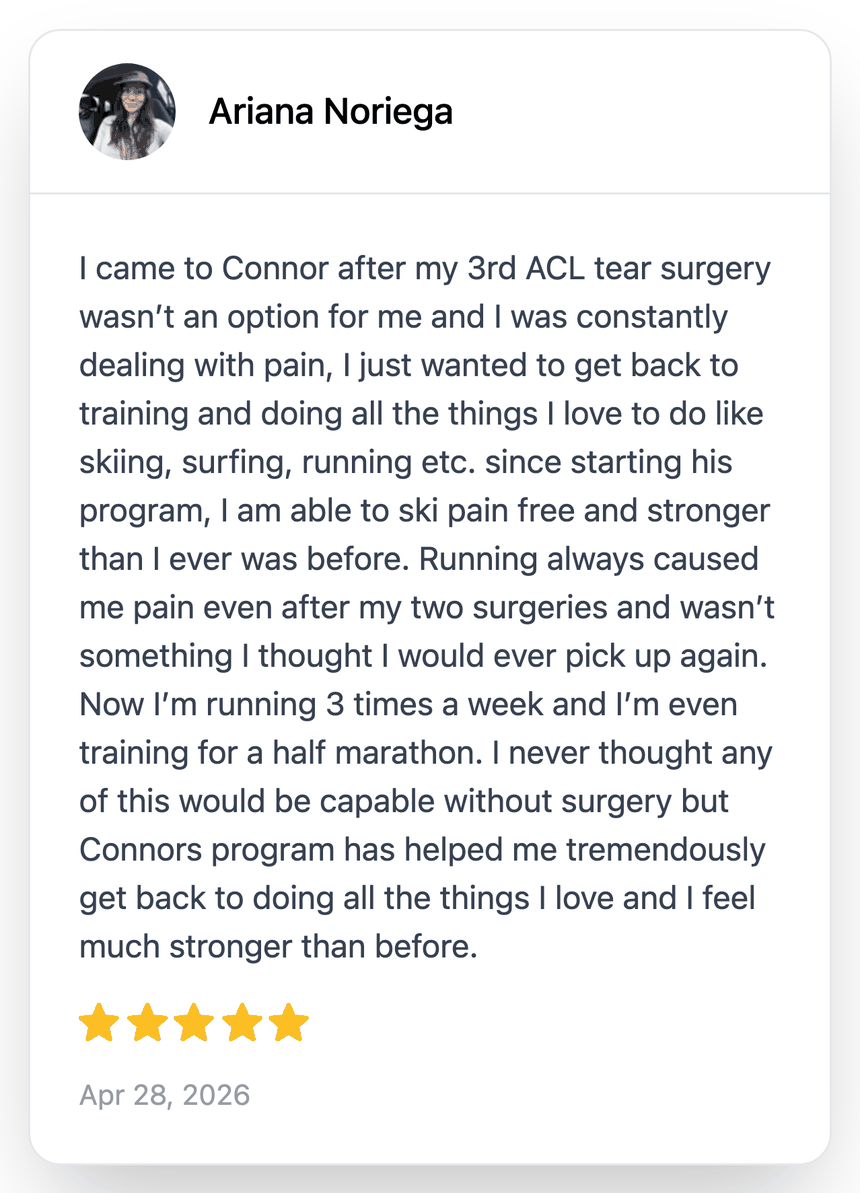
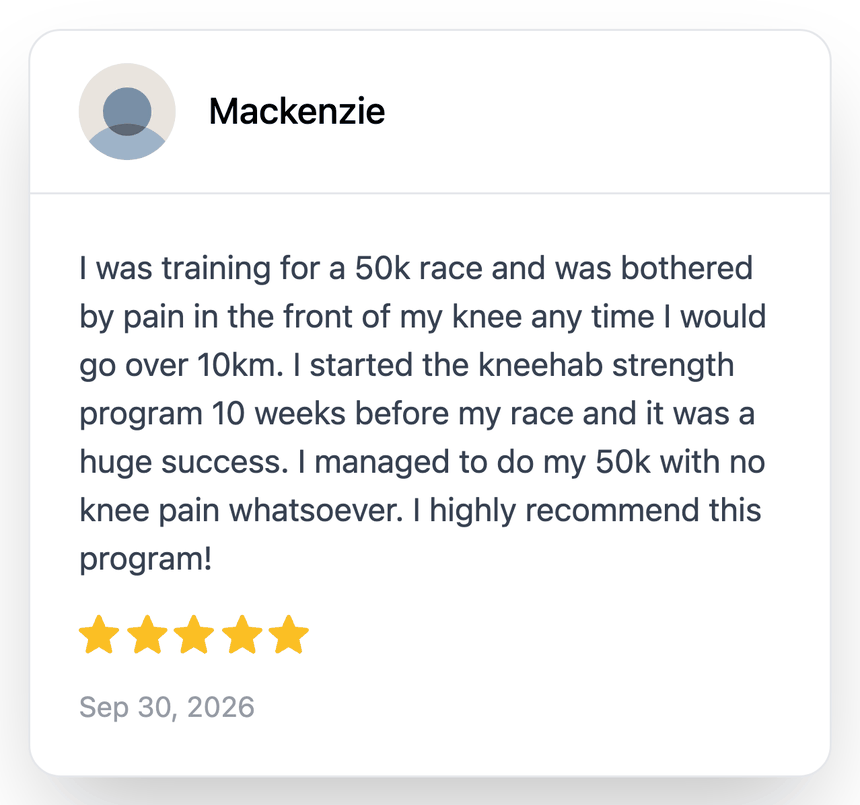
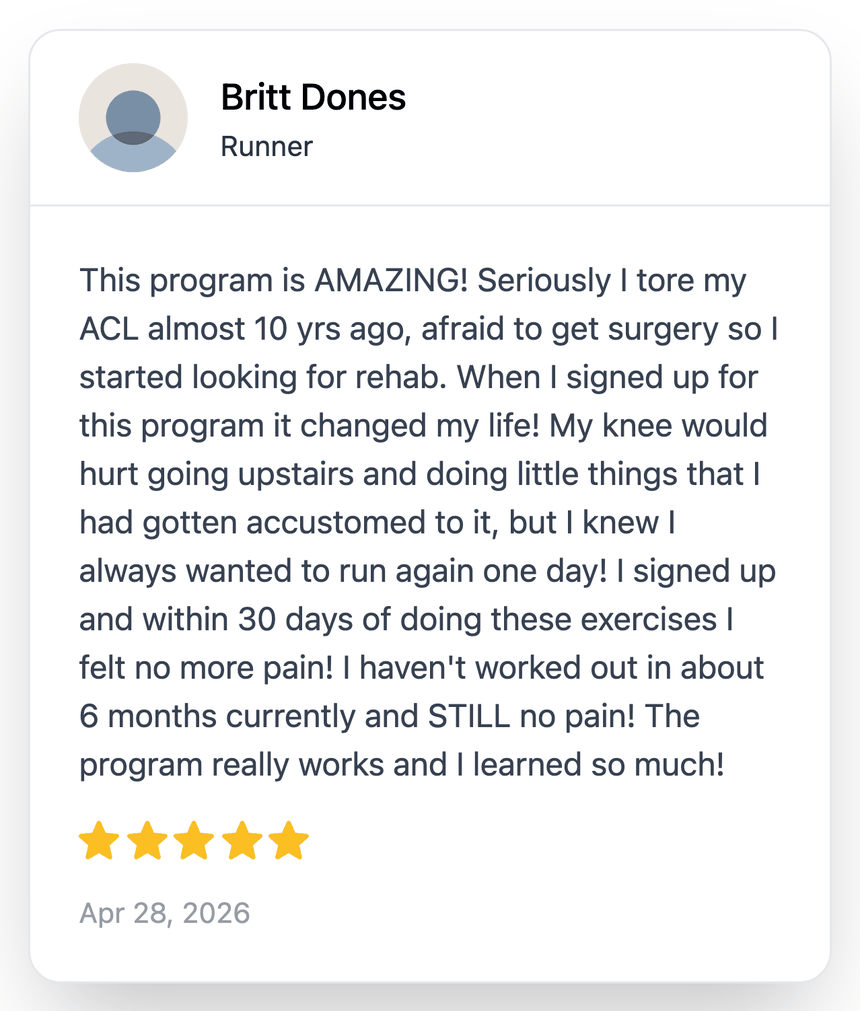
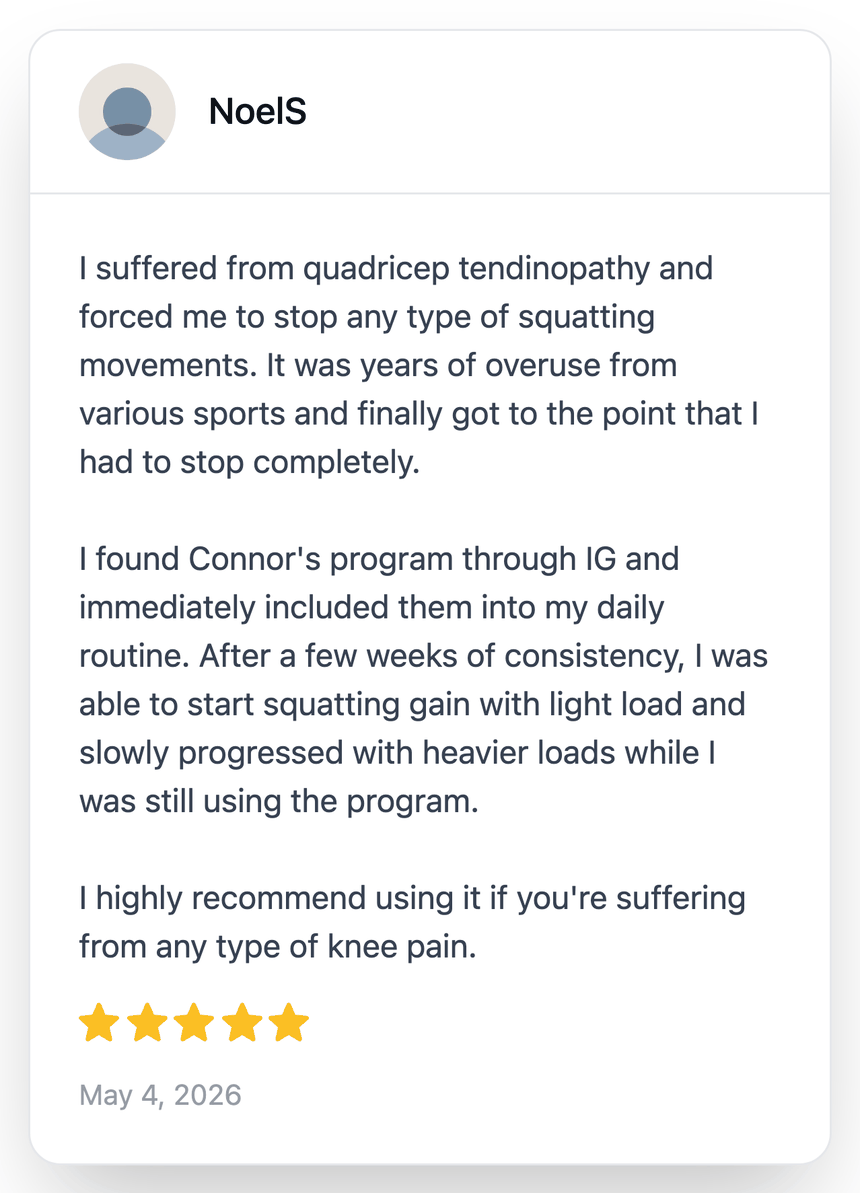
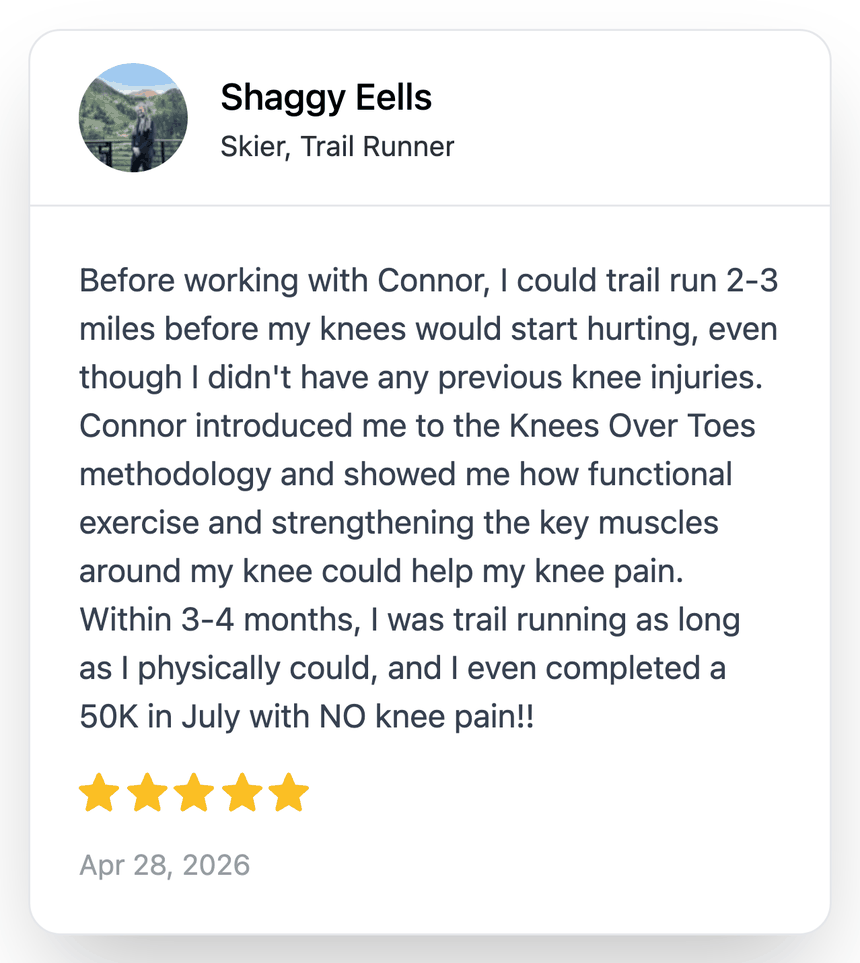
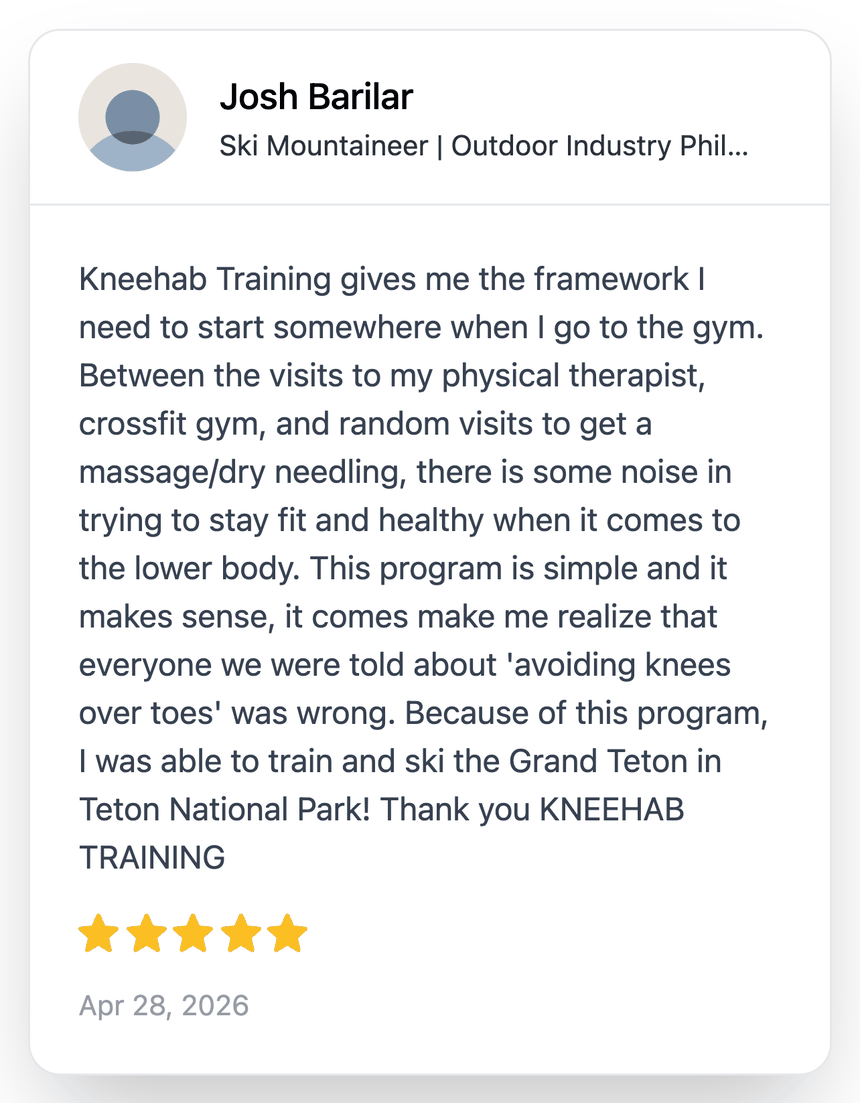
I'm not the only one, either. Below are a bunch of reviews from people I've coached and people who've gone through my programs, the same ones that now make up the Strong Knees System. They're seeing big changes in their knee pain and in what they're able to do, and a few of them are doing it on an ACL that was never fixed or a meniscus that's partly gone. I'm sharing them so you can hear it from people I've actually worked with, and so you can see that I'm not some outlier.
None of those people got a new knee, and their scans didn't change. Michael's meniscus is still 40 percent gone, and Ariana and Britt are both doing all of that on a torn ACL that was never rebuilt. What changed is how strong the muscles around their knees are.
It took some time, too. Mackenzie started the Strength program ten weeks before a 50K. Shaggy went from knee pain two or three miles into a trail run to finishing a 50K, and that took three to four months. Noel started squatting again with a light load after a few weeks and added weight from there.
That's the reason I keep saying your knee pain is usually not a knee problem. Your knee ends up taking the stress when the muscles above and below it are weak, and it gets a break when those muscles get strong. Your knees only get strong in the positions you train in, so if you've spent a year avoiding bending them, there's a lot of strength you can still build.
And loading a knee with arthritis in it doesn't grind it down. A 2019 review of randomized trials found that knee-loading exercise does not appear to be harmful to cartilage in people with knee arthritis or at risk of it. One of those trials took people a few years out from meniscus surgery, had them train three times a week for four months, and the quality of their cartilage on a special MRI improved compared to the group that didn't train. And the Cochrane review, which is about as careful as medical evidence gets, found high-quality evidence that exercise reduces knee arthritis pain. The best thing you can do for a knee with a scary report is get strong around it.
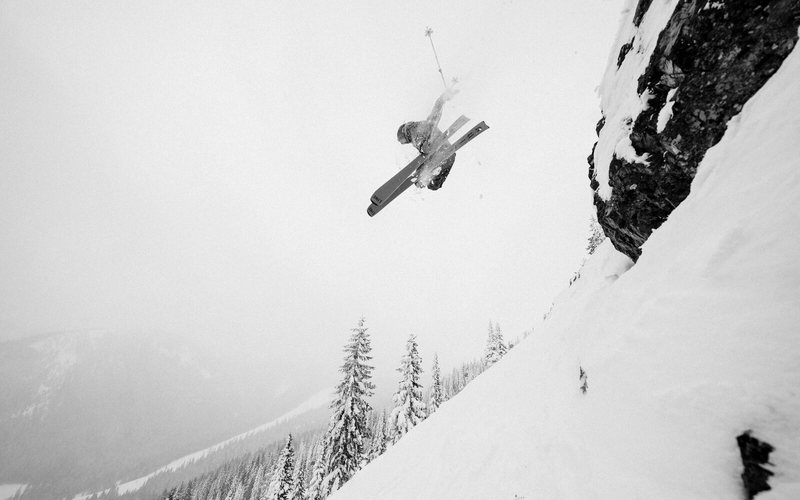
Running, skiing, lifting and a pistol squat on Kilimanjaro, all on the knee from the report at the top of this article.
How I'd ease back in if a report has had you sitting still
If you've been sitting still because of a piece of paper, here's how I'd get going again. A lot of what's below comes straight from my free Kneehab Foundations guide: three sessions a week with a band and your bodyweight, for eight weeks, with a video of me doing every exercise. It's where I'd start if a report just scared you, so grab it here and follow along.
Free download
The Kneehab Foundations Guide
Where I'd start if a report just scared you: eight weeks, three sessions a week with a band and your bodyweight. Banded TKEs, Spanish squats, step ups and wall sits with the progression written in, and a video of me doing every exercise.
The PDF lands in your inbox in about a minute. You'll also get my weekly knee-training email, and you can unsubscribe anytime.
Train three days a week for 30 to 40 minutes. For the first few weeks, the only goal is to show yourself that your knee can be loaded. Keep any pain under a 3 or 4 out of 10 while you train, and use the next-day rule: if your knee feels worse than it did the day before, back off the range of motion or the weight and go from there. Patience is key here. Remember, restraint is the hardest trick in the book.
Walk backward to warm up.Backward sled drags if you have a sled, or plain backward walking if you don't. It's low impact, it's a short range of motion, and it gets blood into your quads and your knee. Start with: 5 to 10 minutes.
Tibialis raises. This is the muscle on the front of your shin that helps slow your knee down every time your foot lands. Start with: 2 sets of 20.
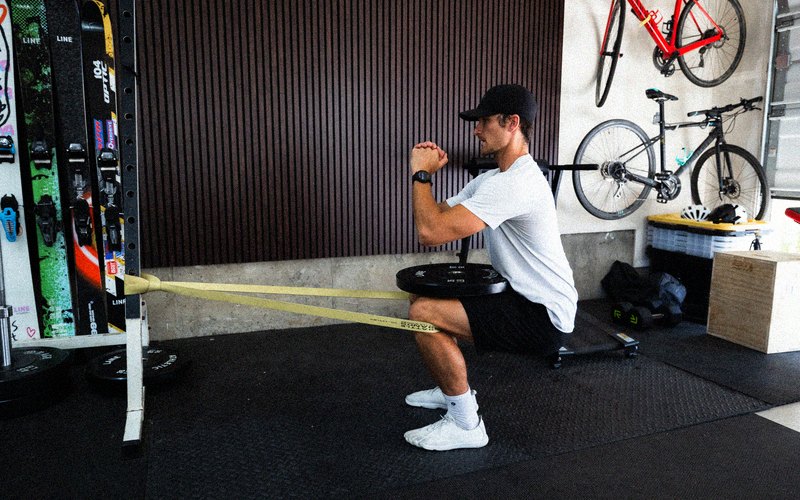
Banded TKEs. These wake your quad up with almost no load on the joint. Think of it as a warm-up. Start with: 2 sets of 20 per leg.
Spanish squat isometric or a wall sit. You get into a position, you hold it, and you sit through the burn. A hold gives your quads and tendons real work without any bouncing or landing (I go deeper on that in another article of mine about knee flare-ups). Start with: 3 holds of 30 to 45 seconds.
Poliquin step ups. Your knee goes over your toe on purpose, under control, on a small step. Start with: 3 sets of 10 per side.
Slant board squats. Go only as deep as you can with the pain staying low, and add range of motion before you add weight. Start with: 3 sets of 10.
Banded side steps. Your hips take a share of every step and every landing, so they get a spot in every session. Start with: 2 sets of 15 steps each way.
Add 5 to 10 percent a week, whether that's reps, range of motion or weight, and give it eight weeks before you judge it. One caveat: a band gets your knee moving again, but it won't make it strong on its own. Real strength, the kind Mackenzie built before that 50K, comes from weights: goblet squats, slow, controlled barbell squats, eccentric step downs, and then jumping and sprinting once you're ready for them (another article of mine, Why Strong Quads Create Quiet Knees, goes through that). That takes a plan with the progression written in and a reason to show up three times a week for months. In other words, you need a system.
What a scan is for
I'm a strength coach, not a doctor, so I want to be clear about where the line is. Imaging matters after a real injury, and it matters when red flags show up: a knee that truly locks, a joint that swells up big and fast after an incident, a knee that keeps giving way, night pain that doesn't change with what you did that day, fever, heat, redness, or numbness. Those are reasons to get it looked at, and no article changes that. If any of that is you, see your doctor first and train second.
For the everyday achy knee with a scary word on the report, I'd do one more thing before you decide anything. Take the report back to the doctor who ordered it and ask one question: "Which of these findings explains my pain, and what would change about my plan if it wasn't there?" The answer usually turns a scary document into a plan.
Where to go from here
If you want to be like the people above who are seeing such positive changes in their knees, the Strong Knees System is exactly where I'd point you. It has the band work, the holds, the step ups, the slow heavy squats, and the running and jumping at the end, built into six programs and over 40 weeks of training, and it starts wherever your knees are right now. Foundations gets your quads and hips working again with a band and your bodyweight over eight weeks. Strength adds real weight over twelve weeks. Performance brings back the running, jumping and cutting. The Patellar Tendon Fix, Kneehab Ski and a library of short mobility sessions are in there too. Every exercise has a video of me doing it, every set and rep is written down, and you just open the app, do the session and check it off.
Foundations, Strength and Performance, and how they look in the app. Every exercise on video, every set written down.
It's the same training I do on the knee in that report. If a scan has had you sitting still, this is the plan I'd hand you.
I can't answer that for your knee specifically, because I'm not your doctor and I haven't seen you move. What I can tell you is what the research says: the reviews of randomized trials have not found that loading exercise harms the cartilage in arthritic knees, and the Cochrane review found high-quality evidence that it reduces the pain. Clear it with your doctor, start with the band work in the free guide, keep the pain low, and build from there.
Does a meniscus tear on an MRI mean I need surgery?
Not automatically. In the Framingham study above, 61 percent of the people with a meniscus tear on their MRI had no symptoms at all in the previous month, so a tear on a scan and a tear that's causing you problems aren't always the same thing. Whether to operate is a decision for you and your surgeon. I wrote about the training side of it in my torn meniscus article.
Thanks so much for reading all the way down here. If a report has been scaring you, I hope this helped, and I hope you'll give your knee a chance to show you what it can still do. If you want to tell me what your report says, send me an email at [email protected]. Happy Kneehabing!
Fransen M, McConnell S, Harmer AR, Van der Esch M, Simic M, Bennell KL. Exercise for osteoarthritis of the knee. Cochrane Database of Systematic Reviews. 2015;1(1):CD004376.